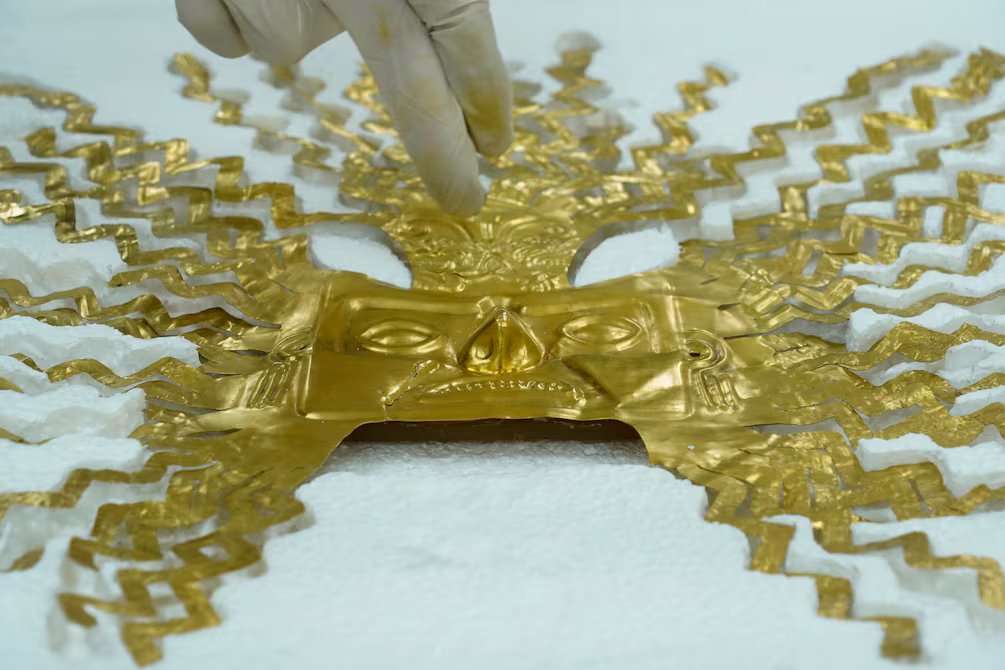
More than 40 snakes in the shape of zigzag of different dimensions, elongated nose and eyes, open mouth showing teeth, all gold-plated. This is the emblematic object that is popularly known as the Golden Sunalthough for specialists it is a mask.


It is kept in a building in the north of Quitoin charge of the Vice Ministry of Culture, in a safe. And because of its antiquity and significance, it deserves it.
It is located in a special room where pre-Columbian objects made of gold, platinum and copper are also kept. They were delivered in transfer of Central Bank of Ecuador (BCE) to the then Ministry of Culture, today the Vice Ministry after the merger with the Ministry of Education.
Archaeological interpretation
Juan Andres Lopezarchaeologist and curator of the reserve in which the object is located, who uses gloves as a rule to manipulate it, mentioned that the mask was probably for ritual use, because gold has always been used for those purposes, directed at a very important person of the culture. La Tolitawhich had the tradition of making trophy heads.

The figure, he explained, does not have rays of sun, but snakes, each of which ends in a head that is biting a human skull, apparently of warriors defeated in some ethnic confrontation over some territory, resource or ritualistic aspect.
In the center of the object there is a human face, but it shows the teeth, which would be a kind of representation of the jaguar, because that culture made reference to felines.
At the top of the head there are also two jaguars that are looking to the sides. There are gaps where the mouth and eyes of whoever would wear the mask would be placed. There are perforations on the sides to hold it to the face.
The origin of the popular name
When received, together with other metal goods, in 1967was identified as a La Tolita mask, which would mean that the speech referring to the sun is later.
This could be because when the Central Bank He made that object his main icon to represent the institution, people saw it as a sun, probably fueled by the indigenism of the 60s and 70s, the expert mentioned.
The figure is gold of alluvial origin, that is, that which is being transported by rivers, and the culture La Tolita I was in those areas.
Composition and authenticity of the object

In 2018 A chemical composition analysis was carried out using X-ray fluorescence metal analyzer equipment, which confirmed the originality of this valuable object. The composition of the property was determined, which is made, for the most part, of gold. It also contains, in smaller proportions, silver, platinum and copper, indicated the National Institute of Cultural Heritage.
Acquisition and cultural context
“He Golden Sunfrom the La Tolita culture that flourished in the province of Esmeraldas between the years 400 BC (BC) and 400 CE (AD)was acquired by Central Bank of Ecuador in 1959 to the collector Max Konanz”, expressed that entity.
López indicated that some of the snakes are wrinkled, which could be because they arrived folded.
Generally, these types of objects, he added, were dedicated to a special person, a great leader, a ruler, because the people of the period of regional development, such as La Tolitawas a hierarchical society in which roles were differentiated.
Exhibition and future of the original piece
In the current National Museum A replica is on display that is apparently made of copper.
The original is not exhibited because, being a unique object, it requires special care.
The original object yes it will be exposed in the new National Museumalthough it has not yet been defined whether permanently or for periods, because the new building will have security, temperature, and lighting conditions, and will be strategically located in a room to close the visit.

Photo: Fernando Gimeno
Characteristics and symbolism
The period of regional development has been considered the boom of metallurgy, the emergence of rituality; Agriculture intensifies and there are exchanges with areas of the Peru and Colombiawhere culture La Tolita maintain contact with culture Tumaco.
Its dimensions are approximately 30 centimetersbut it must be taken into account that it is not a regular figure due to the unequal extreme sides.
One of the interpretations of the object is that it could be a calendar, perhaps agricultural or ritual.
It must also be taken into account that the solar cult arrived with the incasbut there were also supposedly demonstrations before that arrival, he added.
According to the Vice Ministry of Culturehe Golden Sun It was hammered and embossed in a single sheet of gold and consists of an anthropomorphic face that shows the symbolic conjunction of the jaguar, the snake and the harpy eagle, surrounded by 44 zigzag threads that end in anthropomorphic heads and is the insignia of the ECB.
The valuation of the mask cannot be revealed. (YO)