There are six commissions of the Chamber of Deputies who have opposed the granting of the powers requested by the Executive to legislate for 120 days in eight matters, including citizen security. The main rejection came from the left-wing benches.
The refusal occurred in the Energy and Mines commissions; Infrastructure, Housing and Transportation; Production; Work and Science. This Thursday the Justice Department was added, chaired by legislator Catherin Palomino (Together for Peru), linked to the coup plotter Pedro Castillo.
At the other extreme, the Environment and Defense commissions considered it viable to grant the powers to the Government of President Keiko Fujimori.
The Economy Commission, meanwhile, plans to debate the issue on Monday, September 14.
—Majority wins—
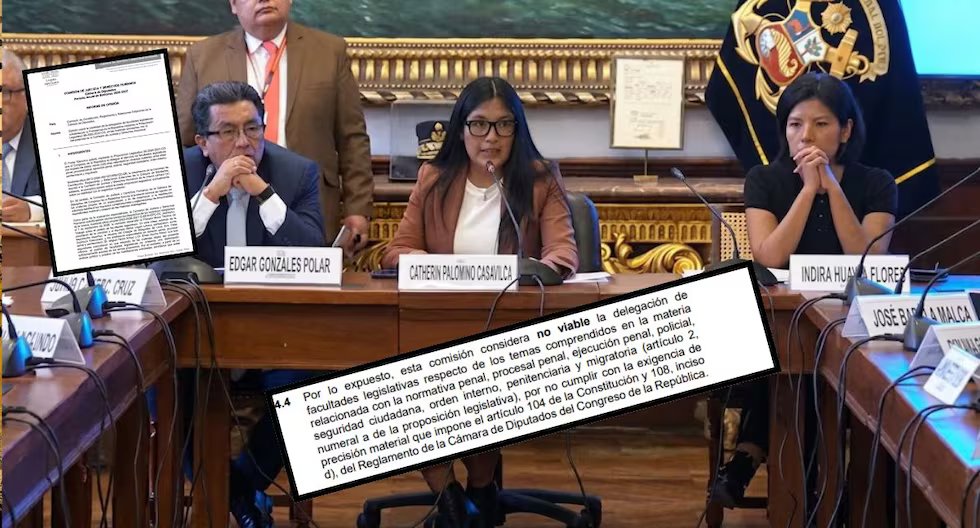
This Thursday morning, the Justice Commission presented an advisory report that concluded that granting legislative powers to the Executive was not viable.
In the document, which this newspaper had access to, it is maintained that the content of the proposal “did not comply with the constitutional requirement of specifying the matters to be regulated.”
“For the above reasons, this commission considers the delegation of legislative powers to be non-viable with respect to the issues included in matters related to criminal regulations, criminal procedure, criminal execution, police, citizen security, internal order, penitentiary and immigration for not complying with the requirement of material precision imposed by article 104 of the Constitution,” the content concluded.
He did not delve into the merits of the case and only submitted to the general document of the request for powers. That is, the commission omitted to analyze the explanatory statement, a situation that was alerted to in the middle of the session.
When the case was debated, the majority of the working group supported the report and consequently opposed the Government’s request.
Catherin Palomino, Alejandro Manay, César Tito and Daniel Varas, from Together for Peru, voted in favor of the report. They were joined by Edgar Gonzáles, Rosaana Alayza and Romina Uribe, from the Good Government Party.
Indira Huilca and César Holguín, from Ahora Nación, voted in the same sense; as well as Heber López and Luis Masco, from the Obras Civic Party.
The minority votes corresponded to José Baella and Roxana Rocha, from Renovación Popular; and Karina Beteta and Carlos Zegarra, from Fuerza Popular.
In total, there were 11 votes in favor and four against.
—Refusal—
Before the vote, representative Roxana Rocha took the floor and asked Palomino for an intermission so that the commission’s technical team could reevaluate the report, considering the more than 400 pages of explanatory reasons, the explanations provided by the Minister of Justice, Ernesto Álvarez, and the recommendations of specialists.
The legislator also had an alternative legal formula to the report, in which she argued point by point the matter of citizen security.

Legal formula raised by Roxa in the Justice and Human Rights Commission.

Legal formula raised by Roxa in the Justice and Human Rights Commission.
However, no point was addressed by the board of directors of the working group, in particular by Palomino, who, instead of submitting it for consideration as is customary, pointed out that the report had been sent to each office and that no contributions were received. He also questioned that the Minister of Justice, Ernesto Álvarez, did not participate in the session, despite having promised to do so.
Following these arguments, Palomino put only the content of the report to a vote.
Rocha stated that his request had not been taken into account.
“I took the trouble to propose a precise, limited legal formula, so I asked the president to put an intermission in the debate so I could present it to all my colleagues, and I was surprised when she told me that it is her prerogative, which I took as an obstructionist attitude as part of it,” he said after his departure from the working group.
—What will come next?—
For now, the opinions of the commissions from which the Constitution requested a position regarding the request for powers are not binding. That is, they do not have an effect on the substance of the project nor do they require modification of its content.
After the deliberation of all the working groups, the Constitution Commission must prepare an opinion. In parallel, the benches could propose a minority opinion.
Once this instance has been exhausted, the proposal will go to the plenary session of Congress and will require the vote of a simple majority, as it is an ordinary law.
José Elice, former Senior Parliamentary Officer, assured that if the majority opinion is rejected, “the minority opinion comes in.” “In the course of the debate there may be the chance of reaching an agreement and approving a replacement text,” he stated.
If the Chamber of Deputies does not approve any content, the Senate will not be able to approve any proposal.
“If there is no law approved in the Deputies, there is no law that the Senate can debate or approve. If there is no approval, the case remains there,” he added.
Elice maintained that, if the proposal is rejected in its entirety, the Executive must present another project.
“This would have to go through all the normal procedures because it is an ordinary law,” he added.
Finally, he made it clear that the opinions of the commissions are not binding, since these bodies serve the plenary session and it is the latter that decides ultimately.