-
Prepared by: Edona Binaku

- May 1, 2026 7:03 p.m
- Share to:
Allowing the participation of Russia and Israel in the Art Biennale in Venice culminated in the resignation of the jury. The winners will be selected by the public’s vote, while the clashes have also intensified in the political circles
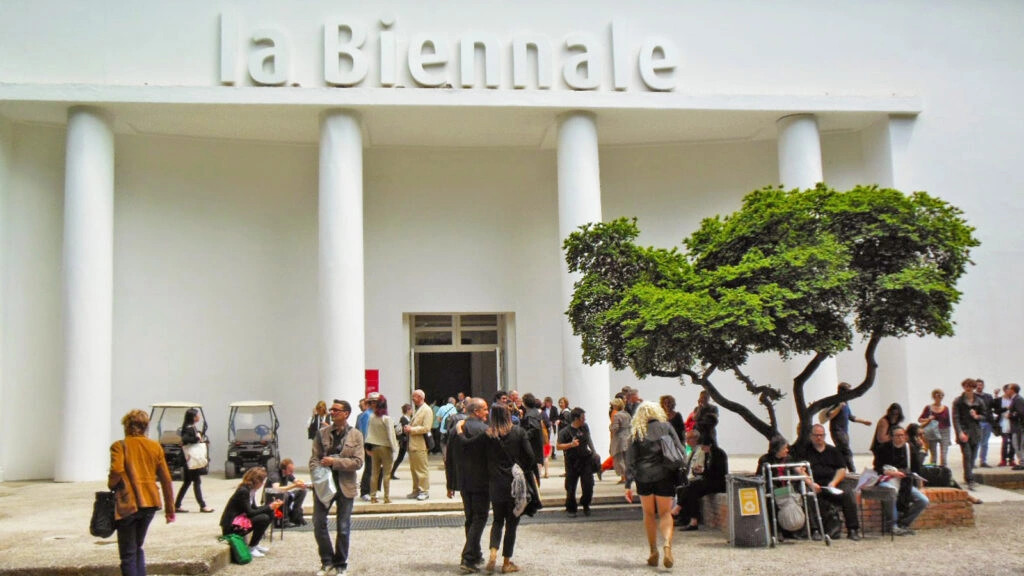
The 61st Venice Biennale has lost its international jury just days before the preliminary opening – the sharpest point yet in a protracted debate over the participation of Israel and Russia in this year’s edition.
The five-member jury, headed by Brazilian curator Solange Farkas, had announced on April 22 that it would “abstain from consideration” of countries whose leaders are subject to arrest warrants by the International Criminal Court – a direct reference to Benjamin Netanyahu, the prime minister of Israel, and Vladimir Putin, the president of Russia.
On April 30, the jury members resigned collectively stating: “We, the international jury selected by Koyo Kouoh, artistic director of the 61st edition of the ‘In Minor Keys’ Biennale, have resigned. We do so in accordance with our statement issued on April 22, 2026.”
It is not clear whether the jury was asked to withdraw by the Biennale Foundation. In a statement issued the same day, the organizers of the Biennale accepted the jury’s resignation and announced that the award ceremony will be postponed from May 9 to November 22, the last day of the exhibition.
In the absence of a traditional jury, the Biennale has opened the voting process to the public for the first time.
“This is in accordance with the founding spirit of the Biennale, based on openness, dialogue and the rejection of any form of closure or censorship”, announced the Foundation. “The Venice Biennale aims to be – and must remain – a place of truce in the name of art, culture and artistic freedom”.
The jury was chaired by Solange Oliveira Farkas, founder and artistic director of the cultural association “Videobrasil”, and included Zoe Butt, curator and founder of the “in-tangible” institute and artistic director of “Decentral” in Chiang Mai, Elvira Dyangani Ose, curator and artistic director of the Biennale of Public Art in Abu Dhabi, Marta Kuzma, curator and professor at the “Yale” art school and Giovanna Zapperi, art historian and professor at the University of Geneva.
The biennial announced that visitors will choose the winners of two awards: “Golden Lion”: “Best participant” in the 61st “In Minor Keys” exhibition and “Best participation” among 100 national pavilions. Prizes will be awarded on closing day, November 22.
Koyo Kouoh, who had been chosen as chief curator — the first African woman to hold the role — had designed the framework for the “In Minor Keys” exhibition before being diagnosed with an aggressive cancer from which she died last year at the age of 57.
These latest developments come as the art world prepares to gather in Venice for preliminary days starting on May 5, ahead of the exhibition’s public opening on May 9.
The reaction to the jury’s earlier stance was immediate. Israel’s Foreign Ministry criticized this move as politicizing the exhibition, while Israeli artist Belu-Simion Fainaru said it created a “hostile and degrading environment” and put his country at a disadvantage.
Belu-Simion Fainaru, a sculptor representing Israel this year, had consulted lawyers regarding the Biennale jury’s decision. On Wednesday, Italy’s culture minister called Fainaru to express his support, according to a press release.
Fainaru, 66 years old, said in an interview that he was satisfied that the jury had resigned.
“Their decision discriminated against me on a racial basis,” he said. “I am an artist and I have equal rights and I cannot be judged by belonging to a country or race. I must be judged only by the quality and message of my art”, said Fainaru.
Fainaru said the jury’s initial verdict reminded him of the actions taken against his father in Romania during World War II. At that time, according to Fainarus, his father was banned from teaching at the university and then sent to a forced labor camp for three years.
“I didn’t think that discrimination would happen to me or any other artist working today in Italy”, said Fainaru.
Other Italian political figures also reacted. Prime Minister Giorgia Meloni reiterated that the government had not supported the decision taken by Biennale president Pietrangelo Buttafuoco to allow Russia to participate, while recognizing the Biennale’s autonomy.
“I myself would not have made this choice”, she said in a press conference. “But the Biennale is an independent body.”
Deputy Prime Minister Matteo Salvini has welcomed the decision to go to a public vote, describing it as a positive alternative to decisions made by juries.
In a previous statement, the organizers had defended the independence of the jury, describing its position as “a natural expression of the freedom and autonomy” that the institution guarantees.
The resignations and visitor-led prize presentation mark a significant departure from the long-standing traditions of the Venice Biennale – which dates back to 1895, when the first International Art Exhibition was staged – adding further uncertainty to an edition already shaped by political tensions and institutional upheaval.
The Biennale’s contemporary art exhibition is the oldest and most important in the world, including a main exhibition curated together with national pavilions, which are individually curated by the participating countries. The art biennale usually attracts more than 600,000 visitors during its seven months.
This text is based on world media reports. Prepared by: Edona Binaku