The United States claimed on Wednesday night to have completed a new wave of bombings against Iran, which responded with attacks on Washington bases in the region and the threat to target any ship transiting the Strait of Hormuz.
“Members of the United States Marine Corps, Air Force and Navy conducted precision shots against Iranian targets that posed a threat to US forces and international merchant ships transiting through regional waters,” Centcom, the military command for the Middle East, said on the X social network.
In a previous message, the command had claimed “legitimate defense.”
Iranian media reported explosions on the country’s southern coast, near Hormuz, a key route for the transit of hydrocarbons and where US forces had already hit air defense installations, radars and other infrastructure on Tuesday.
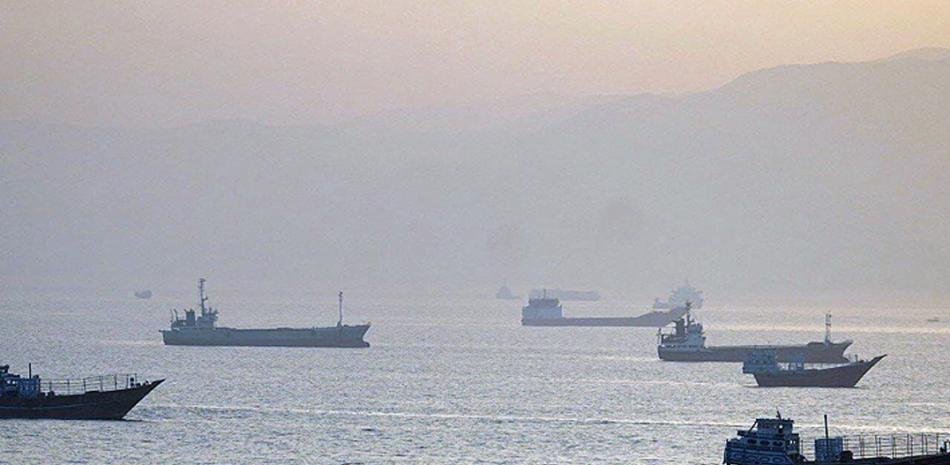
Following these hostilities, the Iranian military immediately announced that it would attack any vessel passing through that strait, and announced that it will now be “completely closed to any type of vessel, including oil tankers and merchant vessels.”
The Iranian Navy, cited by the country’s media, even reported that “two ships that were trying to illegally cross” that route were “attacked.”
However, Washington forces denied that Hormuz is obstructed: “FACT: Commercial ships continue to transit the strait tonight.”
Iranian media also reported that Tehran attacked the headquarters of the US 5th Fleet in Bahrain, specifically communications antennas and radars of the Patriot anti-missile system.
Iran also claimed overnight attacks on another base in Jordan in response to the US attacks, itself triggered by the downing on Monday of a US helicopter attributed to Tehran.
“Deadly conspiracies”
Trump told Fox News on Wednesday night that senior Iranian officials had called him to ask him to stop bombing its territory, a claim that was immediately denied by the Revolutionary Guards, Iran’s ideological army.
Before the new attacks, the Republican magnate had warned that the United States was going to hit Iran “very hard,” frustrated by the failure of diplomatic efforts to reach an agreement to end this war that began on February 28.
“We were really close to an agreement, but they keep dragging us out, they keep taking us for idiots,” he told reporters in the Oval Office.
Twenty-two countries, including the United States, Australia and several European nations such as the United Kingdom, France and Germany, also asked Iran in a joint statement to stop attacks against people in their territories.
They condemned “deadly plots and other malicious actions in Europe, North America and Australia” by the Islamic republic against “Iranian dissidents, journalists and Jewish communities and interests.”
100 million barrels
In Kuwait, the army claimed to be facing “hostile aerial targets” without specifying their origin.
Authorities in Bahrain said they had intercepted several attacks, while the Jordanian army reported destroying five missiles headed for a US base.
The United States also announced that it had taken out of service the Palau-flagged oil tanker M/T Settebello, which was attempting to violate the blockade of Iranian ports imposed by Trump.
The attack by a fighter jet left three of the ship’s Indian crew missing, according to New Delhi, which summoned the American charge d’affaires in protest. Twenty-one other sailors were rescued.
Trump also said on his Truth Social network that the US military had carried out “a secret mission” that allowed 100 million barrels of oil to pass through Hormuz.
Netanyahu’s request
For his part, Israeli Prime Minister Benjamin Netanyahu called on the Lebanese on Wednesday to join Israel’s fight against Hezbollah, stating that their country has been “taken hostage” by that pro-Iranian Islamist group.
Following Israeli bombings on Beirut, first Iran and then Israel carried out reciprocal attacks on Sunday and Monday, for the first time since the April 8 truce came into force.
Tehran demands that Lebanon, where Hezbollah has been fighting Israel since March 2, be included in any agreement to end the war in the Middle East.
More than 3,600 people have died in Lebanon in Israeli bombings since the start of the war.