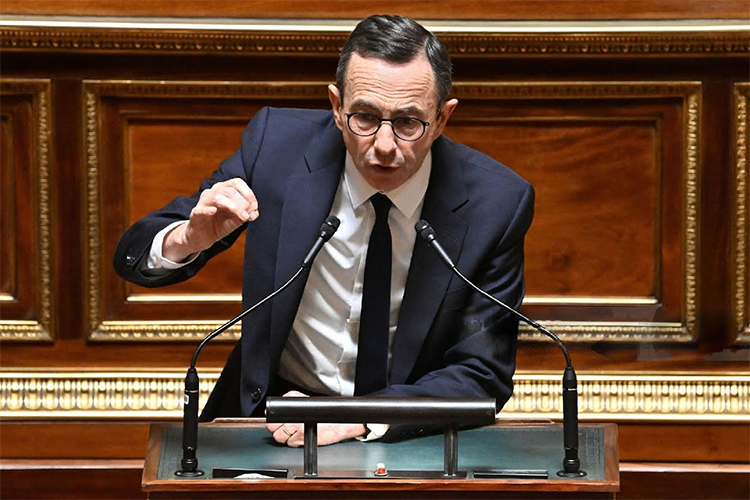
He introduced a law to prevent the construction of mosques and freeze the assets of religious associations:
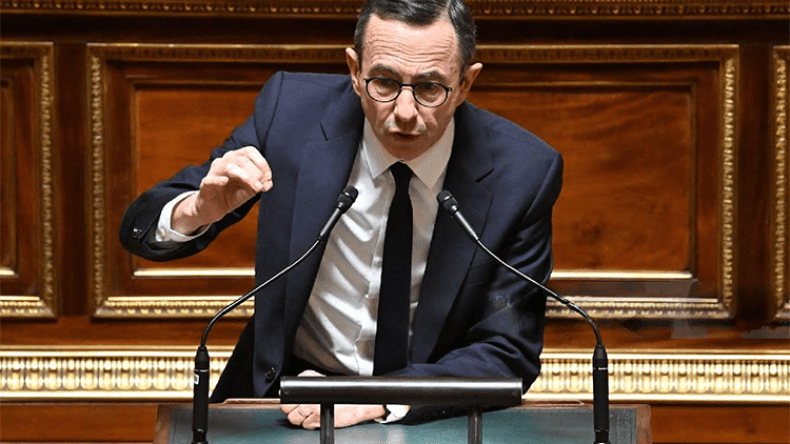
father-in-law
On Tuesday, May 5, the French Parliament began discussing a draft law targeting Muslim communities, proposed by Senator Bruno Rotayo, amid widespread rejection by the majority of representatives, due to its targeting of a specific category of the French people, as well as the contradiction of many of its provisions with the Constitution, according to the parliamentary group of the Socialist Party.
The current Minister of the Interior, Laurent Nunez, stands with the camp against Bruno Rotayo’s project, which is led by the leftist movement (the New French National Front), as well as the French President’s party, “Ronesons,” and criticizes the proposed project as “inciting discrimination, hatred, and violence, and aims to attack the values of the French Republic.”
For the first time, the current French Minister of the Interior clashes with his predecessor in Parliament over combating what the extreme right-wing movement considers “Islamic infiltration,” according to what was reported by the French press agency (Agence France Presse), which said that the leader of the “Republicans” party, the candidate in the 2027 presidential elections, began to reveal the main points of his upcoming electoral program, which seemed clear that it targets a category of the French people, which is the Muslim community that numbers millions.
Based on a report published in May of last year, when Bruno Rutayo was Minister of the Interior, the text includes a series of measures to facilitate the dissolution of associations, and to tighten penalties for what it considers attacks on the “principles of the republic.” It also aims to regulate the construction of religious buildings, in reference to mosques, in a more strict manner, and to freeze the assets of groups they accuse of separatism, and here they mean Muslim communities.
In the face of criticism from wide segments of French politicians, a member of the French Senate (Routaiu) tried to justify his controversial project, saying that through it he aims to “rearm the state” against what he describes as “political Islam.” He also tries desperately to deny that his project has electoral and political motives, as he is a candidate for the upcoming presidential elections, accusing the government of negligence in this regard.
Observers in France say that it is difficult to imagine that this Bruno Rutayo project will gain the necessary support for its passage in Parliament, given that it does not have a majority in the National Assembly (the lower chamber of Parliament), in what the Minister of the Interior, Laurent Noniaz, considers “unfinished business,” while he is trying to win the love of Muslims by asserting: “I have no problem with Islam in France. For me, it is a religion that has its rightful place in our republic.”
The matter was not limited to the government’s reservations about the former Minister of the Interior’s project, but the rejection extended to the largest parliamentary bloc in the lower chamber of Parliament, which is the “New French National Front” bloc, formed from the Proud France Party led by Jean-Luc Mélenchon, and the Socialist Party led by Olivier Faure, as well as the Ecologists (Environment), who previously declared that it is a “political publication” and many of its texts contradict the French Constitution.
Socialist Senator Corinne Naraseghen described it as “a deliberately poorly worded text to show Bruno Rutayo that the constitution does not allow him to indulge his concerns towards immigrants and Muslims,” while the group for the Socialist Party asked the President of the Senate, Gérard Larché, to refer the proposal to the Council of State.