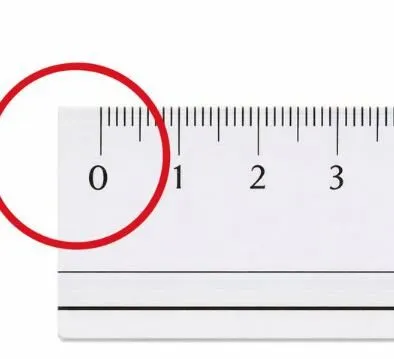
A post on social media these days has once again made thousands of people take the ruler out of the drawer and really look at it, perhaps for the first time in a long time. The story actually begins a few years ago, when a user posted a picture of a regular ruler and asked, “Does anyone know why there’s that space before the zero?”
Most of us never even noticed it properly. Before the numbers start, there is always a small blank, about a centimeter of plastic or wood. It’s not a manufacturing fault, but at first it doesn’t seem to have any purpose. And then the logical question arises – what is it for?

The answer is actually simple. The edge of the ruler wears out over time – it is constantly bumped, scratched, dropped and worn. If the zero was at the very end, any damage would move the start of the measurement and cause an error. It is enough to lose half a millimeter on the edge and you already have a wrong measurement.
That’s why manufacturers move the zero slightly inward. That blank serves as a kind of protection – it takes hits and the markings stay accurate. Thus, the ruler remains precise even when its edges are already worn.
It is interesting that the people working with the measures immediately knew what it was about. Carpenters and tailors had no dilemma – they know very well how a worn edge can spoil a measurement. Their professions depend on trusting the zero line, not the physical end of the tool.