“They say that this point was the only one in Uruguay where there was a bowling alley on every corner. There was El Latino, there was Sokos, here in front was El Chivito de Oro. Unfortunately, and I say this in a heartfelt way, the only ones left are us“he said to The Observer Federico Celsi, owner of the Facal bar, on the four corners of 18 de Julio and Yí.
The new face of July 18 is full of these examples: in total there are 19 pharmacies -counting Farmashop, San Roque, Pigalle, El Túnel, Tundisi and Farmaglam- and 16 chain restaurants, counting La Pasiva, McDonalds, Burger King, Mostaza, Subway and Il Mondo della Pizza, to which the two Starbucks coffee shops could be added. They have also opened near a dozens of branches of supermarket chains such as Tata, El Dorado, Tienda Inglesa and Frog.
Burger King 18 and Ejido, former location of “La Pasiva”. July 18 bars

Meanwhile, old bars tend to disappear. Celsi points out that, between Plaza Independencia and Plaza de los Firefighters (19 blocks), Facal is the only traditional bar left. Towards the east, between that Plaza del Cordón and the Obelisk, several more survive: The Palms (Gaboto), Great Sportsman (Tristán Narvaja), Papyri (Joaquín Requena) and Castrobo (John Paullier).
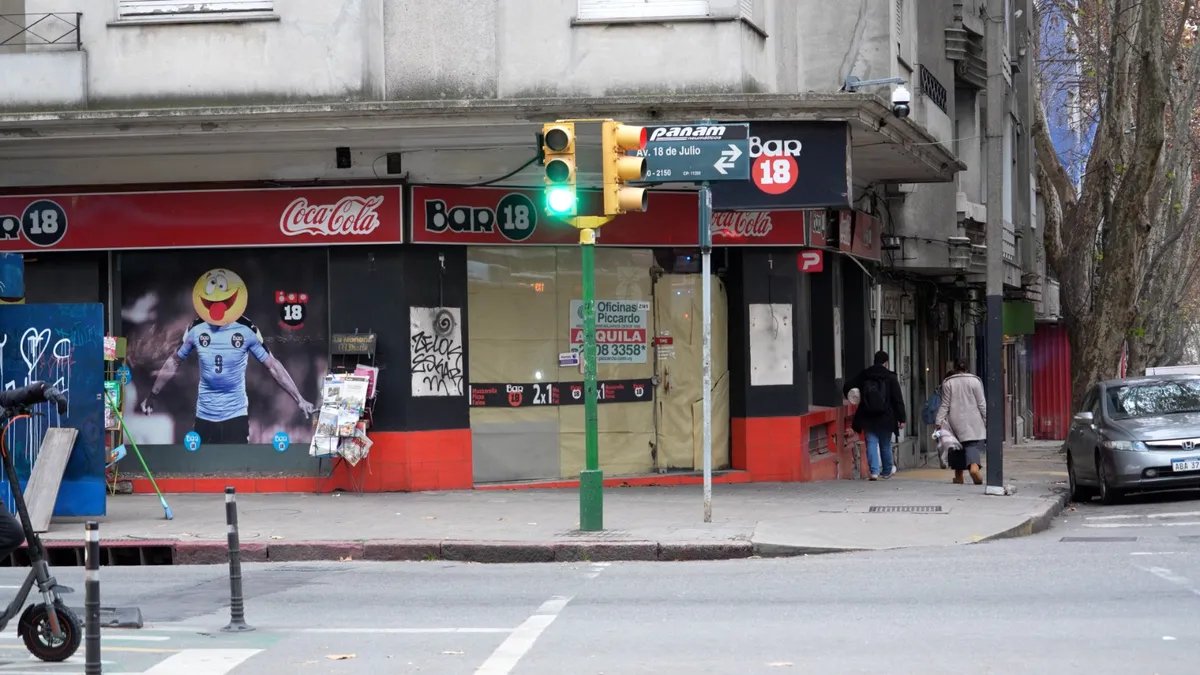
The last one to close, which had less tradition than those mentioned, was Bar 18located on the corner with Juan Paullier and which was open for a few years, until The drop in sales made its operation impossible. The same thing happened some time ago to other bars that did not have a long life, such as @Bar in Acevedo Díaz and The Basque in Martín C. Martínez.
Bar 18. July 18 Bars

The closure of La Papoñita generated much more impact in 2024, a large restaurant located on the corner of Minas for 63 years. Its owners linked the drop in clientele to two problems in the neighborhood: insecurity and lack of parking spaces. The fifth Farmashop on the avenue was installed there.
Before the pandemic, another historical figure had already fallen into disgrace: The Manchester bar, which for more than four decades It was located on the corner of Convention. La Pasiva settled there.
“None of that old guard remains”
Daniel Fernández, president of the Cambadu union, knows the landscape well. Standing in front of where La Papoñita was and with the also disappeared La Fiaca – property of the deceased gastronomic businessman and president of Nacional Ceferino Rodríguez – behind him, he regrets that “In just a few years, a huge number of bars have disappeared”
“None of that old guard of bolicheros remains, they were dying. There are some exceptions with the sons who continued the business, such as Gran Sportman and Facal,” he told The Observer.
Facal Bar. July 18 bars

For Fernández, the problem with large traditional bars is structural. “The great bars are frozen in time. It is very difficult to make a jump. The investments are in the millions, the margins are extremely reduced due to the large tax burdens, mainly municipal, and habits have also changed. Notice that small, small boats are working very well,” he said.
In their diagnosis, many young entrepreneurs have “found their way” to another type of service, different from that of the “white elephants”. And he points to extensive menus as one of the big mistakes of the traditional model: “Large restaurants today should work with three, four dishes and a dish of the day with whatever is cheap in the market. And then the classic: two pastas, two meats, two chickens, two or three fish and nothing more. “You can’t have 32 varieties of pizza,” he said.
The model that remained in time
Celsi, who remained the only representative of the traditional bars in the first half of the avenue, shares with Fernández. “This type of business has very extensive menus, which provide cafeteria, snack, lunch, and dinner services, with a very large staff load (…) is out of use throughout the world“he stated.
Facal Bar. July 18 bars

But for the owner of Facal, insecurity and lack of parking — the factors that the owners of La Papoñita pointed out when closing — are only part of a more complex equation. “I could add many more points to you, but it’s also a change in consumer habits. We are the first to have to adapt to what people are looking for, what they are looking for in experiences. Long ago the location was the most important thing when it came to the decision to go to a restaurant and Nowadays the product is much more important than the location. Networks appeared. Before, when you found out that they opened a place 10 blocks from 18 de Julio, it was miraculous,” he explained.
What is the secret of Facal? Adaptation and permanent innovation, assured Celsi, a capacity that she attributes to her father, who died in 2013. “The first deck that was in Uruguay is the deck therewhich we did with the mayor of Tabaré Vázquez. The first place to have floor-to-ceiling glass was Facalsomething that is now basic. We brought things from outsidewe sold hot chocolate with churros after traveling to Spain, we copied the waffles and imported a machine from Belgium, we always try to innovate in the menus, we sell merchandising, we invest in accessibility“, he listed.
“Nothing disappears, it transforms”
Juan Antonio Varese, who has researched and written about the history of the city and its bars, mentions how the avenue changed. “I remember well another July 18th, full of lights, especially cinemas. There was a tandem between cinema and coffee, it was the prelude or sequel to cinema. You are going to make me cry by telling me that there are so many pharmacies”he expressed.
For Varese, the decline is neither a recent nor abrupt phenomenon. “The declines are gradual, it is a process that began slowly in the 80s, with the change of customs. People gathered less and the clubs were losing because the youth were not interested in going to talk about football, politics, and spending entire hours in a club,” he said.
Bar “El Vasco”. July 18 bars

For the writer, the case of July 18 is “a reflection” of what happens in the rest of the city. “The change occurred fundamentally because the city has become impoverished. On July 18 there are fewer and fewer peoplethere is also an issue of insecurity,” he stated.
Even so, Varese maintains a partly optimistic view: “This is like in physics, nothing disappears, it transforms. The old cafes have given rise to modern cafes, what are called specialty coffees, where there is a special quality,” he concluded.