The Romanian parliament has only one attempt left to approve the prime minister and the new cabinet. In case of failure, the country’s President Nikusor Dan may dissolve the parliament. Nobody wants early elections except the sovereignists from the AUR party, who are winning against the backdrop of the ongoing chaos and may well come to power. At the same time, the crisis and contradictions between systemic political players are so deep that the emergence of a compromise prime minister is looking less and less likely. NM tells how the political crisis in Romania is deepening, what future scenarios are possible and how all this could turn out for Moldova.
Miscalculations of Nikushor Dan
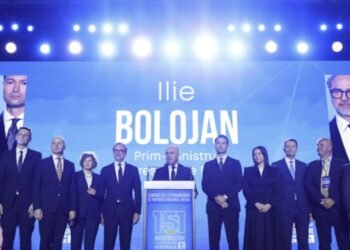
In April 2026, Romania’s largest party, the Social Democratic Party (PSD), withdrew its support for the majority government led by Ilie Bolozhan. In the 2024 parliamentary elections, the PSD received the most votes, but this was not enough to form a government on its own. As a result, power passed to a coalition that included the PSD, the country’s second largest party – the National Liberal Party (PNL), the Union for the Salvation of Romania (USR), the Democratic Union of Hungarians in Romania (UDMR) and representatives of national minorities.
PNL leader Ilie Bolozhan was confirmed as Prime Minister. However, it was the PSD that played first fiddle in the coalition thanks to the largest faction in parliament. After the Social Democrats withdrew political support, Bolozhan quickly lost his position – his government was dismissed on May 5, 2026.
Romania plunged into a political crisis: the ruling coalition collapsed, and the country was left without a full-fledged government. The candidacy of the new prime minister is proposed by the president after consultations with parliamentary factions. The first attempt was the nomination of Nikusor Dan’s own adviser Eugen Tomac. He was presented as a compromise “technocratic” figure, but Tomac’s candidacy did not even reach a vote in parliament. Tomac was unable to gain the support of parliamentary factions and refused the mandate to form a government.
After this, Nicuşor Dan nominated Alexandra Veştiu, vice-chairman of the PNL, but thereby only caused a final split within the party. The fact is that no one consulted the National Liberals about Veshti’s nomination. As a result, the PNL refused to support its own representative. Without the votes of the majority of liberals, it was not possible to approve Veshta as prime minister.
Political analyst Mihai Isak emphasizes that the split in the PNL did not arise overnight. The stumbling block was cooperation with PSD: “On one side there was Ilie Bolozhan’s group, which advocated distancing itself from PSD. On the other side there was a group of liberal leaders, especially representatives of local authorities and the so-called local “barons”, who believed that the PNL should return to governing the country together with the PSD.”
Isak points out that the president appointed a candidate without prior consultation. This led to a failed attempt to establish the government.
After the failure to appoint the Veshti government, on June 23 the president again gathered parliamentary factions for consultations. However, the parties’ visions for overcoming the crisis remain different.
What do the National Liberals offer?
The PNL proposes to form a minority government. That is, a cabinet from parties that do not have a majority in parliament, but which negotiates with representatives of other forces on support when voting to approve the government. For its sustainable work, party leader Ilie Bolozhan proposes concluding a six-month political pact.
“What is needed is a national-style political agreement in which, over the next six months, the signatory parties commit that no matter who is in power, they will commit to a few basic conditions that take into account our current priorities and the economic and budgetary situation,” he said.
The PNL proposes a minority government formula with the participation of its own party, UDMR and USR. However, the opposition does not intend to vote for such a configuration. The PSD does not support this idea either, and without the votes of the Social Democrats, the approval of the cabinet is almost impossible.
At the same time, the PNL also allows an option in which the PSD itself will form a minority government, but only after signing such a pact.
What do social democrats want?
After consultations with Nicusor Dan at the Cotroceni Palace, PSD leader Sorin Grindeanu announced the party’s readiness to take over the government of the country. However, the votes of the Social Democrats alone are not enough to approve the cabinet.
At the same time, the question remains whether the PNL and other former coalition partners are ready to support the PSD prime minister, given that it was the Social Democrats who overthrew the Bolozhan government.
“For the PSD, the most favorable scenario would be its own minority government, supported by a pact with the PNL, USR and UDMR, or a new pro-European coalition in which the post of prime minister would belong to the PSD. In this way, the party would control the executive power, but responsibility for unpopular measures would be shared with other parties,” Isak said.
Golden voices of AUR
The key remains the issue of cooperation with the main opposition force in the country – the Alliance for the Unification of Romanians (AUR) party. It was their votes that turned out to be decisive in the vote to approve the Veshti cabinet. The leader of the sovereigntists, Djordje Simion, kept the intrigue until the last moment, invited Vestya for consultations at the AUR office (and even achieved this visit), but in the end refused support.
After this, Grindeanu publicly rejected the possibility of forming a government together with the sovereignists. However, former PSD general secretary Paul Stanescu said the party made a mistake by distancing itself from the AUR.
Mihai Isak believes that cooperation between PSD and AUR would be more beneficial for sovereignists.
“Open cooperation with AUR might secure votes in the short term, but would be risky in the long term. PSD would legitimize its main electoral competitor, lose part of its pro-European image and allow AUR to participate in power, and they, in turn, would shift responsibility to PSD for all unpopular decisions,” Isak suggests.
AUR, however, apparently is not ready to cooperate with anyone. They successfully play the role of the main anti-system force, which criticizes everyone and scores points on disappointment in the system parties and the political class. At the same time, the party strives to legitimize and get rid of the “extremist” label. And the combination with the visit of the presidential nominee Veshti to negotiations at the AUR office became part of such legitimization.
In practice, AUR wants either early elections, in which they could strengthen their positions, or their own prime minister, that is, direct participation in governing the country. However, such a scenario still looks unlikely.
Nikushor Dan has already stated that he will not nominate a candidate for prime minister from the sovereignists. “Nevertheless, the president can nominate a candidate from the PSD or an independent politician, hoping that he will receive some of the votes from the AUR. However, such a design would be extremely fragile. The president should not appoint a candidate before he sees in writing a parliamentary majority ready to support him,” says Isak.
Are early elections inevitable?
Meanwhile, it is AUR that remains the main political beneficiary of the deepening crisis. Already according to May polls, AUR was the most popular party in the country.
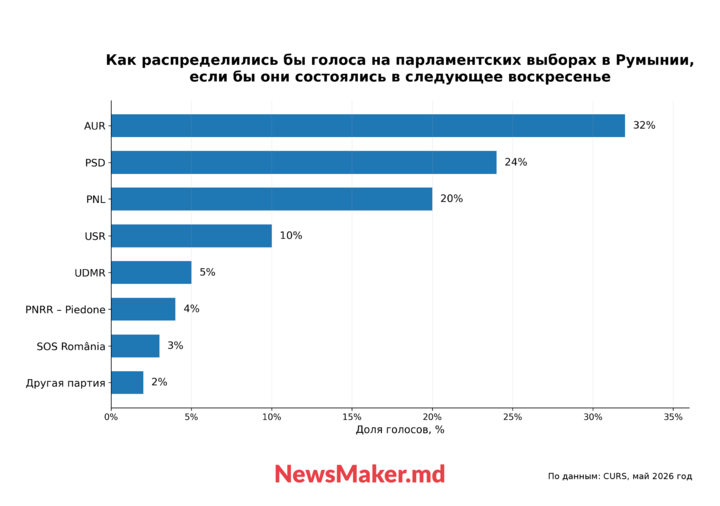
The current crisis, which has hit systemic political players even harder, will only strengthen the position of sovereignists.
Moreover, according to the same opinion polls, more than half of Romanians consider it necessary to hold early elections. Romanian law stipulates that the president can dissolve parliament if MPs fail to approve the prime minister twice within 60 days of the first failure.
The nomination of Eugen Tomac is not considered such an attempt, since there was no vote in parliament. The first official attempt was a vote on the cabinet of Alexandru Vesti. After its failure, parliament has 60 days to approve a new government. Otherwise there is a risk of dissolution.
At the same time, the law gives the president the right to dissolve parliament, but does not oblige him to do so. Thus, if the second attempt also fails, Nikushor Dan will be faced with a difficult choice: not to dissolve parliament and thereby deepen the crisis, leaving the country under the control of an acting prime minister, or to go for broke and call early elections, which will most likely bring his main political and ideological opponents from the AUR to power.
What’s wrong with this for Moldova?
Romania remains Moldova’s main political and economic partner. Therefore, political instability in Bucharest inevitably affects Chisinau. It is Romania that is considered the main lawyer of Moldova in the European Union. Without strong and stable support from Bucharest, Moldova’s European integration process risks slowing down.
Mihai Isac believes that the most favorable scenario for Chisinau would be the formation of a stable and firmly pro-European government.
“The specific formula of the coalition is less important than the presence of clear commitments to support Moldova’s accession to the EU, the continuation of energy and transport projects, cooperation in the field of security and the fight against disinformation, support for Ukraine and security in the Black Sea region,” the expert believes.
However, he emphasizes that the best option for the Moldovan authorities would be a majority or minority government based on an agreement between the PSD, PNL, USR and UDMR and independent of the AUR: “Unionist rhetoric cannot replace a predictable foreign policy, energy projects and support for European integration.”
Subscribe to our Telegram channel @newsmakerlive. Everything that is important to know right now about Moldova and the region quickly appears there.
Want to support what we do?
You can contribute to quality journalism by supporting us one-time through the E-commerce system from maib bank or by taking out a monthly subscription to Patreon! This way you will become part of changing Moldova for the better. Thanks to your support, we will be able to implement even more new and important projects and remain independent. No matter how you support us, you will receive a small gift. Follow the link to become our partner. It’s not difficult and even pleasant.