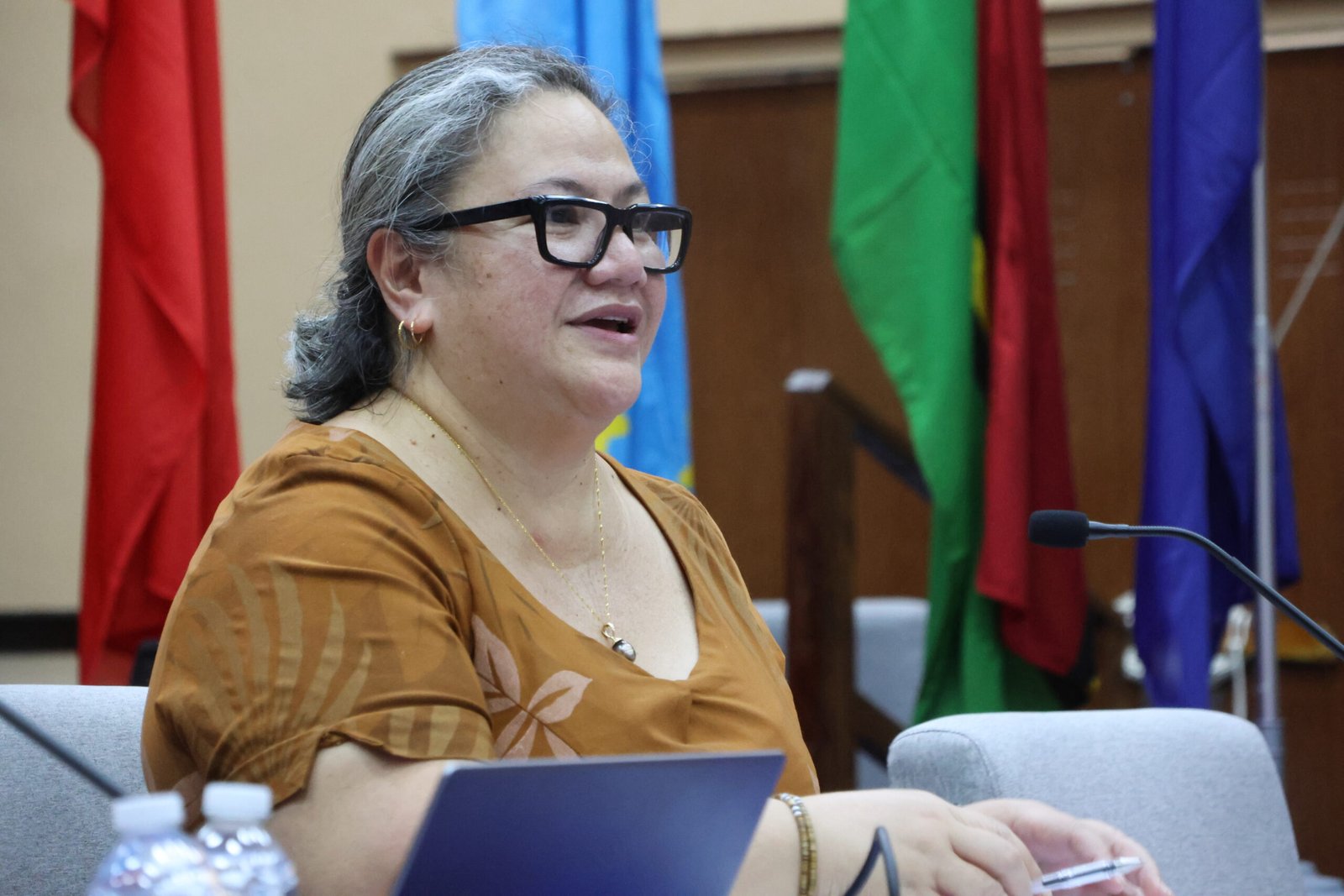
Delivered by the Pacific Islands Forum Deputy Secretary General, Desna Solofa at the 2026 Forum Economic Officials Meeting.
Majuro, Republic of the Marshall Islands.
22 June 2026
Chair of the Forum Economic Officials Meeting;
Excellencies and Senior Economic Officials;
Ladies and Gentlemen.
Iakwe, Talofa-lava and a warm Pacific good morning to you all. Welcome to the 2026 Forum Economic Officials Meeting here in the Republic of the Marshall Islands. On behalf of the Pacific Islands Forum Secretariat, I am delighted to welcome all delegates and participants here present or online, to this important regional meeting. We would like to extend our sincere appreciation to the Government and people of the Republic of the Marshall Islands for their generous hospitality and for hosting us in their beautiful country.
The annual Forum Economic Ministers’ Meeting (FEMM) provides a valuable platform for the Secretariat to update Ministers and Senior Officials on achievements over the past year, reflect on ongoing and emerging challenges, and outline the strategic priorities and work programme for the year ahead in support of the mandates entrusted to us by Ministers.
While many economies have recovered to pre-pandemic levels, the global economic environment remains very challenging. Recent fuel supply disruptions and surges in fuel and energy prices have highlighted the Pacific’s vulnerability to external shocks. These are having significant implications for energy security, transportation costs, inflation, economic growth and the livelihoods of our people across the region. This will require a coordinated regional response rather than a narrow fuel-price intervention. Against this backdrop, the Pacific region continues to attract increasing geo-political attention from both traditional and emerging political and development partners.
As highlighted in the Regional Economic Outlook, Forum Island Countries had been on a steady path of recovery following the COVID-19 pandemic. However, recent geopolitical developments, particularly the conflict involving Iran, have once again dampened global economic prospects and slowed recovery momentum. The Middle East conflict reached its 108th day on 15 June 2026. While the reopening of the Strait of Hormuz has been announced, with a formal agreement expected to be signed on 19 June 2026, the economic implications of the crisis continue to be felt globally and will be discussed further during this meeting. The regional macroeconomic environment remains fragile.
According to the World Bank’s Pacific Economic Update (May 2026), Pacific Island countries continue to be among the most affected by the conflict despite having no direct involvement. Regional economic growth is now projected to average only 2.8 percent, down from the earlier forecast of 3.2 percent. Rising fuel and shipping costs, supply chain disruptions, and heightened global uncertainty have increased inflationary pressures and placed additional strain on government budgets and external balances across the region.
While recent easing in geopolitical tensions may provide some relief over time, higher input costs have already been absorbed into business operations, public budgets, and consumer prices. Encouragingly, tourism performance through April 2026 has been more resilient than initially anticipated, underpinning growth in several tourism-dependent economies. Nevertheless, the outlook remains uncertain and will depend largely on the effective implementation and durability of the ceasefire arrangement and broader global economic conditions, especially developments in global oil prices.
These conditions make one point clear: incremental adjustments are no longer sufficient. The scale and nature of the challenges we face require a more ambitious, transformational response. Business as usual will not deliver the resilience, growth and sustainability our region now demands.
These ongoing vulnerabilities underscore the structural nature of the challenges facing the region and the need for a longer-term, coordinated response to strengthen resilience and economic stability. The 2050 Strategy for the Blue Pacific Continent provides our long-term vision for a resilient, secure and prosperous region.
Within this framework, the Pacific Roadmap for Economic Development (PRED), translates that vision into a practical and coordinated regional economic agenda. Endorsed by Economic Ministers in 2025 and welcomed by Leaders, the PRED reflects a shared understanding that resilience and prosperity cannot be achieved through fragmented national approaches alone.
Accordingly, regional economic integration is now not just important; it is essential. Recent global shocks, including disruptions in energy and supply chains, have reinforced the limits of fragmented responses and highlighted the urgency of deeper and meaningful integration to deliver more effective and resilient outcomes for our economies.
The FEMM agenda has been deliberately designed to demonstrate the PRED in implementation, ensuring that agreed regional priorities are translated into coordinated and practical action.
[ENDS]