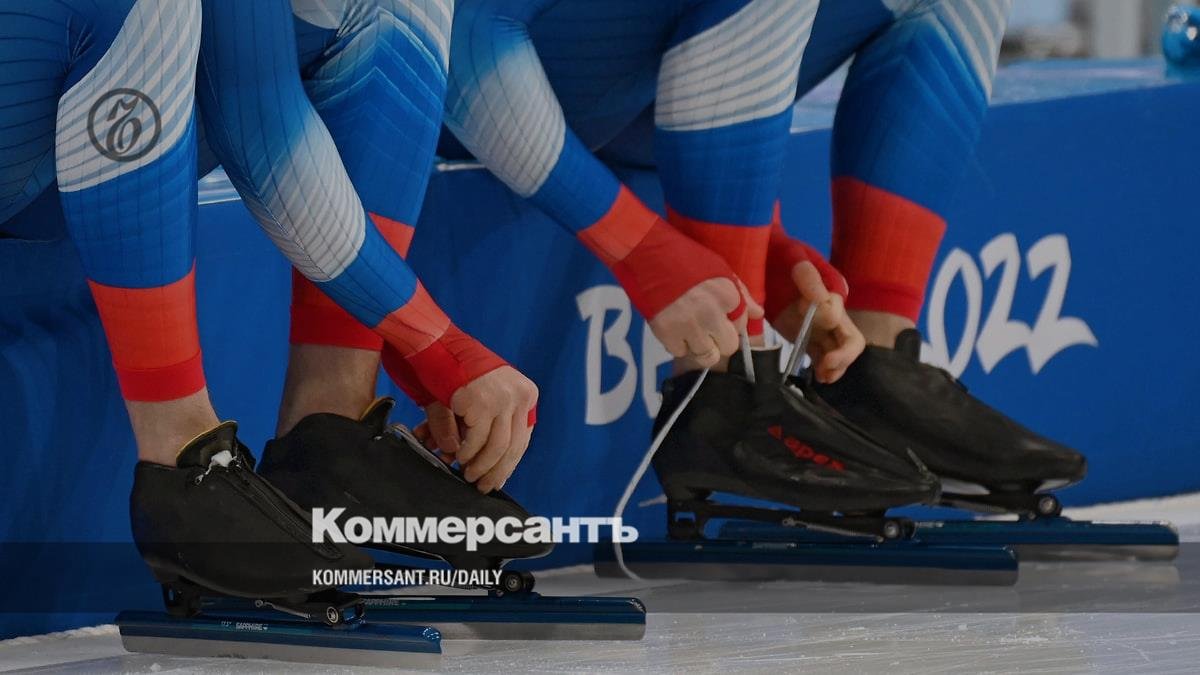
Russia has achieved another notable victory in the fight for a full return to world sports. The International Skating Union (ISU), one of the largest sports federations, has lifted the isolation regime that has been in place for its representatives for more than four years. This means that in the coming season, starting in the fall, Russian speed skaters, masters of short track speed skating, and, most importantly, figure skating, which is one of the most popular sports in the country and in the world, will finally be able to take part in major competitions. True, what this participation will be is completely unclear due to the colossal number of reservations and restrictions set forth by the ISU.
On June 30, the International Skating Union published communique number 2804 signed by its President Kim Jae-Yol and General Director Colin Smith, which states that athletes from Russia and Belarus will be able to take part in official international competitions under the auspices of the structure in a neutral status in the coming season. The statement noted that the decision was made taking into account “developments in the Olympic movement”, the study of “approaches” to the issue by “various federations”, the experience associated with the Olympic Games in Milan and Cortina d’Ampezzo held in February, as well as the qualifying competitions for them, and two recommendations issued by the International Olympic Committee in December 2025 and May 2026.
- The first called on federations to allow Russian junior athletes to compete without any restrictions.
- The second introduced the principle of “political neutrality” into the Olympic Charter in order to protect athletes from “external influence.”
- Both were interpreted as a call for further easing of the sanctions regime against the domestic sports industry, introduced in 2022, after the start of a special military operation in Ukraine.
In fact, the ISU announcement also appears to be a major breakthrough in Russia’s fight to fully return to world sport.
“Reintegration” into it after a long period of almost complete isolation was initiated shortly after the 2024 Paris Olympics by Russian Minister of Sports Mikhail Degtyarev, who on June 30 recalled the successes achieved in this process in recent months, emphasizing that “the practice of returning Russian athletes to international competitions continues to expand,” “the ice has broken in many sports,” and “in dozens of international federations our adult and junior athletes can compete as part of the Russian national team with the flag and anthem of the country.” Mr. Degtyarev had in mind, first of all, the federations responsible for judo, taekwondo, wrestling, gymnastics, fencing, aquatics, and weightlifting that finally abolished the neutral status for all age categories.
One of the first such successes is associated with ISU. Back in December 2024, this federation, one of the largest, allowed Russians to participate in the Olympics in Milan and Cortina d’Ampezzo. Before her, all the structures responsible for winter sports, except the International Ski Mountaineering Federation (ISMF), adhered to an exceptionally radical position on this issue, which, it seemed, could nullify Russia’s chances of sending a delegation to Italy that was even remotely similar to a team. However, a small team of 13 people was finally formed after winning the trials against the International Luge Federation (FIL) and the International Ski and Snowboard Federation (FIS) at the Court of Arbitration for Sport (CAS). Half of it consisted of athletes competing in events controlled by the ISU. And if speed skaters Ksenia Korzhova and Anastasia Semenova and short track speed skaters Alena Krylova and Ivan Posashkov did not show anything remarkable at the Olympics, single skaters Adelia Petrosyan and Pyotr Gumennik were not so far from medals: both took sixth place.
At the same time, after the Olympics, the ISU was in no hurry to take new steps regarding the “Russian issue.” And back in the spring, according to the statements of the federation functionaries, it was impossible to assume that they were ready for the admission of Russian athletes, which caused the strongest resonance among those who are interested in figure skating.
This is quite understandable due to the special status of the sport being an Olympic super hit, in Russia comparable in popularity to football or hockey and, moreover, always bringing the country many valuable awards. At the Beijing Olympics in February 2022, shortly after which an avalanche of sanctions hit Russian sports, there were six of them in five disciplines, including two golds – in the team tournament and Anna Shcherbakova’s singles. The first, however, then turned into bronze due to Kamila Valieva’s doping suspension. In the next four years, if we leave the Italian Olympics out of the equation, numerous stars of domestic figure skating like the same Petrosyan and Gumennik, the pairs of Alexandra Boykova with Dmitry Kozlovsky and Anastasia Mishina with Alexander Gallyamov, instead of fighting for awards in international competitions, were forced to play them out at domestic competitions.
At first glance, the Russian Figure Skating Federation (FFKR) reacted to the news from the ISU with surprisingly restraint. The FFKR told Kommersant that “they will refrain from commenting for now” and “will see how events develop.” However, according to sports manager Andrei Mitkov, the restraint is understandable “due to the conditions and reservations” contained in the communiqué, which “perhaps make the joy over his appearance somewhat premature.”
There are really a huge number of these conditions and reservations.
The ISU maintained a ban not only on the use of the anthem and flag of the Russian Federation, as well as its national symbols, but also on the presence of Russian officials and judges at competitions. In addition, it is generally unclear how many people Russia can send to tournaments. The communiqué clarifies that quotas for neutral athletes will be determined based on “the same objective qualifying criteria,” that is, results and ranking positions, that “apply to all skaters.” And since the Russians have not had the opportunity to perform or gain points in the world rankings during their more than three-year absence, their initial quota allocation is calculated on an objective basis, just like any other skater returning to competition after a comparable break. In practice, this means that the Russian quota, at least at the beginning of the season, the main part of which starts with the French stage of the Grand Prix series at the end of October, will be minimal, like that of outsider countries – one single sculler and single sculler, one sports pair and dance duet. And it is unclear whether it is possible to raise the rating in time for the January European Championships in Lausanne and the March World Championships in Tampere.
But that’s not all. The right to neutral status must still be earned by passing the ISU commission’s verification of compliance with the admission criteria. They are approximately the same as those used by the federations at the height of the lockdown. An athlete cannot be a member of the armed forces of the Russian Federation or “security agencies”; his biography cannot include “active” participation in a special operation, plus there cannot be episodes of “public support” for it. Moreover, the ISU warned that it will continually evaluate the situation after the return of Russian athletes and reserves the right to either relax or “strengthen restrictive measures” if it notices incidents that threaten the “safety and integrity” of the competition.
Different federations interpreted such criteria differently. But in winter sports, the interpretations have always been distinguished by maximum rigidity. For example, in cross-country skiing, despite admission to competitions in a neutral status being formally opened to Russians last year, only famous athletes who participated in the Olympics, Daria Nepryaeva and Savely Korostelev, were able to quickly obtain it. The lion’s share of candidates for the Russian national team were not satisfied with their applications.