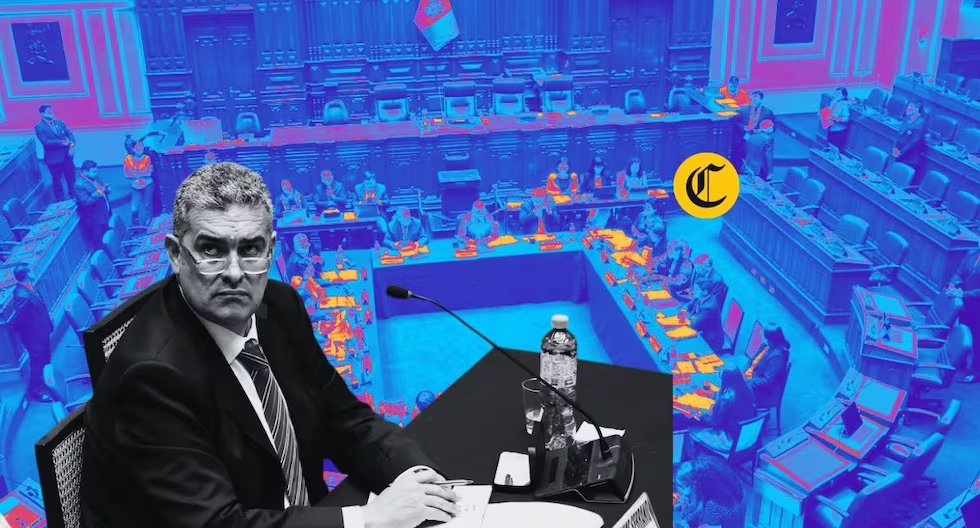
The acting head of the National Office of Electoral Processes (ONPE)Bernardo Pachas, minimized the impact of the delay in the installation of the voting tables in Lima and the failures in the Technological Solution to Support Scrutiny (STAE) system used in the first round of the 2026 General Elections.
Read also | Roberto Sánchez: His own Congressional representation reports reveal his partisan activities
Pachas appeared before the Constitutional Commission of Congress together with Carmen Velarde, head of the National Registry of Identification and Civil Status, with the aim of answering for the irregularities detected on Sunday, April 12.
The president of the National Elections Jury (JNE), Roberto Burneo, was also invited to the session, who sent a letter informing that he would not attend because he was leading a meeting of the plenary session of his institution. His absence was questioned by various parliamentarians, who demanded that he be urgently summoned to the next plenary session.
In his presentation, Pachas stated that the average delay in the installation of polling stations nationwide was 15 minutes, except in the cases of Metropolitan Lima, Madre de Dios, Callao, Loreto, Ucayali and Amazonas, which recorded delays.
“Although it is true that Metropolitan Lima presented logistical delays, due to the facts that we already know, the polling stations had an electoral participation similar to the regions, 78%, the same as in Chiclayo, Tumbes and Piura,” he stated.
According to the interim head of the ONPE, the results show that at 8:00 am, 64% of the voting stations had been enabled, except in the aforementioned regions. However, he did not mention that the elections began at 7:00 am and the tables had to be set up minutes before.
Pachas explained that Metropolitan Lima was the only constituency that had tables installed after noon. The delay occurred in 13 districts, especially in Cieneguilla, Lurín and Pachacamac. In total, 388 tables, representing a total of 94,069 voters, were opened after 12 p.m.
“They represent 1.34% of the total tables in Metropolitan Lima and at the national level they represent 0.4%,” the official stressed.
“The levels of participation in the districts whose tables were set up after twelve are highly similar to those that were set up after twelve. Before twelve, the percentage of electoral participation was 80.8% and, after twelve, 79.9% of citizen participation,” he said.
He added that in the most affected districts (Cieneguilla, Lurín and Pachacamac), the levels of participation were similar or higher than those registered in the 2021 general elections.

Presentation of the ONPE for the Constitutional Commission of Congress.
Pachas also defended the organization’s use of the STAE by pointing out that “the congressional election matrix was very complicated and very difficult to handle for voters and polling station members.” However, he said that the contingency plan if this system failed was conventional voting.
“The storage of the results in the encrypted form, STAE operates without an Internet connection, there is no use of biometrics, it encrypts the results, the results of each table that are transmitted to the ONPE are not known (…) Therefore, the STAE ensured the integrity, the authenticity of the information, with secure technology and support at each stage of the electoral process: installation, voting and scrutiny,” he indicated.
Pachas stated that all the information about this system was sent to the JNE, such as its training versions, simulation and the one used on April 12. The latter was delivered on March 19.
Likewise, he indicated that of the 29,266 STAE tables projected, 26,695 were able to be installed, while 2,571 could not apply the system. In Lima and Callao, the tables that used the STAE recorded only 4% of observed minutes (5,244), unlike the 2021 elections, when this system was not used and the percentage of observations reached 17.84% (14,994).
The ONPE representative said that the second round will be less complicated because only two contenders will be chosen and the counting sheet will be much simpler than in the first round, the same in the case of vote counting. “Therefore, we will not have STAE in this second round,” he said.
Pachas said that it will be the decision of the new ONPE head whether the STAE will be used in the Regional and Municipal Elections.
Regarding minutes 900,000, he explained that the establishment of voting stations in town centers is a strategy implemented by ONPE to generate greater accessibility to voting since 2006. In these elections, the implementation of this strategy was directed at 1,109,147 voters at voting stations in town centers.
Read also | X-ray of Jorge Nieto’s bench between the technocratic profile and political inexperience
Questions
Various parliamentarians such as Alejandro Aguinaga (Fuerza Popular), Gladys Echaíz (Honor and Democracy), Noelia Herrera, Norma Yarrow, Alejandro Muñante (Renovación Popular), Wilson Soto, Luis Aragón, Maricarmen Alva (Acción Popular), Alejandro Cavero (Avanza País), Edward Málaga (Ungrouped) questioned whether Pachas minimized the impact on the delay in the installation of the tables in Metropolitan Lima.
They also consulted about the 900,000 lot of populated centers, the application of the STAE and whether the organization would be willing to undergo an international audit.
Aguinaga consulted what the criteria were to select 1,900 population centers of the 90 thousand that the country has. Herrera, in turn, asked the same question and also questioned the statement that “the electoral schedule cannot be altered” under the argument that “no rights have been altered.”
For his part, Wilson Soto stressed that for these elections the electoral bodies demanded that they be provided with a larger budget. “41 million soles for laptops and printers that did not work, no one says anything (…) You were general manager of the ONPE during Piero Corvetto’s administration and therefore had great responsibility in carrying out a clean electoral process, which is not happening,” he said. He also questioned the president of the JNE and asked him to evaluate his resignation.
Muñante asked where the scope of article 31 of the Constitution was and why the JNE has rejected the annulment, even of the tables that were installed out of time. “Isn’t the right of the citizens who were violated on April 12 valid here (…) Or is it that we are perhaps ignoring a discriminatory discourse against Lima voters?” he expressed. The congressman from Renovación Popular joined the call for Burneo’s resignation.
Echaíz joined the criticism for Burneo’s absence. “As a guarantor of the transparency of an electoral process and with the role of supervisor that he has, he had to come to this meeting in order to convey to the population the real knowledge he has of everything that happened in this electoral process,” he noted. The parliamentarian also recalled that citizens have the right to vote under equal conditions.
On the other hand, he questioned whether Pachas had minimized the delay at the tables and the failures of the system and asked him about his work as manager of the ONPE in the management of Piero Corvetto and his responsibility for the inefficiency of the process. “What did the manager supervise? Were the JNE supervisors there? (…) Aren’t you responsible for guaranteeing the vote to that 1%? (…) Have you not won the election in previous processes due to minimal differences? (…) So, why do you minimize that it is 1% that has not been able to express its will due to the conscious limitations of the members of the body in charge of carrying out the elections?”, the parliamentarian asked.

(Photo: Joel Alonzo /GEC)
Maricarmen Alva and Alejandro Cavero spoke about irregularities at the University of Lima and other voting locations in Surco. “If this had happened in tables in the south, people on the left would be furious (…) I think this is a serious blow to the legitimacy of the process. What guarantees will you give us Peruvians that this will not happen again?” said the Avanza País parliamentarian.
Málaga said that, although the Organic Law of Elections does not contemplate many things, that is what the Constitution and Congress are for. “Finally, this debate is going to end in the Constitutional Court. Those who argue that the electoral schedule is extremely important and inviolable are talking about article 116 of the Constitution, not thousands of regulations,” he asserted.
It should be noted that article 116 establishes that the President of the Republic takes the oath of law and assumes office before the Congress of the Republic on July 28 of the year in which the election is held.
For Málaga, above an organizational term is the constitutional right that citizens have to elect and be elected. The parliamentarian said that “the legitimacy of the system” and “the credibility of our democracy” are at stake.
Yarrow, in turn, asked the head of ONPE if his organization would be willing to undergo an audit by an international company.
Meanwhile, Ruth Luque (Democratic Bloc) questioned her colleagues, especially from Renovación Popular, for “using the Constitution Commission to continue spreading a story of losers.” “If we are going to talk about illegalities: a first illegality is that elections were allowed on April 13, without any legal basis; second illegality, that the National Board of Justice has accepted the resignation of Mr. Piero Corvetto when that position cannot be renounced (…) another illegality is to talk about the annulment of elections,” he expressed.
Pachas admitted that what happened on April 12 “was a blunder” that led to a meeting with the plenary session of the JNE in which it was decided to extend the elections until April 13. He added that they added a complaint to the one filed by the JNE in order to “know the truth” about what happened.
Likewise, he indicated that they have made personnel changes in the administrative part of the ONPE where hiring is carried out.
He highlighted that all parties were invited so that they could learn how their computer system and the STAE work. He also mentioned the audit that his organization passed in November 2025, carried out by an international company, whose hiring was monitored by the Comptroller General of the Republic.
In addition, he announced that they will undergo a new audit after the second round. However, he did not say anything about what the JNE ordered. Regarding Yarrow’s proposal, he warned that it is very “delicate” to enter the computing system in the midst of the vote counting. “As for a new audit, we should ask ourselves when it will be, who is going to pay for it, what company is because right now we are at the close of the election, because the results of the presidential formula have to be announced,” he questioned.
He added that, while it is important to regain trust and reverse bad opinion, not all staff can be fired. “It is not about making a clean slate but improving the aspects in which we have failed,” he said.
FACT
- Constitutional law specialists Domingo García Belaunde, Jorge Luis Cáceres Arce, president of the Peruvian Association of Constitutional Law, and Elías Jesús Silva Huallanca also participated in the session. The latter pointed out that the minutes of lot 900,000 lack a legal basis.