“Those who know what’s really going on, what geopolitical plans Donald Tusk has been involved in, are aware of the idea of replacing, at least at the narrative level, America – meaning Trump’s America – (…) with France. Because when it comes to France, we have “better associations”, historical references to Napoleon, it resonates much better with Poles than Germany,” said today on TV Republika the station’s program director, Michał Rachoń.
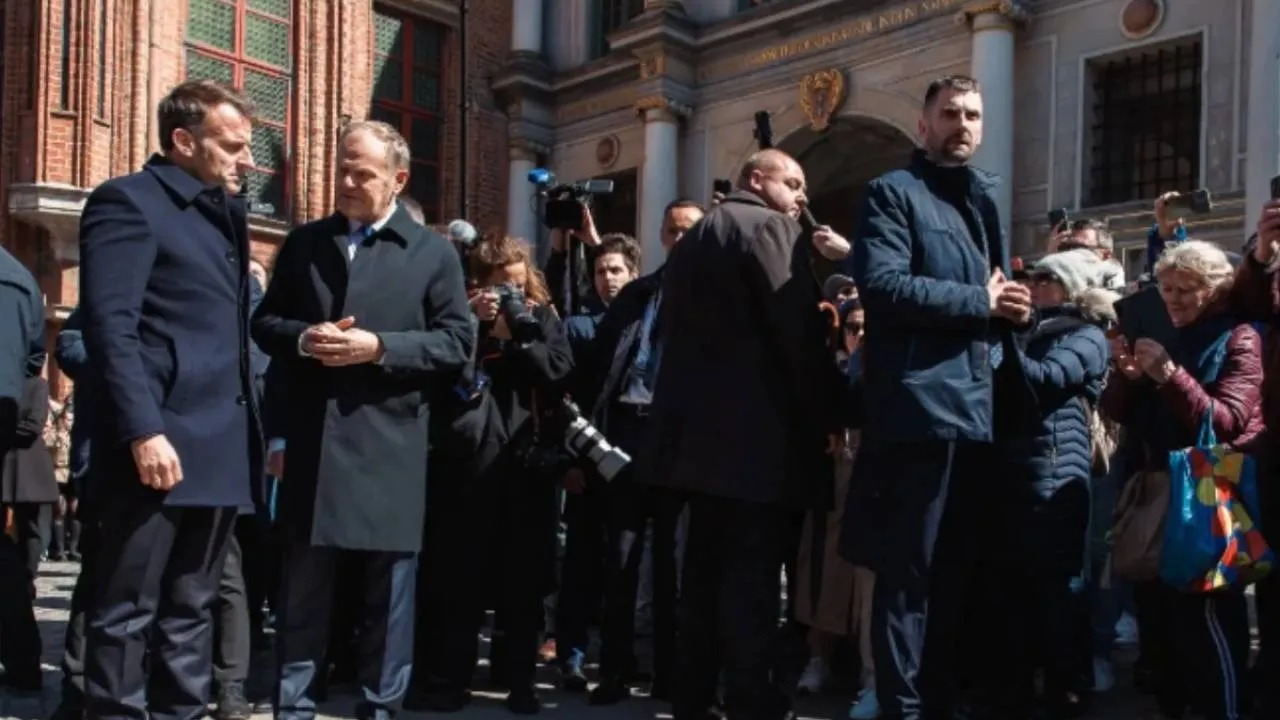
On Monday in Gdańsk, French President Emmanuel Macron met with the head of the Polish government, Donald Tusk. The meeting was connected to an “intergovernmental summit on the occasion of Polish-French Friendship Day”. The talks concerned, among other things, security, energy, and allied relations.
However, during the French president’s visit, there was no meeting with his Polish counterpart, President of the Republic of Poland Karol Nawrocki.
Rafał Leśkiewicz, the president’s spokesperson, said that “Macron came to Poland at the invitation of Donald Tusk, and the Ministry of Foreign Affairs did not extend an invitation to President Karol Nawrocki”.
According to Leśkiewicz, the prime minister “planned the visit in such a way that a meeting between the presidents would not take place”. That is why – as the spokesperson emphasized – Tusk “pushed for the visit to take place in Gdańsk rather than in Warsaw”.
Deputy Foreign Minister Marcin Bosacki stated that “the lack of a meeting was a decision of the French presidential palace”.
“Those who know what’s really going on…”
Michał Rachoń said this morning on TV Republika that the geopolitical context of the Gdańsk meeting is being underestimated.
“Those who know what’s really going on, what geopolitical plans Donald Tusk has been involved in, are aware of the idea of replacing, at least at the narrative level, America – meaning Trump’s America – (…) with France. Because when it comes to France, we have “better associations”, historical references to Napoleon, it resonates much better with Poles than Germany,” Rachoń indicated.
“Those who call Gdańsk ‘Danzig’ thought: “we’ll do it in such a way that we tell a story about the French, that there will be French bases here, that we will make an agreement with the French, Emmanuel will come here, we will sign a treaty”. People who understand security policy have been talking about such things for many months,” he added.
Michał Rachoń recalled that Tusk’s walk with Macron took place in the center of Gdańsk, near the Artus Court, where on September 1, 2009, Tusk organized a reception summarizing the anniversary commemorations of the outbreak of World War II, at which “Lech Kaczyński said what he said”.
“And that is why Vladimir Putin did not take part in that reception. Earlier, he spoke with Donald Tusk, and Tusk – as he claimed – told him about how difficult the life of a prime minister is, because he has security protection and goes jogging on the beach in Sopot,” the program director of TV Republika recalled.
What is Europe’s “strategic autonomy”?
Rachoń pointed out that the most important issue raised on Monday in the statements of Macron and Tusk was the concept of Europe’s “strategic autonomy” or “strategic sovereignty”.
“We know this term, because it has been used many times in Europe to emphasize that Europe must build its own military and energy capabilities. Why? Because it does not want to be dependent on the United States. Why? Because the engine of Europe, Germany, is politically dependent on the United States, because in 1944 they landed on the coasts of France and then advanced to Berlin. Since that time, American troops have been in Germany. This is a geopolitical problem for Germany, but since it is tied to a geopolitical complex and guilt related to World War II, they must find a way out of it. Therefore, the French president and the Polish prime minister discussed ‘European sovereignty’,” he said.
The program director of TV Republika emphasized that one cannot speak of “European sovereignty”, because there is no such thing as a “European sovereign”.
“European sovereignty and the sovereignty of the European Union mean this narrative about becoming independent, primarily militarily, from the United States,” he added.
Referring to Macron’s statements, he noted that Europe must today defend itself against the Russian Federation.
“This is the main threat, so why did the same France and the same Germany build cooperation with the Russian Federation all this time, which the United States opposed from the very beginning, as did the equally disliked George W. Bush?” he recalled.
Rachoń asked what the “independence of Europe” expressed by Macron means when Ursula von der Leyen or her superiors decide which funds to grant or withhold from the Polish state.
“What does this ‘independence’ mean for Berlin, for Portugal, for Spain, and for Hungary? These EU countries sometimes have common interests – and sometimes conflicting ones. What does the concept of Europe’s ‘independence’ actually mean? The idea of the European Union and NATO is tied to the transatlantic concept,” he stressed.
Macron promotes nuclear energy
Michał Rachoń pointed out that the second aspect of the event in Gdańsk concerns nuclear energy.
“We have been conducting talks and agreements with the American side on this matter for a long time, we even have bridge agreements being extended for negotiations. Because we still do not have a final construction contract. Macron was promoting his services in this area,” he said.
Polish-French cooperation in nuclear energy is also addressed in the treaty signed in Nancy in 2025.
“It is no surprise that the French are interested – they possess the technology and export it. At the same time, Poland, within the framework of its strategic policy goals – which until now had been unquestioned – was to build its relations, including energy relations, with the United States,” Michał Rachoń noted, pointing out that the signing of the agreement with Westinghouse for the construction of a nuclear power plant in Choczewo is being delayed.
“No reasonable person would want to return to that”
Michał Rachoń also referred to the lack of a meeting between the presidents of France and Poland.
“It is also about differences in political strategy, especially in the area of security. The counterpart of a president is a president. (…) The fact that the French president does not meet with the President of the Republic of Poland, and if this happens as a result of an intrigue carried out by the Polish prime minister, and if it takes place in Gdańsk, then we have a whole range of associations that no reasonable person would want to return to. Intrigues by the Polish prime minister against the Polish president using international security relations. That is exactly what happened here,” he said.
“The fact that this issue is being raised, together with matters concerning military security, raises questions,” he concluded.
Dworczyk: Tusk’s policy is absurd
Michał Dworczyk, former head of the Prime Minister’s Chancellery, also commented extensively on Donald Tusk’s policies on social media.
He described the government’s security policy as “absurd”.
He recalled that under the Polish Constitution, the Supreme Commander of the Armed Forces is the President of the Republic of Poland, Karol Nawrocki.
“At the invitation of the government, the president of another country – one of the most important allies – comes to Poland, and the Prime Minister’s Office actively blocks the possibility of his meeting with his Polish counterpart. The Ministry of Foreign Affairs does not even formally invite the President to participate in the meeting,” he added.
Dworczyk pointed out that during the Tusk–Macron meeting, the head of the Polish government “raises fundamental issues related to the defense of the Republic of Poland”.
“On fundamental matters, could the government not rise above political divisions?” he asked.