While the USA has requested that Kosovo become part of the regional project for American gas, the current Government has given another proposal. The Minister of Economy, Artane Rizvanolli, has deposited at the American Embassy a request for support for projects related to coal gasification, citing the large reserves of lignite and the policies of President Donald Trump to support the coal industry.
The government has offered the American administration cooperation in gas projects, but not for connection to the regional network, which the US insists on.
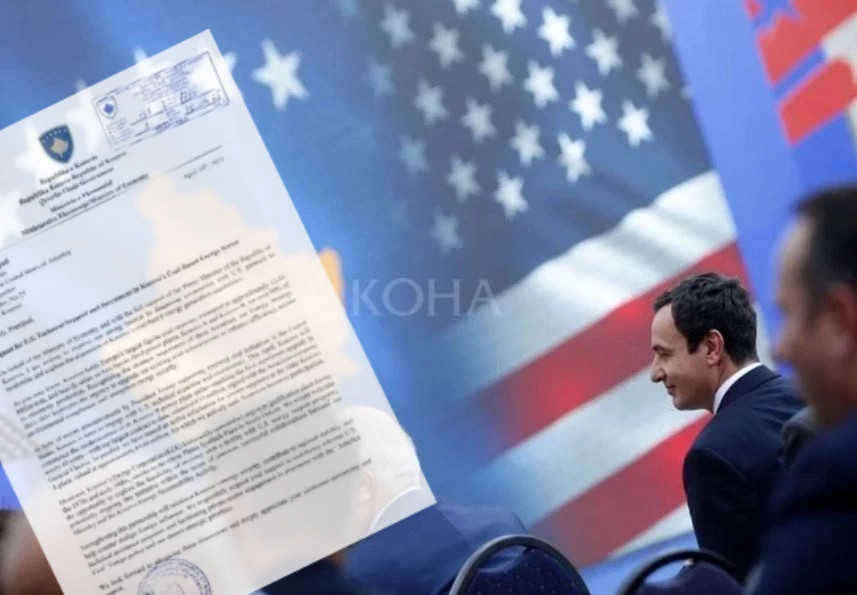
He did this through a letter that in April, the Minister of Economy, Artane Rizvanolli, addressed to the charge d’affaires at the US Embassy, Anu Prattipati. In the letter provided by KOHA, the Government has asked the US for technical support and also American investments in the coal-based energy sector.
“Kosovo Energy Corporation (KEK) has historically operated a Lurgi-type gasification plant during the 1970s and early 1980s, similar to the Great Plains Synthetic Fuels Plant in North Dakota. We would welcome the opportunity to explore the feasibility of reviving such a facility with US energy support programs, potentially aligning this initiative within the scope of previous collaborations successful between our Ministry and the Kosovo Activity for Energy Sustainability”, says Rizvanolli’s letter.
In the letter, Rizvanolli emphasized that he has the full support of Prime Minister Albin Kurti. He started it at the American Embassy, a few days after a meeting he held with Prattipat, in which the expansion of energy and mining opportunities between the USA and Kosovo was discussed.
After Rizvanolli’s letter, Prattipati publicly called on Kosovo to enter into a long-term energy partnership with the US through the liquefied natural gas (LNG) project, saying it would help secure its energy future.
However, Prime Minister Kurti, nor other government officials in office, have not expressed readiness to be involved in the project.
The energy expert, Adhurim Haxhimusa, has said that there are paradoxes in the Government’s request to the USA, for support in the analysis and coal gasification project.
“The first is that the USA has already made a concrete offer to the countries of the Western Balkans to become part of the regional gas network, for the consumption of American gas, and in this case the question is added whether the gasified line can be competitive with American gas, knowing that that gas will come for a large consumption and will be very competitive”, he said.
The construction of coal gasification plants, according to Haxhimusa, contradicts the environmental standards of the EU, which the country intends to join, and remains financially unworkable, because international institutions have blocked funds for this technology.
And, in the letter that Rizvanolli sent to Prattipat, it was emphasized that Kosovo has the largest reserves of lignite in Europe, estimated at around 12.44 billion tons. In it, it is also said that in light of the recent announcements by President Trump in support of new initiatives for coal, Kosovo wants to engage with technical expertise and American investments.
The possible non-inclusion of Kosovo in the regional American gas network has also fueled political clashes. The former prime minister, Avdullah Hoti, on Saturday called for a protest with the request that Kosovo become part of the American gas project. He even called Vetevendosje in power anti-American.
“The reasons given by the Government of Kosovo for the rejection of the gas project are of an economic nature and completely unfounded. It is stated that the project contains risks and that additional information is needed to assess whether it is economically viable. It is stated that the new energy strategy of Kosovo foresees the renewal of existing capacities with coal and the creation of new capacities from renewable sources. And recently, the Government’s interest in the idea of converting coal into synthetic gas”, the elected deputy of the LDK wrote on Facebook. Hoti has further added that none of these reasons contradicts and does not exclude the American gas project.
The elected deputy of Vetëvendosje, Ilir Kërçeli, reacted to him. He ironized by saying that the LDK should be protected, since, according to him, this party’s tenant is being changed. Kıçeli has emphasized that there are those who care about the alliance with the USA and who protect it.
The gas issue is considered one of the conditions that opposition exponents have mentioned as a condition for a possible coalition with Vetëvendosje for the formation of institutions. The Democratic League, whose senior officials have expressed readiness for coalition negotiations, also promised in the campaign a gas thermal power plant, which would be located in Ferizaj, not far from the border with North Macedonia, from where Kosovo could be connected to the American project.
Until now, the acting Prime Minister, Kurti, has not expressed his willingness to be involved in the project, despite the appeal that the American Embassy has recently made. But on Friday, Deputy Prime Minister Donika Gërvalla affirmed that the government has discussions with the USA about the gas issue, but emphasized that this topic is among many others discussed with the allied countries. As she said, decisions are made based on the interest of Kosovo.
Recently, a call has been made for Kosovo’s institutions to act quickly for the country’s inclusion in regional natural gas projects, calling it necessary for energy security and economic development.
In fact, it has been said by the economic odes in Kosovo that the rejection of American gas can negatively affect the partnership with the USA.
The United States has expressed its intention to change the way the Western Balkans are supplied with energy, making a network of agreements for the import of liquefied gas.
The goal is to reduce the region’s dependence on Russia and strengthen the energy corridor from the south to Central Europe. For this, projects are planned in several countries of the region – from Croatia, Bosnia and Herzegovina, North Macedonia, Albania and Montenegro, to Kosovo and Serbia. These projects include new pipelines, liquefied natural gas terminals and gas-fired power plants, and are supported politically and financially by the US and the European Union.
Kosovo has no gas infrastructure and relies entirely on coal-fired power plants.
The project for a gas interconnector with North Macedonia was previously included in the EU investment plan for the Western Balkans, but was stopped due to, as the Government said, high costs and the strategic focus on renewable energy sources. The pipeline would give Kosovo access to gas from Greek LNG terminals in the Aegean Sea, and the idea was to also build a pipeline to Albania.
Kosovo has refused to invest about US$200 million in gas infrastructure through the Millennium Challenge Corporation (MCC) program and has diverted the funds to battery energy storage systems.