And the state entity frames this project within its Urban Mobility Plan for Lima and Callao 2025-2045, which not only includes the realization of cable carsbut also the start-up of 9 metro lines, all of which are interconnected so that the benefited population can move not only quickly, but also safely and economically.
Given this, the urban architect Aldo Facho Dede, in conversation with the newspaper El Comercio, highlighted that the Urban Mobility Plan is an urban initiative, but that our country has the great problem of delaying its infrastructure works for a long time: “Being realistic, and seeing that Line 2 of the Metro has more than 10 years of execution, it is possible that not all the planned infrastructure will be developed, but, if we are orderly with the procedures and times of the project, with the ATU maintaining clear guidance and leadership “Associated with the support of the central government, it is possible.”

Design of the Urban Mobility Plan for Lima and Callao 2025-2045 that includes the metro lines, the Metropolitan and the cable cars. (Photo: ATU)
What are the benefits of the cable car?
With this plan, Peru is on par with countries like Colombia, Brazil, Ecuador, Chile and Bolivia (the highest in the world), so its journey will be of vital importance. In that sense, Gustavo Díaz Paz, Deputy Director of the Planning Subdirectorate of the ATU, told this newspaper:
“The focus of these cable cars is to connect the mass transportation systems with the subways and the Metropolitan; it is a new model as is done in Medellín. Likewise, to connect the neighborhoods on the slopes because there is an economically vulnerable population for whom it will be easier to get around. Lima is a city with mountain ranges along the Andes, a reality like in Colombia and Bolivia.”
In that sense, Facho Dede complements this by ensuring that it is crucial that this means of transport necessarily connects with other rapid systems: “If someone who goes from Manchay to Villa María del Triunfo does not have a connector like the Metro that leads to Lima East, North or the Center, it will be of no use. Otherwise, they will end up taking over combis and custers. It would be very disappointing if in 5 or 10 years we have the 8 cable car lines built and that the people who come from Cajamarquilla reach the conventional bus stops.”
In addition to this, the ATU spokesperson highlighted another benefit that this project will have, not only for the population of the area, but for the entire city: “We want the urban cable cars to have a tourist function, since they are going to pass through the mountain ranges of Lima, these have a particular ecosystem called Lomas Costeras: in winter it becomes a green lung, what is the problem? That people cannot get there because they are too high. With the cable cars they will be able to reach these parks.”

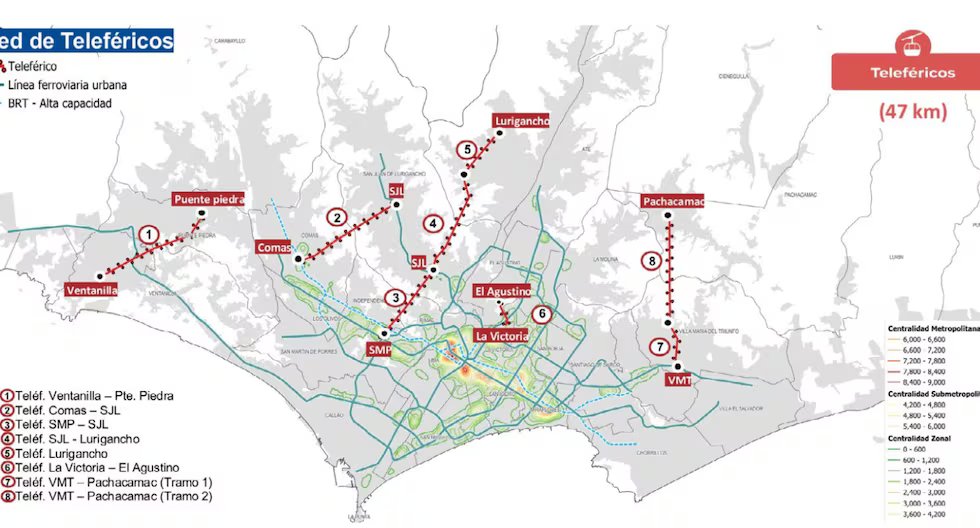
Map with the extension and locations of the 8 cable car lines planned by the ATU for Lima and Callao, which will be delivered by 2045 as the deadline. (Photo: ATU)
When will the cable cars be delivered?
According to Díaz Paz, the cable car project for Lima and Callao aims to benefit an average of one million people. Although it is true that the comprehensive plan includes total delivery by 2045, the truth is that the ATU will deliver some lines long before said date:
“This is the cable car that connects San Juan de Lurigancho, where the La Hacienda Metro is, the Los Jardines station on Metro Line 1; it is a very busy area. From that point, take them to Plaza Norte. This would be ready, in the worst case, by 2031, but it could be presented sooner.” It must be remembered that this border area between San Martín and Independencia connects with a series of high traffic points such as the Plaza Norte Terrestrial Terminal, close to the National University of Engineering (UNI), as well as a station on the future Line 3 of the Metro.
And he added: “It can be built in two or three years and then, with technical cooperation from the Andean Development Corporation (CAF), we have already started the preliminary studies to start this project.” It is no less a fact that the journey from Lima Norte to San Juan de Lurigancho in current transportation, in the best of cases, can last a little more than an hour. With the cable car, a trip of only 18 minutes is expected.
Facho Dede agrees on the importance of this first section, but recognizes the failures of the Peruvian system when carrying out this type of works: “We have to be aware that our public investment and public infrastructure management system is not agile or efficient; we take so long to plan, to make the pre-investment, the investment and execution. If we wait for the perfection of the metro system for the city to function, it will take many years, decades, even a hundred years. Future projection is needed with short and medium-term plans, while along the way adjustments are made,” he said.

How much will the Lima and Callao cable car cost?
This work is part of the Urban Mobility Plan for Lima and Callao 2025-2045, which has an ambitious budget to carry it out: “We are talking about 950 million dollars for the 8 cable cars. Only the first one would cost about 120 million. In La Paz (Bolivia), it was built in four or five years, developing 30 kilometers. We want to have 43 kilometers. Yes, it can be done quickly with good monitoring of public investment and political will,” Díaz Paz explained.
However, while the vast majority of experts welcome the measure, some consider that 20 years is a very long time. Given this, he assured: “We do not want to make false promises. The problem here is the budget. All 8 could be done, but it must be coordinated with the Government, the Ministry of Economy. Political will is crucial.”
Finally, the ATU representative reaffirmed the importance of cable cars to connect Lima and Callao, mainly to people who live in remote places that are difficult to access: “It will help people who live on the slopes of the hills to move quickly. Lima has heavy traffic and the cable car, to some extent, will reduce the problem because there is no traffic in the air.”

The purpose of the cable cars is to connect residents of Lima and Callao who live in remote and elevated areas with integrated mass transportation such as El Metropolitano or lines 1, 2 and 7 of the Metro. (Photo: ATU)
Are Lima and Callao ready for cable cars?
Despite everything said, the question must be asked, Are these areas of Lima and Callao prepared to withstand the socio-economic impact that the construction of the cable cars represents? In this regard, Aldo Facho reveals that preparing such places to house these transportation systems can be a problem if it is not planned efficiently: “What do I gain by installing cable cars if I do not have drinking water, nor drainage? When the cable car arrives, will there be a city? That is, a habitable space with basic services or will they only be built in precarious human settlements that do not have basic infrastructure for people to live with dignity.”
The urban architect highlights another factor to take into account: that both the Urban Transportation Authority (ATU) and the Metropolitan Municipality of Lima (MML) have development plans that are not necessarily connected: “If these plans (the Mobility Plan and the Urban Plan) do not converge, if we do not work on the comprehensive urban improvement of these areas, we are only going to generate greater poverty and marginality; since by installing cable cars many people are going to mobilize to populate them, being at “mercy of land trafficking and speculation.”
“We have to take care that non-urbanizable areas do not continue to be developed, areas where neither water nor drainage will ever reach. A work like the cable car must have urban development interest, this will cause many families to go look for housing in these sectors,” he added.
It is true that the cable car seeks to connect residents who live in places with high and difficult access, where in addition to the ATU and the MML, the participation of Sedapal as the entity in charge of water supply and sewage for the capital and the first Peruvian port is also important.
“Where is Sedapal? Does anyone know its plan for 2045? Nobody knows. It is no small issue how water will be supplied to a city that is densifying and strengthening (…) There must be a correlation of an important metropolitan planning presence on how to use developable land. Unfortunately, Lima is one of those few cities in the world that does not have control over its territory, since it does not manage public transportation, nor health, nor education, much less water and transportation. drain,” he stated.