Of Stefano Leszczynski
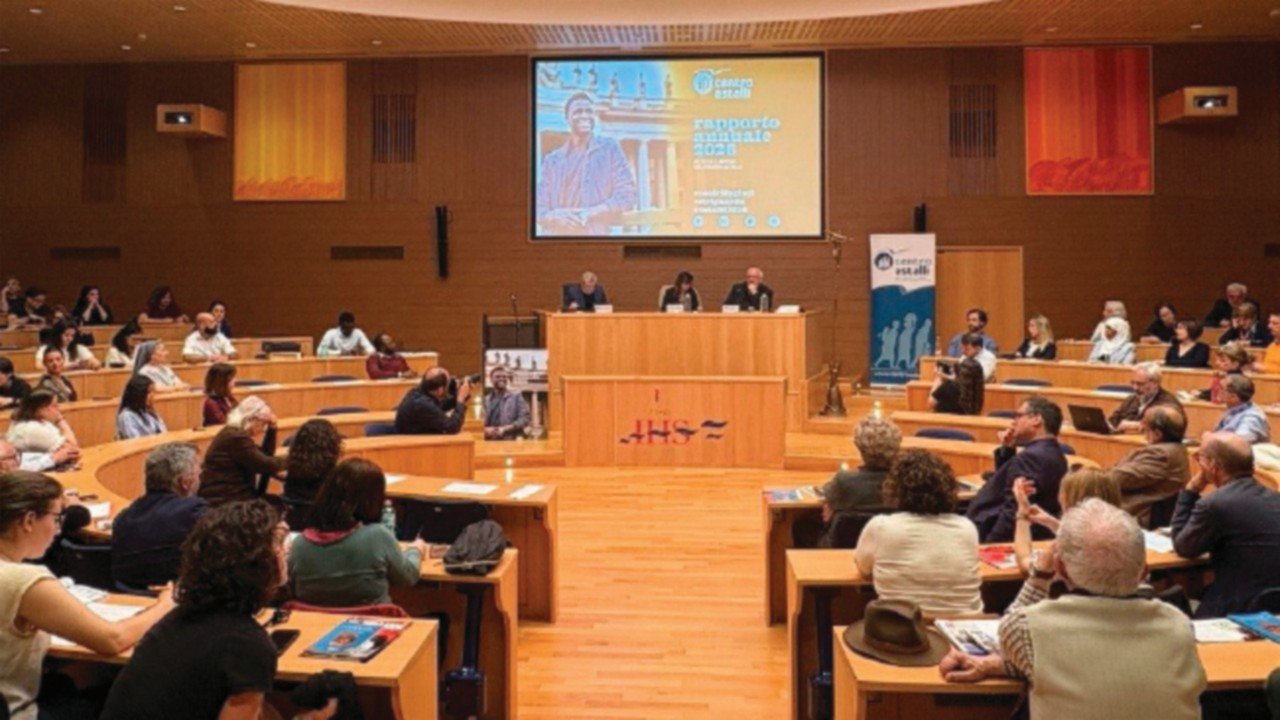
In the year of the Jubilee of Hope, the Astalli Center accompanied, served and defended 21,000 people nationwide, of which 11,000 in the capital alone. The data contained in the 2026 Report and presented on Wednesday at a press conference at the Jesuit General Curia say a lot about the emergencies and needs of those who have had to flee violence, war and poverty. These are numbers that reflect an increasingly unstable global context, marked by weakened multilateralism and growing geopolitical polarization.
«There are 300 million people who migrate in the world, of which 130 million fleeing 54 wars and a hundred environmental disasters, victims of trafficking and exploitation» underlined Archbishop Gian Carlo Perego, president of the CEI Migrantes Foundation, who spoke at the presentation of the Report.
The document draws a critical picture of migration policies and the conditions of refugees in Italy, which is affected by the generally worrying climate at an international level. It is not just wars that are having an impact, underlines the Centro Astalli document, but the contraction of international funding. The cuts to USAID funds and similar measures adopted by various Western governments have produced perverse effects: humanitarian programs suspended, organizations forced to reduce their activities and thousands of people deprived of essential services. Repercussions that also extended to the Italian third sector, putting at risk the continuity of fundamental interventions for reception.
In 2025, 1,205 people had access to the basic services of the Astalli Center in Rome for the first time and the canteen distributed over 62,000 meals. «It is now a growing and structural demand – explains Father Camillo Ripamonti, president of the Centro Astalli – which highlights widespread conditions of vulnerability. By now half of the canteen users are asylum seekers, among those most affected by the legal uncertainty that has been created.”
The progressive tightening of asylum rules in Europe with the expansion of inadmissibility criteria and the redefinition of the concept of “safe third country” do not address the root causes of forced migration, but limit access to protection. Italy – reports the Astalli Center – fully fits into this orientation, privileging border control over inclusion paths, with the result of fueling marginality and precariousness. «In recent years – states Ripamonti – policies have been made in which the asylum seeker finds himself waiting in limbo, which for people turns into further fragility and a condition of exclusion».
Frailties also emerge on a health and social level. The Forced Migrant Health Unit (Sa.Mi.Fo.) assisted over 2,600 patients, with almost 12,000 visits and intense linguistic mediation activity. In particular, the data on the mental health of minors are worrying: there were more than a thousand visits for 151 children and young people, a sign that highlights urgent and complex needs.
For adults, the length of stay in the centers is lengthening, also because the process of becoming independent is hindered by the difficulty of finding accommodation. Although more than 30 percent of guests are employed, the work is not enough to guarantee living independence, due to high costs and widespread prejudices. Single women with children are particularly vulnerable, often without adequate tools to combine work and care.
Presenting the annual report, Father Camillo Ripamonti launched a strong appeal to the political world, hoping for greater commitment in building effective networks between services, institutions and communities to achieve true accompaniment towards integration: «Care – he said – is, first of all, a political and cultural fact. It means deciding that no one is waste, that services cannot simply stop, but must be supported by far-sighted visions. Reception and inclusion must be considered together: there is no before and after, but a single process that has the dignity of the person at its centre.”
The Report sends a clear message: another model is possible. The experiences of the Astalli network demonstrate that inclusion can work, even in a difficult context, if supported by adequate policies and an active civil society. The challenge is to transform this possibility into a concrete and shared choice, capable of building a more cohesive and just society.
«The challenges that this context poses to the operators and volunteers of the Astalli Center – concludes Father Camillo Ripamonti – can be summarized in the commitment to work together for a more inclusive society, a society in which the various people can feel at home wherever they come from».