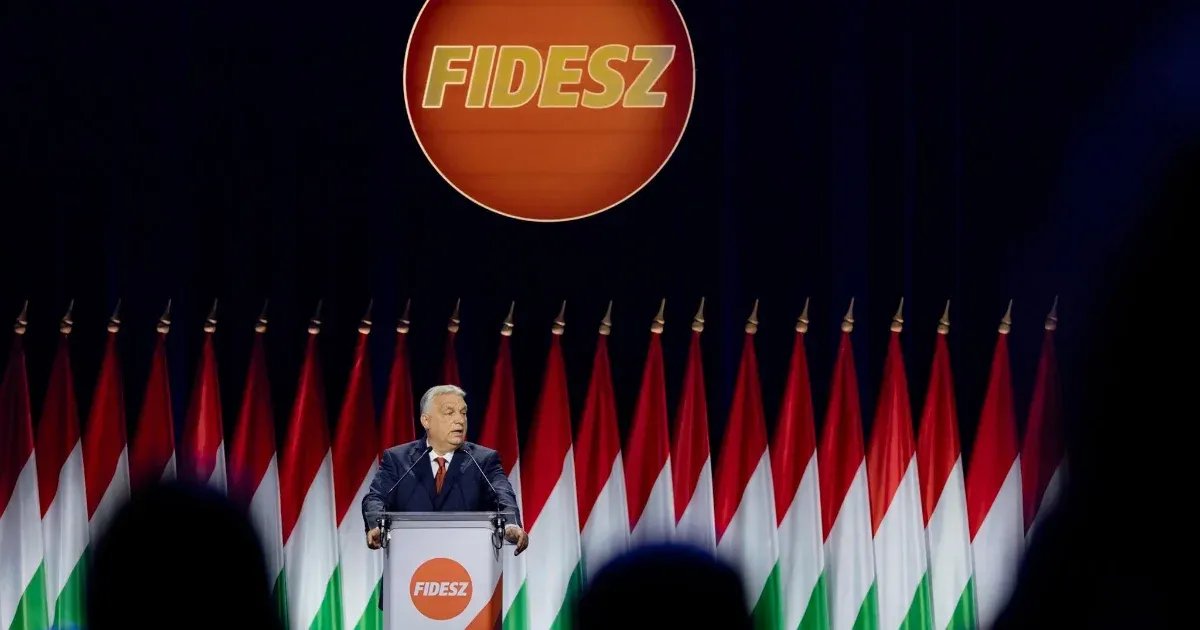
“You know that I have no desire to change. I will not do a half-turn or a complete turn”, declared Viktor Orbán after Fidesz at the renewal congress on Saturday he was elected again as the party president, and before that the party members repeated for hours, almost to the point of boredom, that renewal and rejuvenation were needed after the defeat in April.
By the way, Orbán did not deny this either, analyzing the reasons for the election defeat in the morning, he said that he was the only one responsible as the main columnist of Fidesz, but he even got to the point where the young people rudely rejected him, and according to him, in the end, the whole election was lost because of this. However, he dismissed the responsibility by stating that he offered to resign after the electionthen he was again elected as the head of the party at the renewal. There was no challenger this time either.
From the speeches of the congress, which lasted nearly six hours, the picture emerged that there is no real demand for his departure within the party, but even the dilemma of whether renewal with Orbán is possible did not even arise for half a sentence. Member of Parliament Balázs Hidvéghi unusually hard and honest got involved in Fidesz’s communication and campaign mistakesbut until then he didn’t even dare to say what kind of responsibility Orbán has in this. Rather, he spoke about the need to protect “Viktor Orbán’s exceptional political performance” in the next period.
Hidvéghi was the only one who listed the 2024 pardon scandal as one of the reasons for the defeat, from which the history of Fidesz’s descent and the history of the Tisza Party can be traced. According to him, this wound has not healed since then, and it is still not clear what exactly happened. Others only talked about communication and organizational errors, and the fact that they did not have an adequate response to the criticism of the luxury of the NER elite and the accusations of corruption. Andrea Gyurákovics, politician Lázár from Ferencváros recalling what he said last March he criticized the ticks attached to Fidesz, and according to former government commissioner Máriusz Révész, they committed many moral mistakes, and there will be no renewal until they face them.
This was the rarest opinion, the majority of the congress attacked Péter Magyar and the Tisza Party instead of the reasons for the defeat and the substantive renewal. Tibor Navracsics, for example, said that the new government is building an inhumane and dysfunctional country and is dismantling the system of checks and balances, while others were worried that Hungary would destroy the rule of law and democracy. Perhaps the speech of László Kövér and Tamás Deutsch showed how much they do not understand the message of the April 12 election: the former called the governance of the Tisza Party the destruction of “Brussels puppets”, and the latter spoke almost exclusively about gender ideology, migration and Brussels.
The recurring promise of renewal was at most indicated by the absence from the program of the key players of the Fidesz campaign: Péter Szijjártó, János Lázár, Máté Kocsis, Tamás Menczer and Balázs Orbán. For most of the day, local ambassadors, unknown in national politics, gave their opinions in a few minutes. The maximum that could be read from these was that the leadership of Fidesz had completely distanced itself from the local organizations in recent years, and they had no input or feedback at the lower levels of the party.
The script was based on Orbán giving a speech at the beginning of the congress, then responding to the comments and criticisms in another speech at the end, but after his election, he essentially only said that he would not change. He made a promise to the membership: he will not repaint himself and will not continue to attend herebere for parties. Rejuvenation also came up in his afternoon speech, and he stated that a generational change is also needed at the head of the party. “Let the young people come, in their forties and thirties, who are willing to put thirty or forty years of their lives into the service of their country.” He promised that he would work as president for the next year so that “this happens as soon as possible and a new great era can begin in the life of Fidesz”.
According to his claim, he only accepted the presidency for one year because he considers it a matter of honor to resign after the defeat, but not stand aside. “I consider it a matter of honor to hand over Fidesz to young people as an organized, modernized party with a chance of victory. I will do this work.” However, we could not actually learn anything about what this work will consist of.
Orbán said in his morning speech that a different kind of operation is needed in the opposition, and that their task is to be the voice of the people and to organize resistance to “the government’s wrong decisions, views and violent abuse of power”. According to him, it will become clear by autumn how long the country will tolerate the abusive governance of the current government, and then the time will come for the great national resistance of the patriots.
“By the time the leaves fall, the renewed Fidesz must be ready”
– declared Orbán, and he also talked about the fact that they should be ready by then in case the government fails and the people get fed up with the Magyars.
Who gave the order: Fidesz must be put in order from the basement to the attic by September. To this end, the electoral district system, which had been successful for the past 16 years (with the exception of the April election), was abolished by amending the constitution. In the future, Fidesz’s organization will adapt to the local government system: the party will have settlement groups and county committees. The county committees elect county presidents, who automatically become members of the new presidency. The national presidency of Fidesz will be significantly expanded, so in the future it will consist of the 19 county and capital presidents, the president of the national committee, the leader of the Hungarian and European parliamentary factions, as well as the president elected by the congress and four vice presidents, i.e. a total of 28 people.
Of the vice-presidents of Fidesz until now, only Gál Kinga, EP representative, was able to keep his position, Gábor Kubatov, Lajos Kósa and Szilárd Németh were completely sidelined. Gál was joined by János Bóka and Alpár Gyopáros, members of parliament, as well as Salgótarján mayor Bálint Kreicsi, there were no other candidates for this position. And the majority of county presidents it is made up of electoral district candidates who failed in the election, so it would be difficult to talk about renewal here as well.
At best, the announced organizational restructuring covers up the fact that Fidesz is still incapable of substantive innovation.
It is not clear what they will change after the defeat and what new topic they will come up with. The congressional decision to reject the migration pact was somewhat overshadowed by Péter Magyar press conference announced for Saturday morningat which the Orbán government presented its secret plans for the migrant camp in Vitnyéd. The former prime minister to this he could only respond to the pressthat there are no migrant camps in Hungary, while Gergely Gulyás claimed that the plan was only to deceive the EU.
“Did it work?” former government spokesman Zoltán Kovács might ask. The plan to end the era leading to defeat with the current congress hardly succeeded. Based on Saturday, it seems that they still haven’t found the antidote to Péter Magyar’s road cylinder. Rejection of testicles, a Setting up a line of defense and the monotonous repetition of renewal will not be enough for that.