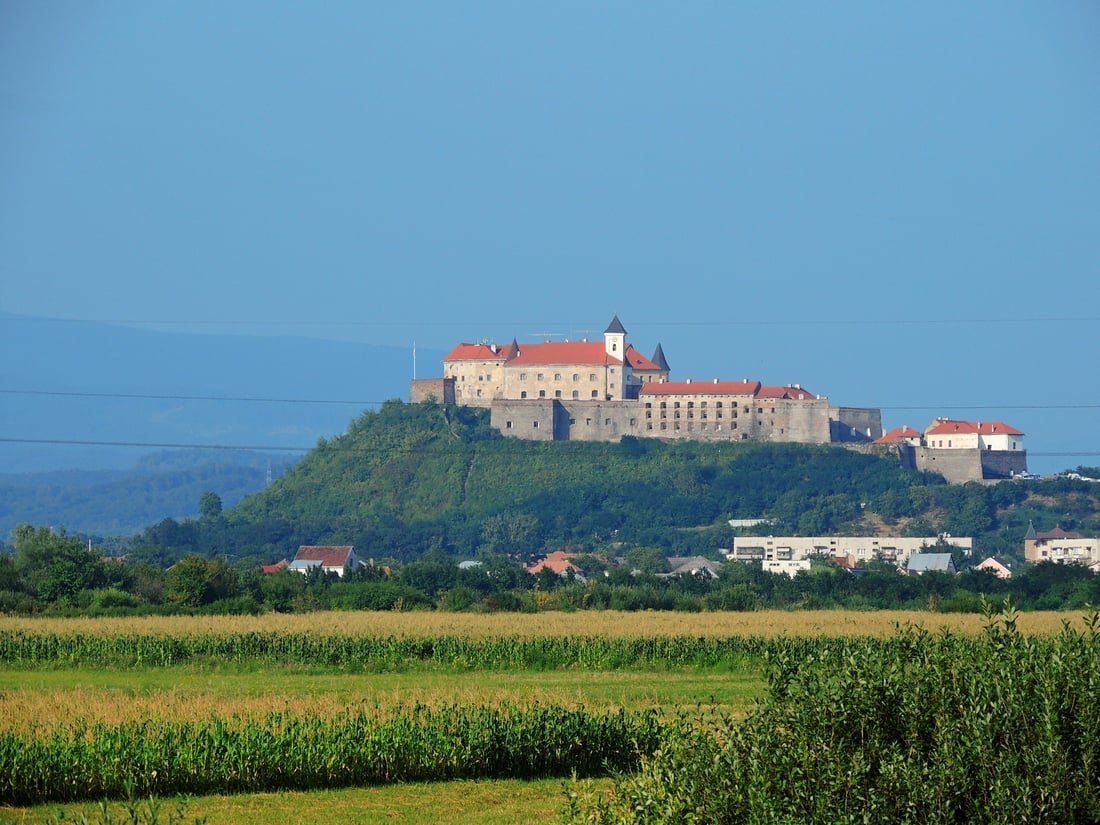

Castle in Mukachevo (Munkács)
The news announced last week of an agreement made between Budapest and Kyiv regarding the minority rights of the Transcarpathian Hungarians left political observers rubbing their eyes in disbelief. The lengthy list of commitments made by the Ukrainian government exceeded even the most optimistic expectations of the long-suffering Hungarian community. Precisely for that reason, a faint suspicion arises that this sudden change of course may come with a catch.
During the election campaign, Péter Magyar was frequently seen with a certain Roland Tseber, a man from Transcarpathia with close ties to the Ukrainian intelligence services, who assisted the TISZA leader in matters of Ukrainian-Hungarian “reconciliation,” whatever that may mean.
The future prime minister did not seek the proximity of the legitimate representatives of the Hungarian minority;
everything he learned about the situation of the indigenous ethnic community came filtered through the aforementioned individual, one of the showcase Hungarians of the Kyiv regime. Such people may be of Hungarian descent, but they unreservedly represent Ukrainian state interests, regardless of the interests of their community of origin.
This makes the rapid conclusion of the declaration of intent announced last week all the more surprising. Certainly, the agenda has been established for years and was negotiated by the previous government with varying degrees of success. However, there was never a genuine breakthrough, because the Orbán government did not support either the neighboring country’s accession to the European Union or Brussels’ irresponsible war policy. From the perspective of national policy, the balancing of interests is indeed a delicate act: what is required here is not short-sighted politics focused on headline-grabbing successes, but rather a long-term strategy that takes into account the fact that Kyiv has repeatedly made verbal commitments regarding fundamental, human, and minority rights, yet has rarely, if ever, followed them with concrete action.
In addition to these objective circumstances, there are also personal factors which, while not directly influencing the negotiations, certainly play a role in public communication. It cannot be ruled out that
the reported successes regarding Transcarpathia contain as little substance as the announcement of securing EU funds,
which later proved to be nothing more than a political declaration of intent. Both Magyar and Zelenskyy urgently need “progress” that they can present to the public. Others, such as the leaders of the two parties representing the Transcarpathian Hungarians, are trying to secure the goodwill of Budapest’s new rulers by aligning their public messaging as closely as possible with theirs.

László Brenzovics. Photo: MTI/Máthé Zoltán
We are dependent on their statements—or on Magyar’s statements—because there is no official record of the three weeks of negotiations, as Lőrinc Nacsa, the former State Secretary for National Policy, rightly pointed out.
László Brenzovics, chairman of the Transcarpathian Hungarian Cultural Association (KMKSZ), and László Zubánics, chairman of the Hungarian Democratic Alliance of Ukraine (UMDSZ), both point out that nine of the eleven points proposed by the Orbán government as a basis for discussion were already on the verge of being signed. Both agree that Ukraine’s promised EU accession and the lifting of the Hungarian veto played a decisive role in enabling the country to negotiate—or, rather, to be willing to negotiate—the relevant issues with the new government.
The declared return to the 2015 status quo, particularly regarding education, language, and symbols, represents a breakthrough in the opinion of the two minority politicians.
According to Zubánics, a concrete draft law covering all aspects has been drafted, which the parties have reviewed and linked to specific deadlines for implementation. Brenzovics is somewhat more cautious in this regard. “This year and next,” he replied when asked when the agreed-upon points would take effect. The issues must still be submitted to the Ukrainian Parliament and passed there. And this brings us to the crux of the matter:
What the government claims it wants to enforce is one thing; what the Verkhovna Rada decides is another,
and the Cabinet has often used parliament as a political fig leaf when it has come to avoiding the implementation of measures demanded by Brussels.
The KMKSZ leader also stated that the Ukrainian side was “surprised” that the new government had so resolutely championed the rights of Hungarians in Transcarpathia. This is likely a staged “surprise” coordinated with Budapest, part of the TISZA government’s communication strategy, whose favor the exiled politician is now seeking.
There is reason to fear that this, like the issue of EU funds, is a zero-sum game—yet another PR stunt by Magyars’s show government. Brenzovics himself had to admit in an interview that his compatriots harbor a certain skepticism, as there have been previous promises from the Ukrainian side that were ultimately not fulfilled. In countries like Ukraine or Romania, the problem is not so much the lack of a legal framework, but rather the inadequate enforcement of laws. Paper is always patient, and Brussels’ culpable forbearance toward the violation of minority rights is virtually endless. Relying on EU guarantees for the enforcement of the Hungarian-Ukrainian agreement is a sign of boundless naivety. As experience shows, the Council of Europe is the only forum where the concerns of indigenous minorities are given any hearing at all, though this body, lacking any means of pressure, is little more than a “token gesture.”
Featured image: Romankravchuk/Wikimedia Commons