For the first time in nearly a decade, a sitting Taiwanese president sat down with the foreign press corps — offering both access and a pointed defense of media freedom in the face of Beijing’s intimidation
-
By David Frazier / Contributing reporter
The last time Taiwan’s foreign correspondents were invited to a special briefing with a sitting president was in 2015. That was two presidents ago under Ma Ying-jeou (馬英九).
But Thursday morning, President William Lai (賴清德) welcomed the nation’s international press corps warmly, speaking specifically to the theme of press freedom.
Lai addressed Taiwan’s foreign press corps saying, “You live, work and report in Taiwan.”
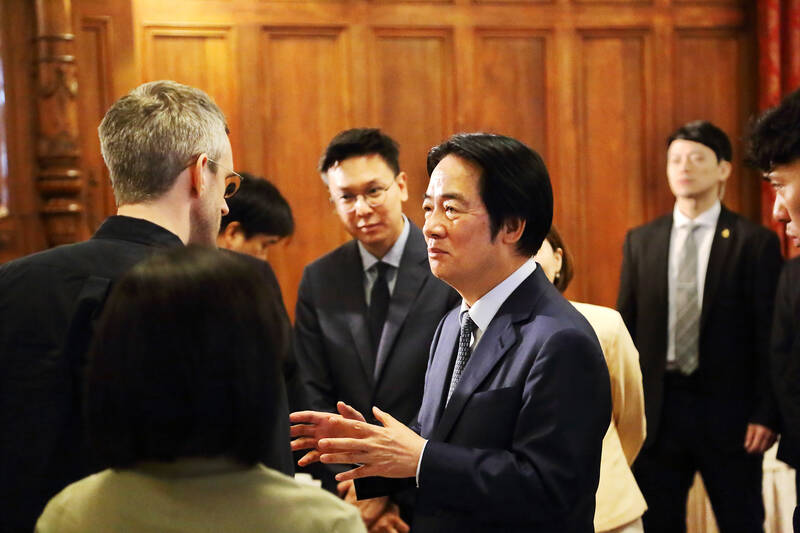
Photo: David Frazier
“Thank you for your professionalism and upholding the spirit of press freedom,” he continued. “As you engage in your work of journalism, you let the world see Taiwan.”
The timing of this event, hosted by the Taiwan Foreign Correspondents Club (TFCC) of which the author is a member, was hardly an accident.
In February, authorities in Beijing expelled New York Times reporter Vivian Wang from China in retaliation for an interview conducted with Lai at the newspaper’s December DealBook summit in New York, according to the newspaper’s reports.
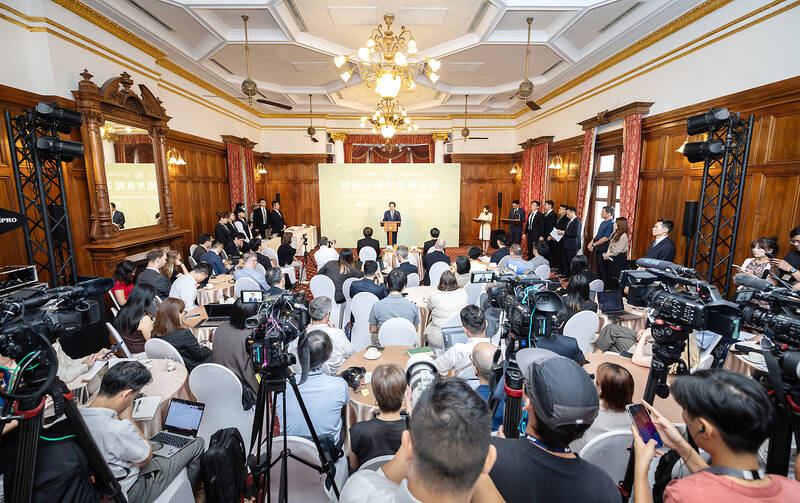
Photo courtesy of the Presidential Office
The expelled reporter, Wang, had no role in either the interview or the forum, and Beijing’s message to the international media was clear: if you platform Lai, whom Beijing characterizes as a “Taiwan independence separatist” and a “troublemaker,” we’ll punish you.
Though Wang’s expulsion happened in February, the story didn’t break in the mainstream media until a New York Times report of May 29. The newspaper described the incident as “the latest example of a crackdown by Beijing on foreign correspondents whose reporting challenges the official line of President Xi Jinping’s (習近平) authoritarian government.
On June 1, two days after the Times’ story, Lai’s office issued a statement.
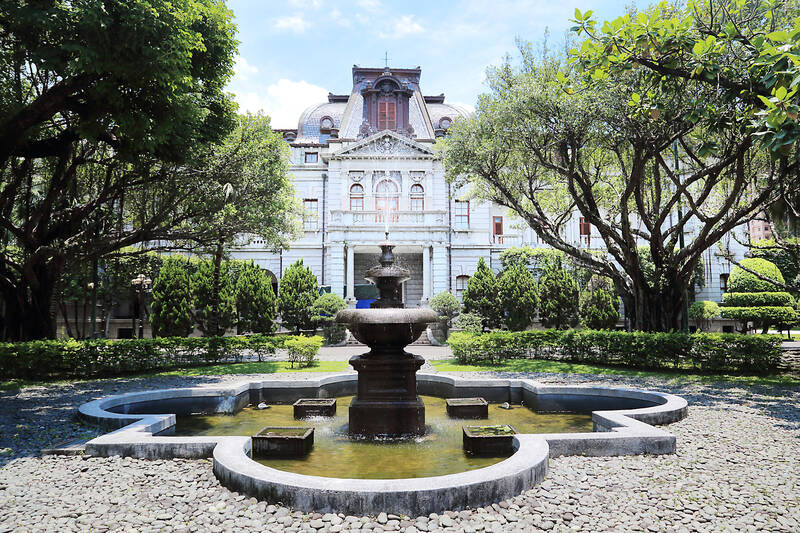
Photo: David Frazier
“China’s use of baseless pretexts and brutal methods to threaten the media and interfere with press freedom not only fails to improve its international image, but also highlights that China is currently a source of instability and a troublemaker,” the statement read.
Around the same time, Lai’s responded to a standing invitation from the TFCC, saying it wanted to organize a special briefing for the international press, according to the club’s officers.
David Demes, TFCC’s Vice Chair and a German freelance reporter, said the event’s planning took about two weeks, though due to complicated planning, club members were only given two days advance notice.
“President Lai does give regular media briefings and foreign journalists are welcome to attend those, but the last time an event happened specially for the foreign press was in 2015,” Demes said.
The press conference, held Thursday morning at 10am at Taipei Guest House, a Japanese colonial-era mansion, accommodated between 40 and 50 international media, including journalists from the New York Times, Washington Post, Economist, Wall Street Journal, Reuters, the Guardian, Nikkei, Asahi Shimbun, Kyodo News, Agence France Press, CNN, the BBC, Sweden’s largest newspaper Expressen and other media from Germany and Spain.
Lai addressed the group from a podium in a stately wood-paneled room with Corinthian columns, gold-leaf encased moldings and Art Deco chandeliers.
CHINA’S PRESS CRACKDOWN
As evident in the pre-event chatter, the room had already speculated on the possibility that Lai was using this event as an answer to Beijing’s press crackdown.
In the Q&A, one reporter directly posed the question of Lai. Referencing the New York Times report and Beijing’s promise to punish media for speaking to him, he asked, “In this situation, what is your response? Today’s press conference with the international media is actually an extremely rare event. Might we be able to consider this as your reply?”
Lai answered, “I know that everyone here, whether you’ve worked in mainland China in the past, or are now in Taiwan, you must have experienced pressure from China, or even coercion or repression across borders.”
“This is why I admire you all,” Lai continued. “Because under pressure, you are still willing to uphold your professionalism in your reporting on Taiwan.”
Despite Lai’s recent expressions of appreciation, Taiwan’s foreign press corps has been expanding for a decade or more. The TFCC says its membership has tripled in the past decade, with the number of correspondent members more than doubling in the past five years. This growth is in part thanks to Beijing, which got much stricter with foreign journalists after Xi became the nation’s leader in 2012. And, in the eyes of many in Taiwan, this has brought improvements to the way Taiwan’s narrative is understood internationally.
According to Michael Turton, an academic who began blogging about international media presentations of Taiwan in 2005 and is now a Taipei Times columnist, a major shift in reporting started from around 2017. Before that time, Taiwan was “covered largely from Beijing and Hong Kong,” he said.
Correspondents would fly in to Taipei only for elections and other major stories, but relatively few of them were based here or developed a good on-the-ground understanding.
As a result, the language used to report on Taiwan was full of tropes that mirrored those of China’s state media — like that Taiwan was a “renegade province” or “breakaway province” of China, or that those who advocated for Taiwan’s national sovereignty were “separatists” or “secessionists.”
The migration of journalists from Beijing to Taipei accelerated around 2020 thanks both to COVID and a new wave of punitive journalist expulsions by China. Within a very short time, TFCC membership ballooned, according to Demes and other club officers.
“While some of those correspondents have since moved on, overall, those developments led to a lasting expansion of the foreign media community based in Taiwan,” Demes said.
Chris Horton, an American journalist based in Taiwan since 2015 and former TFCC vice president, refers to this influx as “the 2020 crowd.”
“[Twenty-twenty] was a big year. China was kicking out journalists and not admitting new journalists. So there were journalists who wanted to cover China and Taiwan was the closest they could get,” he said.
Before coming to Taiwan, Horton cut his teeth as a writer in China, where he lived for 13 years from 2000 to 2013. After moving to Taiwan, he said, “I realized how overlooked Taiwan’s story had been and how much it had been obscured in China’s shadow.”
Turton also noticed changes coming in step with Taiwan’s press corps expansion.
“Not only has the coverage been more cognizant of Taiwan’s many nuances, but a greater variety of topics have been covered,” he said.
ACCESS
Though Thursday’s briefing was Lai’s first direct encounter with Taiwan’s foreign press, Demes described the administration’s attitude towards the TFCC as “extremely open.” In recent months, the club has hosted briefings with a number of key members of Lai’s cabinet, including heads of the Ministry of Foreign Affairs, the Ministry of the Interior and the Coast Guard.
Other club members noted that this level of access is much greater than that during the administration of President Tsai Ying-wen (蔡英文), who did not hold a briefing with Taiwan’s foreign press during her eight year tenure from 2016 to 2024.
To begin Thursday morning’s press briefing, Lai opened with a 10 minute-prepared speech in Mandarin, delivered without notes or a teleprompter. “One got the feeling he’d really prepared for this,” commented one journalist.
Lai then opened the floor to questions. Many of these were predictable, addressing US arms purchases, Taiwan-Japan relations and China’s “gray zone” tactics. As he replied with standard boilerplate statements, he referred to notes on the table in front of him.
Yet on other questions, including one about an impasse in Taiwan’s domestic politics, Lai looked out at the room and spoke off the cuff. Though the Q&A was scheduled for 30 minutes, when press secretary Karen Kuo (郭雅慧) called “last question,” Lai interjected, “We can go a little longer. This is a rare opportunity.”
When the Q&A finally finished, Lai announced, “Next, can we talk about something more relaxed. Like, how is your life in Taiwan? Is there anything we need to improve?”
Though Lai can appear very wooden on camera, in person he is an able orator, if not a spectacular one, and he comes across as extremely genuine. If anything, he is earnest to a fault.
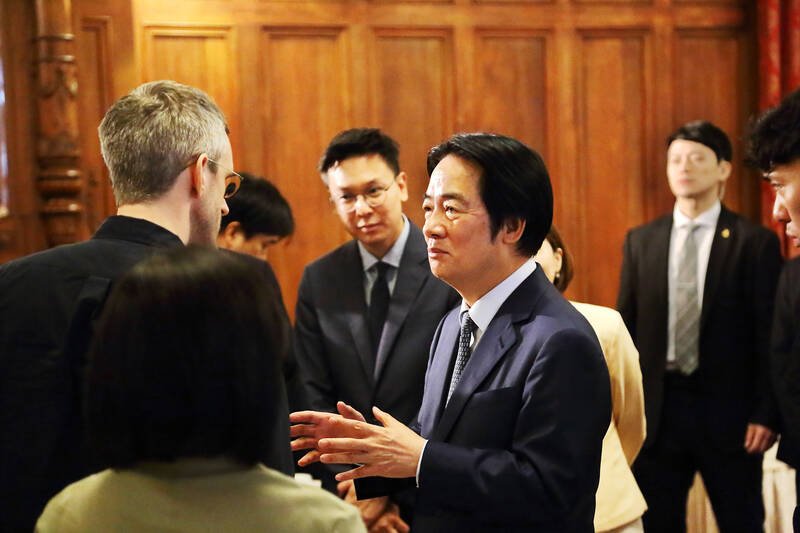
After Lai finished speaking, he walked into the press pool to shake hands with all who’d come to attend. Speaking in English and Chinese, he was jovial, asking people where they were from and, with one Spanish journalist, chatting about the World Cup.
But earlier on when Lai had been speaking, he had already told us what point he was trying to make today: “This is the main point, how Taiwan is different from China. We have and respect press freedom. Taiwan will continue to safeguard the freedom of the press whether it be for international media or domestic media. We will continue to stand together with our media professionals.”