This weekend marks the 130th anniversary of the four-day campaign in which Japanese troops indiscriminately attacked at least 55 villages and allegedly killed thousands during a crackdown on local resistance
-
By Han Cheung / Contributing reporter
June 22 to June 28
“There are no good civilians within Yunlin’s jurisdiction,” declared Yunlin subprefecture head Yunoshin Matsumura before launching a bloody suppression campaign.
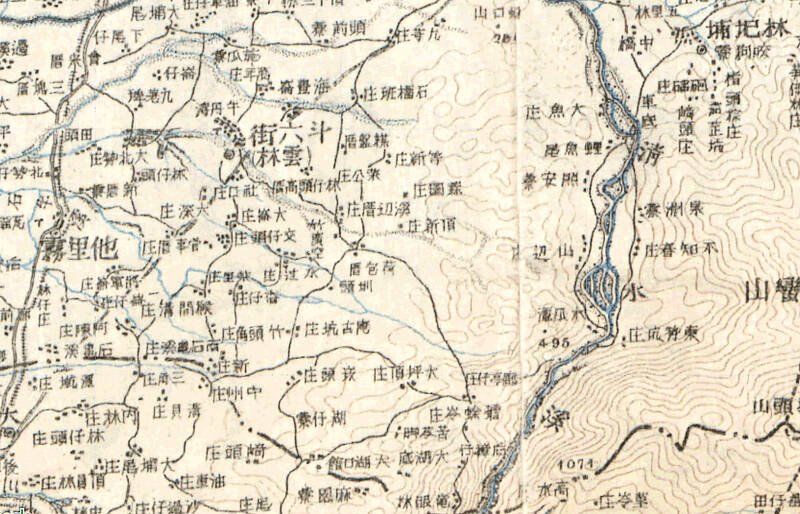
Between June 19 and June 22, 1896, thousands of unarmed villagers were killed. Official reports recorded 4,947 houses burnt down in 55 settlements spanning today’s Douliu (斗六), Dounan (斗南), Gukeng (古坑), Tapi (大埤), Cihtong (莿桐), Linnei (林內) townships, as well as Jhushan (竹山) in Nantou County.
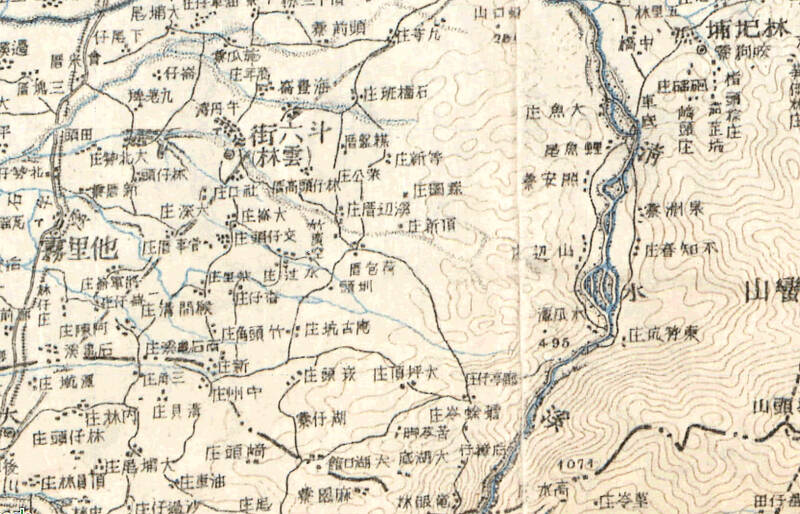
Photo courtesy of Center for GIS, Academia Sinica
Angukeng Village (庵古坑), located near the resistance’s mountain headquarters, suffered the heaviest destruction, with 505 households affected.
Even Japanese accounts noted the brutality: “Wherever the campaign reached, everything became a mountain of flesh and a river of blood. No distinction was made between civilians or bandits, nor between the innocent and guilty. Thousands of houses were burned to the ground, and countless lives became the wronged souls upon the execution platform,” wrote Yunlin subprefecture chief clerk Heizou Imamura in his diary.
The atrocities drew immediate international attention. On July 4, the China Mail reported that the campaign aimed to wipe out the rebels, but “failing to catch them they burned down dozens of villages and butchered the inoffensive inhabitants.” Similar articles continued appearing in English newspapers around the world, including The Times.
Photo courtesy of Taiwan Cultural Memory Bank
Under international pressure, compensation was granted to affected villagers under the name of Emperor Mutsuhito and Empress Haruko, while Matsumura was dismissed and stripped of his honors. But instead of deterring the resistance, the massacre drew more people into the movement.
MOUNTAIN GUERRILLAS
After landing in Keelung on May 29, 1895, Japanese forces advanced southward, pushing through Yunlin in October before capturing Tainan later that month and declaring Taiwan “pacified.”
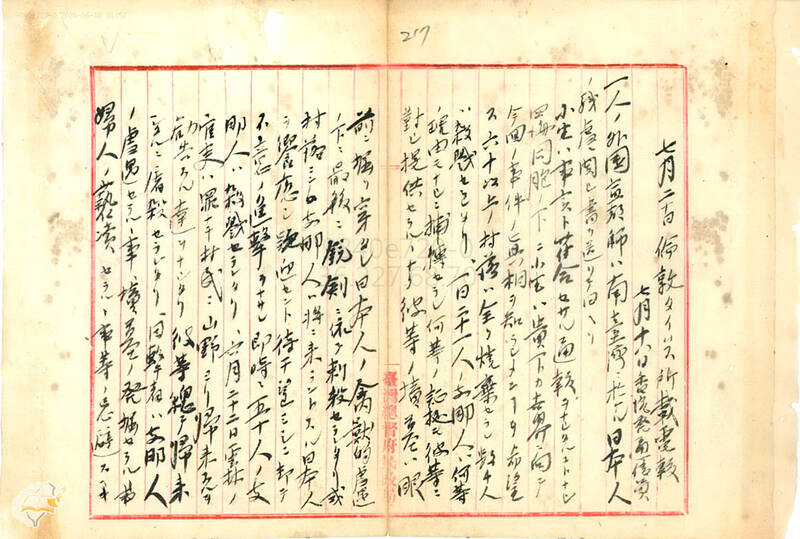
Photo courtesy of Taiwan Historica
However, much of Indigenous territory remained beyond colonial control, while armed resistance among the Han Taiwanese continued. Historian Chang Su-bin (張素玢) writes that the largest resistance movement in central Taiwan was centered around Gukeng, where the rugged and complex terrain provided shelter for bandits during the Qing Dynasty.
The Japanese also labeled the rebels “bandits,” who made use of the landscape to carry out guerrilla warfare. Their main base was on Dapingding (大坪頂), a ridge of about 400 to 450 meters in elevation, situated on the watershed between two streams.
The leader was Chien Yi (簡義), a Gukeng local who had earlier helped the Republic of Formosa resist Japanese troops in Changhua. Another key figure was Ko Tie (柯鐵), who also grew up in these hills and continued the fight after Chien surrendered in October 1896. They maintained contact with resistance groups on the plains and coordinated night raids.
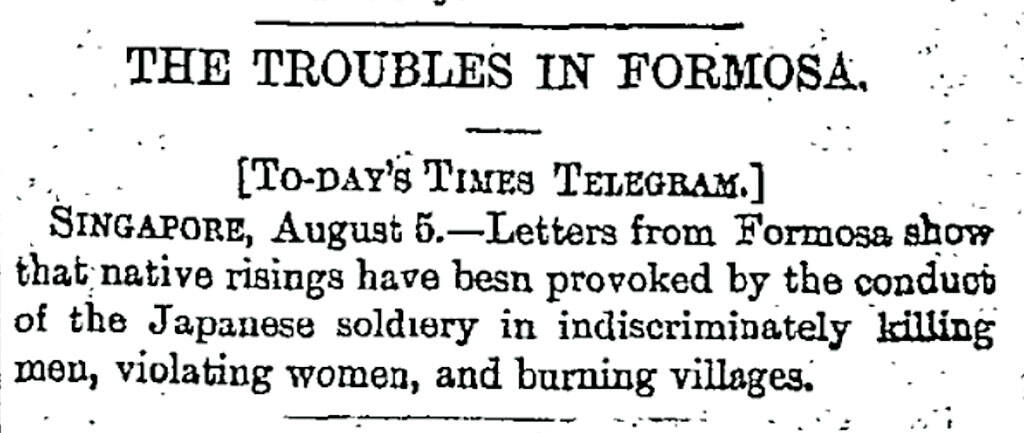
Photo courtesy of The British Newspaper Archive
In January 1896, a Japanese scout party was ambushed in Dapingding, prompting the authorities to station troops in the nearby subprefecture seat of Douliu, Chang writes.
EMBOLDENED REBELS
On June 13, a Japanese-owned store was robbed in the middle of the night, with the perpetrators firing several shots at the subprefecture office before retreating. In response, Matsumura led a sweep of the town and arrested over 20 suspects, learning the location of the rebel base. He immediately sent troops toward Dapingding the next day, but the unit suffered heavy losses, with Lieutenant Nakamura committing suicide after being wounded.
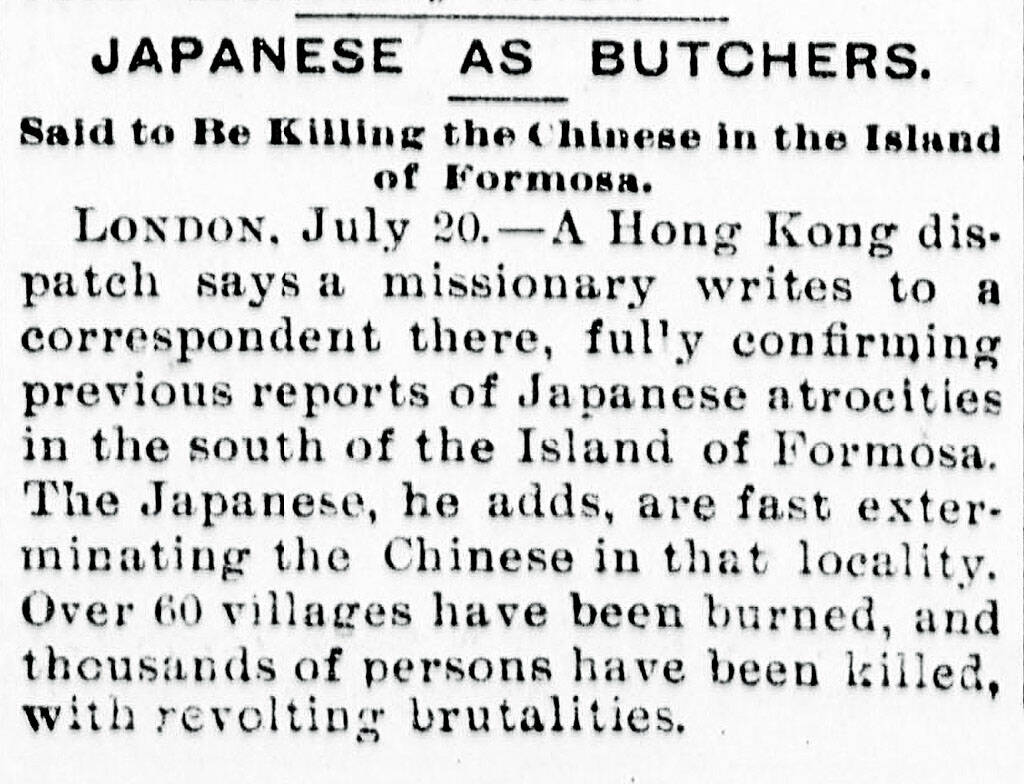
Photo courtesy of University of Nebraska-Lincoln Libraries
Matsumura was so enraged that his “hair seemed to stand on end and his eyes were bloodshot,” Imamura’s diary stated, as he repeatedly called for revenge.
He ordered regional forces to gather in Douliu and launched another attack on Dapingding on June 17. During the clash, another Lieutenant Nakamura was captured, tortured to death and hanged at the foot of the mountain as a warning. On June 18, Major Tsunemasa Sato’s party was caught in a pincer attack in a narrow gorge.
Emboldened by the victory, Ko and his followers declared the establishment of Tieguoshan (鐵國山, “Iron Country Mountain”) under Chien’s leadership, naming the year “Tienyun Year One.” Ko proclaimed himself Generalissimo of Tieguoshan.
Chang writes that this series of events provoking the Japanese caused the campaign to spiral out of control, as they adopted increasingly severe measures.
Retreating from Dapingding, the troops torched residences along the way to Angukeng, about 4km away. Fearing for their lives, villagers offered fresh pork and wine in an attempt to appease the soldiers, but instead were slaughtered and their houses burned. Nearby settlements suffered the same fate, and survivors of all ages fled to Dapingding, vowing revenge.
KILLINGS AND AFTERMATH
Matsumura announced a reward for turning in any “bandit,” personally joining the operation led by Sato. For the next four days, they assaulted villages mostly east and south of Douliu, carrying out widespread sexual violence, looting and killing.
As a result, resistance ranks swelled and Tieguoshan struck back, capturing Douliu and reaching as far as Taichung and Puli. Matsumura and Sato fled, and it took another brigade to drive the rebels back into the mountains in Yunlin by July 25 — this time under strict orders not to kill anyone who was unarmed. The two sides would continue to clash for years.
Not only did foreign residents who witnessed the earlier atrocities bring them to the attention of the international press, even Japanese officials considered the actions excessive. Takenori Takano, chief justice of Taiwan’s high court, wrote to then-prime minister Masayoshi Matsukata, his version describing a six-day campaign in which more than 300 unarmed people were killed across over 70 villages. Many women were raped first, and in one instance, Takano alleged that troops gathered 67 villagers and mowed them down with gunfire.
Although authorities claimed that the foreign news coverage was exaggerated, they took them seriously, with the governor-general’s office compiling every article in a dossier. On Aug. 28, they sent a report to the Ministry of Colonial Affairs, noting that Matsumura’s actions were not only inappropriate, but had exacerbated the situation and fueled anti-Japanese sentiment.
Matsumura was stripped of his rank and decorations and sent back to Japan — the first colonial official in Taiwan to be dismissed. However, the following March, his rank was restored and he was appointed a subprefecture head in Hokkaido, writes Chen Wen-tien (陳文添) in a Taiwan Historica article.
Sato and another officer were court-martialed and sentenced to 12 years in prison, although some accounts suggest that they were punished primarily for retreating without a fight.
A final tragedy occurred in May 1902. The remaining rebels finally agreed to submit to the authorities, but were shot and killed during the surrender ceremony. Unlike the Yunlin Massacre, there appears to have been no repercussions for this incident.
Taiwan in Time, a column about Taiwan’s history that is published every Sunday, spotlights important or interesting events around the nation that either have anniversaries this week or are tied to current events.