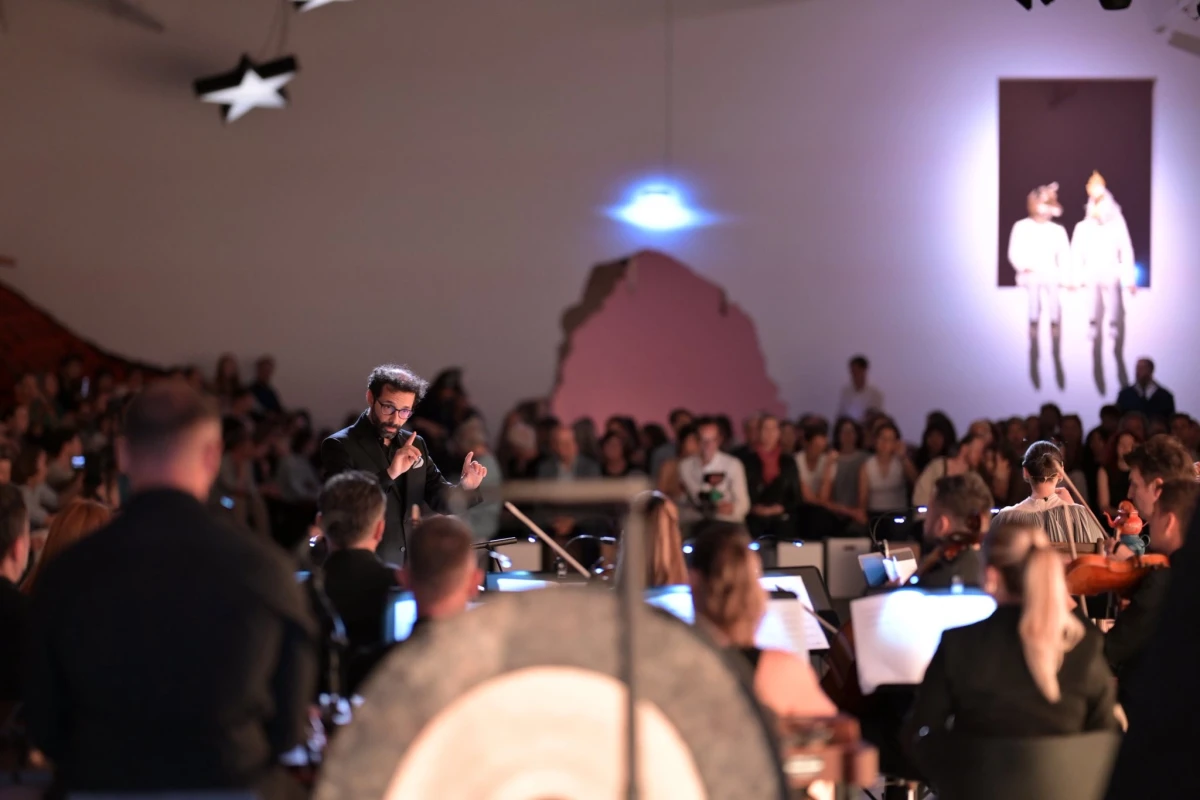
In the iconic spaces of “Hamburger Bahnhof”, an ensemble of the Kosovo Philharmonic and the artists involved have brought to the international audience the interpretation of the opera of the world-renowned artist, turning the work into an experience that combines music, theater and artistic installation. The concert version in Berlin also marks the closing of Petri Halilaj’s exhibition, which since its opening has focused on his first opera, built on myths, stories from the places where he spent his childhood and collective memory
The legends, myths and fables of the artist Petrit Halilaj in the contemporary opera “Syrigana” have unfolded the story even in the German capital, where it was performed in a concert version. In “Hamburger Bahnhof”, one of the most important institutions of contemporary art in Europe, the interpretation was given as part of the exhibition “An Opera Out of Time”, which constitutes the museum version of the opera “Syrigana” and at the same time the central chapter of Halilaj’s personal exhibition in this prestigious institution.
In the iconic spaces of “Hamburger Bahnhof”, an ensemble of the Kosovo Philharmonic and the artists involved have brought to the international audience the interpretation of the opera of the world-renowned artist, turning the work into an experience that combines music, theater and artistic installation. The concert version in Berlin also marks the closing of Halilaj’s exhibition, which since its opening has focused on his first opera, built on myths, stories from the places where he spent his childhood and collective memory.
The acting director of the Kosovo Philharmonic, Dardan Selimaj, has said that the return to Berlin is an important moment in the work’s journey.
“We are very happy that a project that started last year is being successfully completed. The premiere of ‘Syrigane’ was given in June of last year, while now we are returning to Berlin to mark the closing of Petri Halilaj’s exhibition, of which this work is also an integral part”, said Selimaj in an answer to KOHEN.
The contemporary opera “Syrigana” was premiered on June 29 of last year in Syrigana of Skenderaj and is based on the legends of that area, that Adam and Eve stopped there until they went around the globe looking for people, who managed to meet them only when they arrived in Runik of Skenderaj. The line of the legend leads to the hill of Syrigana – the neighboring village of Runik – where the local inhabitants would marry Adam and Eve. The pair get married in Syrigana, not through legend, but in an operatic play.
In this musical project, the content with biblical references is the dialogue with the libretto, which contrasts with the singing of two sopranos: Urta Haziraj and Nina Guo. Unlike the premiere in Syrigana when the Orchestra was conducted by Gregory Charette, in Berlin it was conducted by Marco Crispo, the second conductor with whom the Philharmonia often works recently.
However, the deputy director of the Kosovo Philharmonic, Dardan Selimaj, has informed that the musical concept has not changed, but changes have been made in the visual aspect.
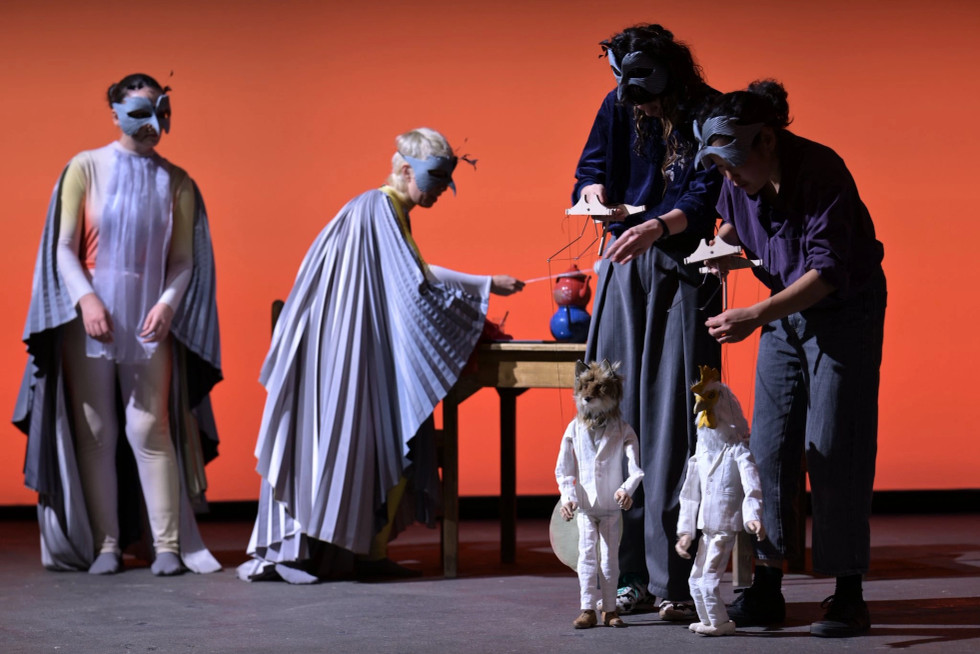
“The artistic concept has remained faithful to the vision presented at the premiere, preserving its aesthetic and dramaturgical integrity. However, some adaptations have been made, especially in the visual aspect, to respond to the specifics of the Hamburger Bahnhof space. The creation of puppets and all the scenic elements has been very successful and I consider that all the components of the work have worked in harmony with each other”, said Selimaj.
He said that the work already has the potential to continue its international journey.
“The four performances in Berlin constitute an important conclusion of what we can call the first life cycle of ‘Syrigana’. I believe that the work has already acquired its artistic identity and has the potential to continue its journey in other scenes in the future”, he considered.
Even the Acting Minister of Culture, Saranda Bogujevci, has described the presentation in Berlin as a proof of the power of local art to penetrate the most important international scenes.
“After the first presentation last summer in Syrigana, tonight the opera took a new form in Berlin, transforming the exhibition space into a special experience between music, installation and theater. Through his unique artistic language, Petrit Halilaj continues to build bridges between our collective memory and the most important international scenes, turning experience and imagination into art that transcends borders,” wrote Bogujevci, who was present at event.
The story of “Syrigana” begins with Adam and Eve artistically brought in the costumes of the rooster and the fox, which unravel love and strength. The central drama focuses on the expulsion from the Garden of Eden after they taste the forbidden fruit. In search of a place where their love can flourish, they decide to stay in Syrigana, where they get married to local popular songs from the group “Don’t listen to your neighbours”.
At the premiere, it was announced that the props for this exhibition would be reconstructed in “Hamburger Bahnhof” as an installation created specifically for the space where it was presented. The exhibition closed on Sunday.
“Hamburger Bahnhof” is one of the most important contemporary art museums in Germany. Housed in a historic former Berlin railway station, the institution has become an important center for exhibitions, installations and multidisciplinary projects by internationally influential artists. Halilaj’s exhibition there is billed as his first major institutional exhibition in Berlin and includes installations, sculptures and narratives dealing with war, exile, identity and cultural freedom.
At the end of April in Berlin, Halilaj revealed another story. In the first reading it is “Chajtore”. “Gaytore” has also intervened. Inside is a miniature Kosovo. The title of the exhibition is complex: “To whom does the earth belong while the wind is painted?” The story of its origin, as well: When he was preparing for the opera “Syrigana” in Drenica, a container of props was set on fire. The signs of Serbian nationalism were left in it. Petrit Halilaj remained silent until the end of April. He turned the burnt container into a work of art, gave it another life by denouncing the crime, but giving it another meaning. It proved the impotence of nationalism to destroy its paradise – Kosovo. There are also works that his mother buried during the war. But the “Teahouse” in Berlin is not only his story.
“A large part of the ‘Garden of Eden’ set was destroyed by fire, from the sculptural flowers and pear trees, to the ocarinas and props such as helicopters and carpets,” the Berlin exhibition said in a statement. The pears are now in the exhibition as a link to Dardania, the Kosovo of antiquity. The large pieces of the container scattered for visual effect are also accompanied by black birds with a lot of symbolism. The pear comes as the etymology of Dardania and elaboration of historical narratives, folklore and popular beliefs. The exhibition also contains many other works with dozens of symbols.
“In that container were parts of a paradise we were building: pears, flowers, elements of the stage, traces of a collective dream. After burning, there were also messages of hate written in spray paint, among them ‘kill you’ and the sign related to the four Cs/Serbian cross, which is often interpreted through the phrase ‘Samo sloga Srbina savga’ – ‘Only unity saves the Serbs’. This symbol is part of heraldry and the Serbian national identity, but in the context of the wars of the 1990s and the violence in the areas of former Yugoslavia, it was often used as a nationalist and threatening sign”, said Halilaj. He explained that when such a sign appears on a burning container in Drenica, along with the words “kill you”, it cannot be read as just a decoration or a coincidence. According to him, it becomes part of a longer history of fear, hatred and attempts to stop the culture.
Beyond that, the opera “Syrigana” questions the survival of love between Eve and Adam from the source in Syrigana, for Syrigana, the narrative has already begun to fly on the international stage. Just as Halilaj manages to take the works inspired by his hometown to the most prestigious artistic spaces.