
Photo courtesy of the press service of the Council of the Republic of the National Assembly of Belarus
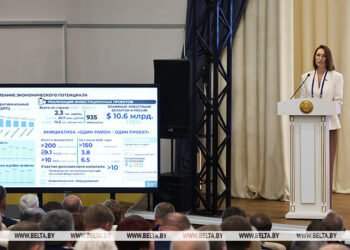
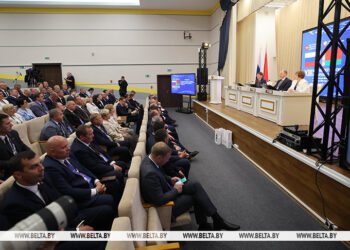
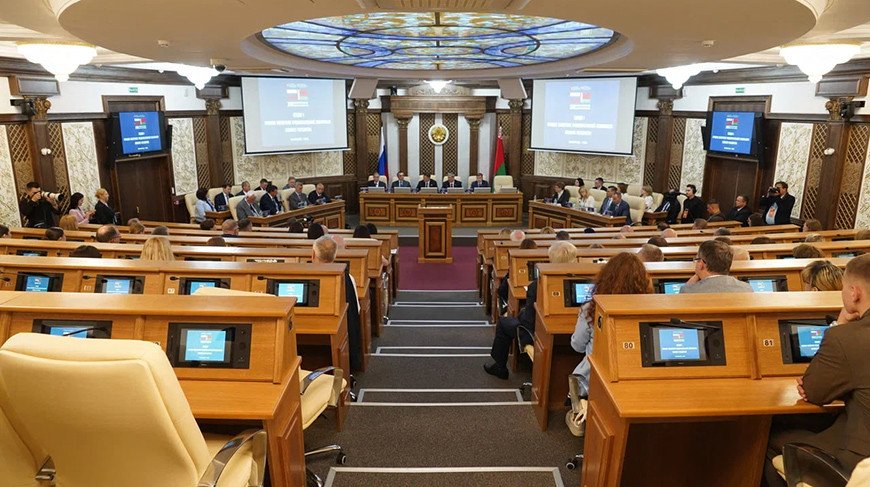
MINSK, 25 June (BelTA) – The synchronization of laws of the Union State of Belarus and Russia allows the two countries to act as a powerful and independent player on the global food market. Chairwoman of the Legislation Commission of the House of Representatives of the National Assembly of the Republic of Belarus Marina Lenchevskaya made the statement during the panel session “Legal support for food security of the Union State” at the 13th Forum of Regions of Belarus and Russia in Minsk, BelTA has learned.
“Legal provision of food security of the Union State is not a static set of laws. This is a living, dynamically developing mechanism,” Marina Lenchevskaya noted. The MP added that the synchronization of efforts at the legislative level allows the two countries not just to produce high-quality products for their populations but also to act as a single, powerful and independent player on the global food market.
The chairwoman of the Legislation Commission of the House of Representatives emphasized that today food security is not just the development of agriculture, it is the foundation of state and technological sovereignty. “The last few years have shown that global food markets are subject to serious risk. In this context cooperation between Belarus and Russia within the framework of the Union State becomes of particular importance. In other words, our countries face a strategic task of guaranteeing the complete independence of our food market,” she stated.
The formation of a harmonized legal space within the framework of the Union State acts as the most important tool for accomplishing this task. “The legal architecture of our food security is built on two key levels: the union one and the national one,” Marina Lenchevskaya pointed out. “An updated Security Concept of the Union State has been approved. This strategic document directly defines the protection of the agribusiness sector as an element of common legislative sovereignty.”
She added that at national levels this system relies on the doctrine of national food security of Belarus for the period till 2030 and the food security doctrine of Russia. “These documents do not contradict but harmoniously complement each other, defining the threshold value of self-sufficiency and standards of the quality of life of our citizens,” Marina Lenchevskaya stated.
The MP emphasized: “The basis of integration today is the implementation of joint Union State programs and approved planned activities. In practice this is the unification of technical regulation. We consistently eliminate barriers in mutual trade, harmonize veterinary, sanitary and phytosanitary standards. Our priority is the mutual and unconditional recognition of test results and quality certificates.”
“The alignment of legislation allows us to clearly forecast production volumes, avoid deficits and eliminate unfair competition between Belarusian and Russian manufacturers,” Marina Lenchevskaya noted.
In her words, legal provision has reached a new, deeper level. It is not enough to simply grow products, it is also necessary to protect the critically important elements of the manufacturing process. This is why the focus shifts to the legislative regulation of selection, breeding and genetics. “We are creating a common legal framework for the operation of joint digital platforms such as a breeding aggregator – a digital platform for large-scale cattle selection,” Marina Lenchevskaya said. “Law must stimulate. Scientific institutes of the two countries work in synergy to completely replace imported technologies, seeds and veterinary drugs with domestic counterparts.”