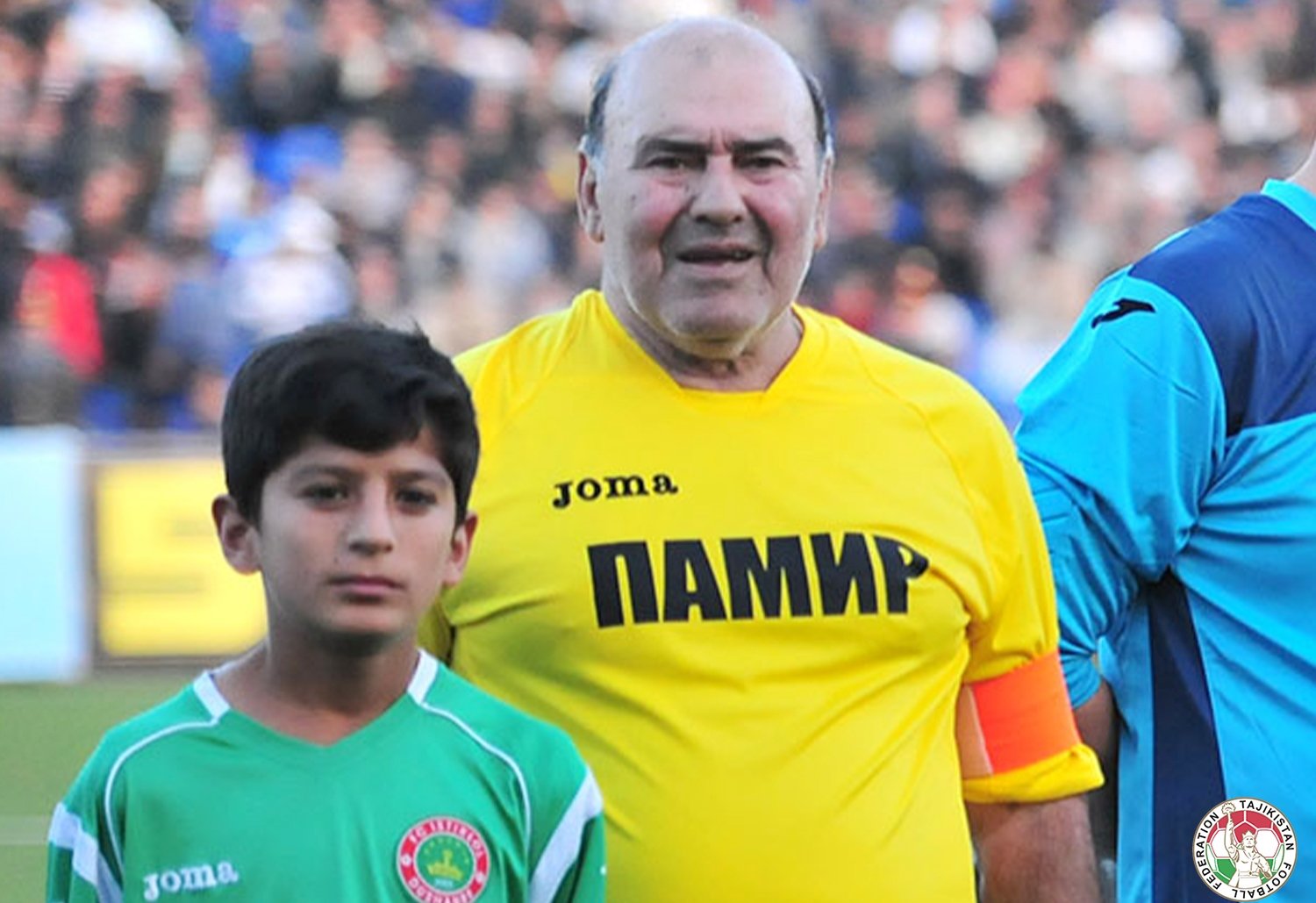
On June 15, at the age of 81, one of the most outstanding football players in the history of Tajikistan, Vladimir Alekseevich (Alishoevich) Gulyamkhaidarov, died in Moscow. His name is forever inscribed in the annals of not only Tajik, but also all Soviet football.
For several generations of fans, he was the personification of “Pamir”, a man who connected different eras – from Soviet football to the formation of the national team of independent Tajikistan.
From the courtyards of Dushanbe to the USSR Olympic team
Gulyamkhaidarov was born on February 26, 1946 in Dushanbe (then Stalinabad) in a family where different destinies and cultures were intertwined. His father, a participant in the Great Patriotic War, served in the Ministry of Internal Affairs, and his mother worked in medicine. Vladimir himself chose football from childhood – already at the age of 10 he was playing in the section at the Spartak stadium, and at 18 he made his debut for the Dushanbe Energetik.
It was here that his great career began. Already in the late 1960s, he became one of the strongest players in the republic, and in 1968 he received an invitation to the USSR Olympic team. In two years as a member of the team, he played eight matches and scored three goals – a unique achievement for a graduate of Tajik football at that time.

Moscow stage and return home
In 1969-1970, Gulyamkhaidarov played for Moscow Torpedo in the top league of the USSR championship. He played alongside legends of Soviet football, including Eduard Streltsov and Igor Netto. This period became an important part of his career – not only sports, but also life.
However, Pamir always remained his true club. Returning to Dushanbe, he became one of the key figures in the team. Fans remember him as a technical, intelligent and effective striker who knew how to solve situations, take penalties and play the game.
He was not just a football player – he was a leader. Gulyamkhaydarov became the author of the first hat-trick in the history of Pamir, dFor many years he was the team’s regular penalty taker and a symbol of its attacking style.

“I’m ready to do anything for the sake of football”
His character is best revealed by a story that has become almost a legend. In the mid-1960s, the coach of Dynamo Minsk, Alexander Sevidov, wanted to invite him. To get around transfer restrictions, an unconventional solution was invented – an operation to remove appendicitis, which was supposed to be a formal reason to stay in the team.
“I was taken to the hospital and had surgery. Sevidov hoped to resolve the issue with the transition during this time. It didn’t work out, but he realized that I was a person who was ready to do anything for the sake of football – to play without money and to go under the knife,” Gulyamkhaidarov later recalled.
Such stories made him a special figure – a man for whom football was not just a profession, but the meaning of life.

A player with unique qualities
Despite his height of 173 cm, he played excellently with his head and won mounted single combats. He himself explained it simply: “The main thing is to choose the right position and jump out in time.” According to the recollections of his partners, he could reach the goal crossbar with his foot while jumping – an indicator of phenomenal coordination and physical fitness.
He was valued for his on-field intelligence, technique and ability to make split-second decisions. It is these players who shape the style of the team and become its face.

The coach who continued the work
Having completed his playing career, Gulyamkhaidarov did not leave football. In 1978, he began coaching, graduated from the Higher School of Coaches and soon headed Pamir. He later worked with Vakhsh, the Tajikistan national team (in 1994), and then continued his career in Kazakhstan, where he coached Kairat, Taraz, Zhetysu, Megasport, Lokomotiv (Astana) and Sunkar.
His experience and knowledge helped the development of football far beyond the borders of Tajikistan. He was not just a coach – a mentor who molded players and teams.
Man of the era
Gulyamkhaydarov was a bridge between generations. He discovered Soviet football, played with its legends, and then passed on knowledge to new generations in the independent countries of Central Asia. He was a master of sports of the USSR, an honored coach of Tajikistan and a man who was respected in football circles far beyond the borders of his homeland.
With his departure, Tajik football has lost one of its key figures – a man who stood at the origins of its development and remained part of its history for decades.