As the Senate Legal and Constitutional Affairs References Committee prepares to report tomorrow, Australia’s latest Nauru arrangement should be terminated because it deflects obligations to refugees and leaves stateless people facing prolonged legal limbo without durable protection.
The Australian Government should terminate its latest arrangement with the Republic of Nauru, which deflects Australia’s obligations to refugees under international law and will have real and significant consequences for stateless people in need of protection.
The ‘offshore processing and resettlement arrangements’ are currently under investigation by the Senate Legal and Constitutional Affairs References Committee which will report on Wednesday 17 June.
Statelessness in Australia
To be stateless means that a person is not recognised as legally belonging to any country. Stateless people have no nationality, meaning they can struggle to access even the most basic human rights many of us take for granted such as access to education, healthcare and employment.
The most recent UNHCR Global Trends Report identified 7,503 stateless people in Australia but the true number is likely to be considerably higher, with the first comprehensive study of statelessness in Australia to be published by the Peter McMullin Centre on Statelessness in the middle of this year.
Many stateless people in Australia are also refugees under domestic immigration law and are currently subject to (or have historically been subjected to) Australia’s ‘offshore processing’ and resettlement arrangements.
Australia’s policy of detaining asylum seekers offshore
Australia has been forcibly transferring people who arrive within its territory seeking asylum by boat to Nauru and Manus Island in Papua New Guinea since 2001, pausing the processing briefly in 2008 before resuming it again in 2012.
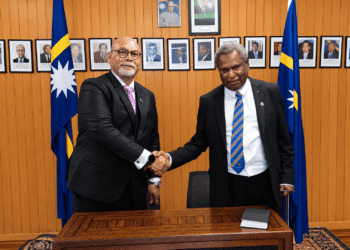
In August 2025 a Memorandum of Understanding (MOU) was signed between the Australian and Nauruan governments, establishing the terms of the latest iteration of the asylum seeker resettlement arrangement between the two countries. The MOU has not been made public, raising concerns about transparency and its compliance with Australia’s domestic and international human rights obligations. The Australian government has since revealed the transfer arrangement, worth $408 million in upfront costs, is forecast to cost Australian taxpayers an estimated $2.5 billion over the next 30 years.
Allegations of suspicious financial activity concerning Australian government payments by members of the Nauruan government indicative of ‘money laundering and corruption’ have been widely documented.
In November 2023 the High Court of Australia overturned almost two decades of legal precedent regarding the legality of indefinite immigration detention, ordering the immediate release of a stateless refugee, known as ‘NZYQ’, from detention where he had been held for more than five years.
The so called ‘NZYQ cohort;’ a group of 354 noncitizens (including stateless persons) had been placed into immigration detention after having their visas cancelled on ‘character grounds’ – some were convicted of crimes (and had already served their sentence) – but were unable to be returned to their countries of origin due to the risk of persecution by virtue of statelessness or because the identified countries refused to accept them.
Following the High Court decision they were released into the Australian community, creating a political ‘headache’ for the government keenly focused on controlling who comes to Australia, and who gets to stay.
The flaws in Australia’s migration system for stateless people
Australia lacks a distinct visa category for stateless people or pathway to permanent residency (something the Australian government could address relatively easily through a legislative instrument or regulation). This means that, with the government unable to return stateless members of the NZYQ cohort to immigration detention, there was simply no legal pathway for them to remain in Australia andAustralian government is not willing to create a new legal pathway (i.e. visa) for them. Instead, it fell back onto their previous practice of sending them to Nauru.
This is is particularly concerning given the complete absence of international or domestic legal protections for stateless people in Nauru. Nauru is not a signatory to either of the two key Statelessness Conventions or other relevant core human rights treaties.
In the absence of agreeing to binding international obligations specific to statelessness, there are no guaranteed safeguards in place for the recognition, protection or resolution of statelessness in Nauru. Stateless people transferred there are likely to face prolonged limbo concerning their legal status and their lack of access to identity documentation, and are therefore likely to be excluded from pathways to durable solutions including naturalisation.
Further, Nauruan President David Adeag has stated that the ‘long term goal’ for people removed to Nauru ‘remains the eventual repatriation of these individuals to their home countries’. Stateless people, by definition, have no ‘home country’ to return to, making this proposed repatriation unfeasible and dangerous.
Conclusion
While the exorbitantly expensive current arrangement remains in place, refugees – including stateless people – will be considered as mere collateral to the bigger economic and political motivations at play between the two nations.
Refugees and stateless people in the Australian government’s jurisdiction should instead be provided with permanent and durable pathways to naturalisation in Australia, with visas specifically designed for stateless persons.
A longer version of this article was published by Melbourne Asia Review_, Asia Institute, University of Melbourne._
The views expressed in this article may or may not reflect those of Pearls and Irritations.