In just a few months, the Iranian regime has turned teenagers and young protesters into an “internal enemy” that is dealt with by quick, secret and often tortuous “spicy” processes – while the world is preoccupied with war and airstrikes on Iran, in the background there is a silent but systematic slaughter of the generation that dared to question the authority of the Ayatollahs.
However, in Iran it is customary to hang young people, as evidenced by a case that happened before the American-Iranian war, which you can see at this link:
These very young people, often athletes and Olympians, are convicted in unfair trials and hanged in the squares of Iranian cities. On one side, the masses loyal to the new leader are cheering, while on the other, mothers and fathers of teenagers fall into despair, looking into the eyes of their beardless sons who are about to let out the last gasp before death.
According to estimates by human rights organizations, since the start of new protests at the end of 2025 and the attack by the US and Israel on Iran on February 28, the regime has executed at least two dozen political prisoners and protesters, while thousands of people – including children – have ended up behind bars, often without access to a lawyer and without any minimum guarantees of a fair trial.
Matin Mohammadi: a minor awaiting execution
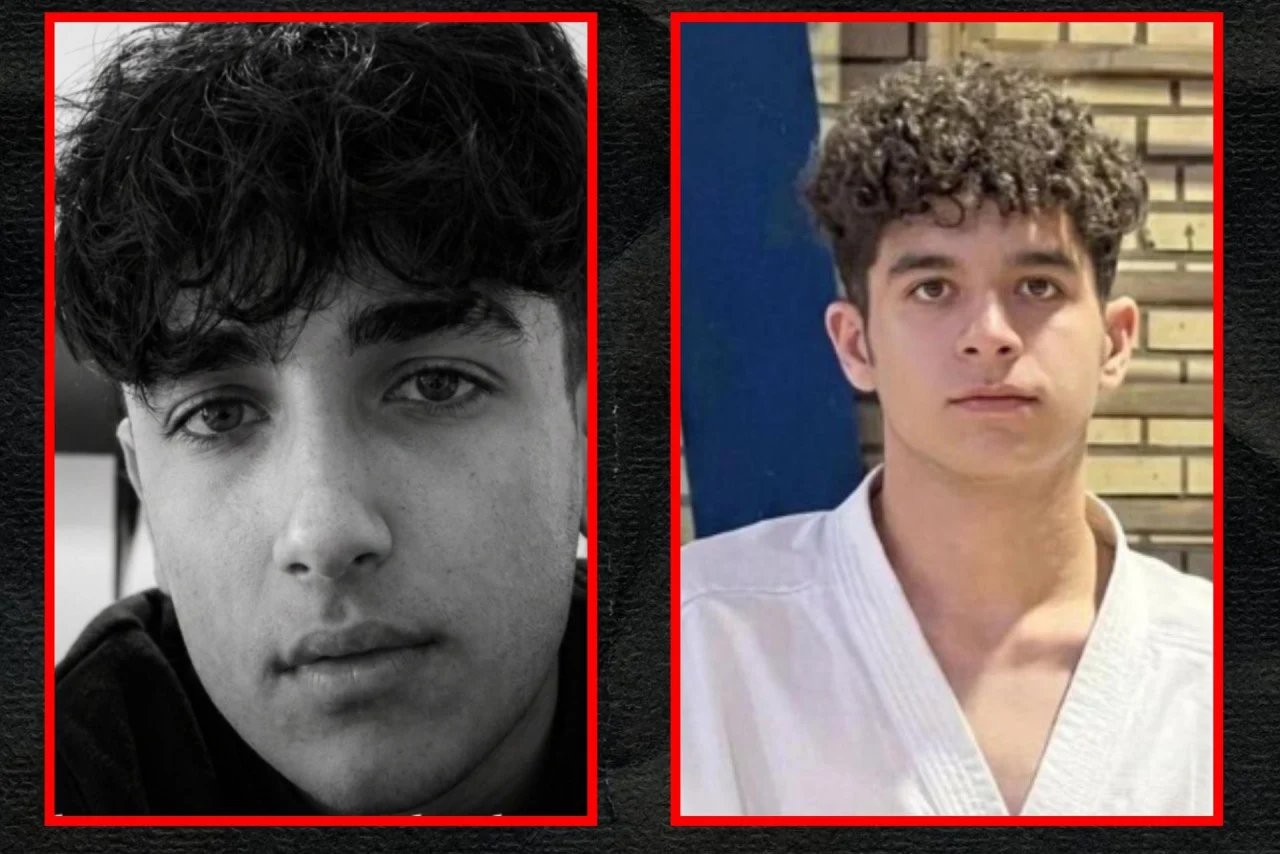
One of the most poignant faces of this wave of repression is 17-year-old Matin Mohammadi, a teenager whose face recently appeared on the cover of the British newspaper The Times, in a story titled “Tengineers on death row for daring to defy the Iranian regime“.
Matin was arrested in January 2026 during the anti-regime protests that engulfed Iran after the escalation of the war, and already on February 9 – less than a month after his arrest – he was sentenced to death. His family claims that the boy never had the opportunity to choose his own lawyer; the court-appointed defense attorney mainly helped the authorities put additional pressure on him to sign a “confession”.
Today, Matin is imprisoned in the notorious Ghezel Hesar prison, a complex known for overcrowding, chronic lack of water and food, and frequent executions. He is surrounded by convicted dealers and murderers, although he himself is still a minor protester who, according to legal analysis, is being tried in flagrant violation of international conventions that prohibit the application of the death penalty to persons who were children at the time of the alleged crime. Activists describe his trial as “hurried, contaminated by torture and grossly unfair”, based on forced confessions under pressure, while Iran’s Supreme Court upheld the verdict in late April, opening the way for a possible execution at any time.
Children under the gallows: at least three teenagers have already been executed
Matin is not an isolated case. According to data from Amnesty International and Iranian human rights organizations, at least three teenagers have already been executed after the new wave of protests, while a whole group of minor or newly adult protesters are on the death list. Among them is Saleh Mohammadi, an 18-year-old wrestler and member of the Iranian national team, who was hanged in Qom in March 2026 along with Mehdi Ghasemi and Saeed Davoudi, after they were convicted of murdering two policemen and “waging war against God” (moharebeh) – a charge routinely used in Iran against protesters and political dissidents.
Amnesty notes that Saleh Mohammadi stated in the verdict that his “confessions” were forced by torture, that the court refused him an independent medical examination despite the broken bones in his hands, and that he was tried in record time, ignoring all objections of the defense. In a separate case, another young protester, Amirhossein Hatami, also imprisoned in Ghezel Hesar, was secretly executed in April 2026, whose death – as Amnesty warns – was the result of a purely political decision, not any standard legal process.
Teenagers under threat of death: names the regime wants to erase
According to Amnesty International’s latest reports, at least 30 people are currently facing the death penalty for alleged offenses related to the January 2026 protests, including several minors. The cases of eight young people who were sentenced to death in February after extremely accelerated procedures are particularly noteworthy:
Saleh Mohammadi (18)
Mohammad Amin Biglari (19)
But Fahim
Abolfazl Salehi Siavashani
Amirhossein Hatami
Shahin Vahedparast Kolor
Shahab Zohdi
Yaser Rajaifar
In addition to them, Amnesty and Iran Human Rights warn of three teenagers whose death sentences have already been confirmed by the Supreme Court, and who were additionally highlighted in April by Iran Human Rights in a report on the “explosion of political executions”:
Ehsan Hosseinipour Hesarloo (18)
Matin Mohammadi (17)
Erfan Amiri (17)
According to the same sources, all three were convicted for their alleged involvement in the fire at the bases of the Basij paramilitary group on January 8, in which two members of the Basij were killed, and the proceedings were marked by violence, isolation and forced confessions from the beginning. One of the family members described to activists that their child “to date has not had access to a lawyer of his own choosing,” while the court-appointed lawyer “helped the authorities put even more pressure on the child to confess.”
“Factory of Death” Ghezel Hesar and the explosion of execution
The entire system is designed to physically and mentally break young protesters before they even get a chance to defend themselves. Ghezel Hesar, a vast prison complex on the outskirts of Tehran, has been described in reports as a “death factory”: overcrowded, with chronic shortages of food and drinking water, where executions are regularly carried out at dawn, often in groups. Today, almost all the mentioned young men are in the same prison – from Matin Mohammadi and Ehsan Hosseinipour to Mohammad Amin Biglari, Ali Fahim, Abolfazl Salehi Siavashani and Shahin Vahedparast. According to Amnesty, prosecutors have already announced that the four could be executed “one day at a time” in a series of executions, a scare tactic reminiscent of the darkest episodes in Iran’s history.
At the same time, Iran Human Rights reports that at least 22 political prisoners have been executed from March 17 to April 27, 2026, including ten protesters arrested during previous waves of demonstrations, while at least 44 protesters are currently at imminent risk of execution. Organizations warn that the real numbers may be higher, given that the regime is again restricting the internet and communications, making it difficult for families to have any insight into the fate of their missing sons and daughters.
The wave of murders that continues on Mahsu Amina
Today’s cases follow a pattern established after protests over the death of Mahsa Amini in 2022, when dozens of protesters were sentenced to death and several men were executed in swift trials that drew global condemnation. According to reviews compiled by BBC Persian and other media, names such as Mohsen Shekari, Majid Reza Rahnavard, Saleh Mirhashemi, Majid Kazemi and Saeed Yaghoobi – young men in their twenties who were hanged after short trials, often without real contact with their families and lawyers – became known to the public. Today’s juvenile and young convicts – Matin, Ehsan, Erfan, Saleh, Amirhossein – continue the blacklist of a generation that is on trial because it sought freedom and did not commit violence.
The goal: to intimidate an entire generation
Human rights organizations and research centers such as the Center for Human Rights in Iran warn that the executions of young protesters are not incidents, but a deliberate strategy of “state terror”. “The execution of young protesters after sham trials based on torture and forced confessions are state murder, designed to intimidate the population and send a clear message: any act of disobedience will be punished by death,” one of the statements said.
While international organizations, individual governments and UN experts call on Tehran to urgently abolish the death penalty for protesters and annul the verdicts against minors, the clock is ticking inexorably for Matin Mohammadi and his peers. Their names – Saleh Mohammadi, Amirhossein Hatami, Mohammad Amin Biglari, Ali Fahim, Abolfazl Salehi Siavashani, Shahin Vahedparast Kolor, Shahab Zohdi, Yaser Rajaifar, Ehsan Hosseinipour Hesarloo, Erfan Amiri and others – may never appear in official Iranian chronicles, but they will remain written in the reports of organizations that record every unjust verdict and every lost youth. For their families, the question is no longer just whether international pressure will stop the gallows, but whether the world will watch at all – or, preoccupied with geopolitical shocks and war, will it allow an entire generation to disappear into the silence of the prison yards of Ghezel Hesar and other Iranian death prisons.