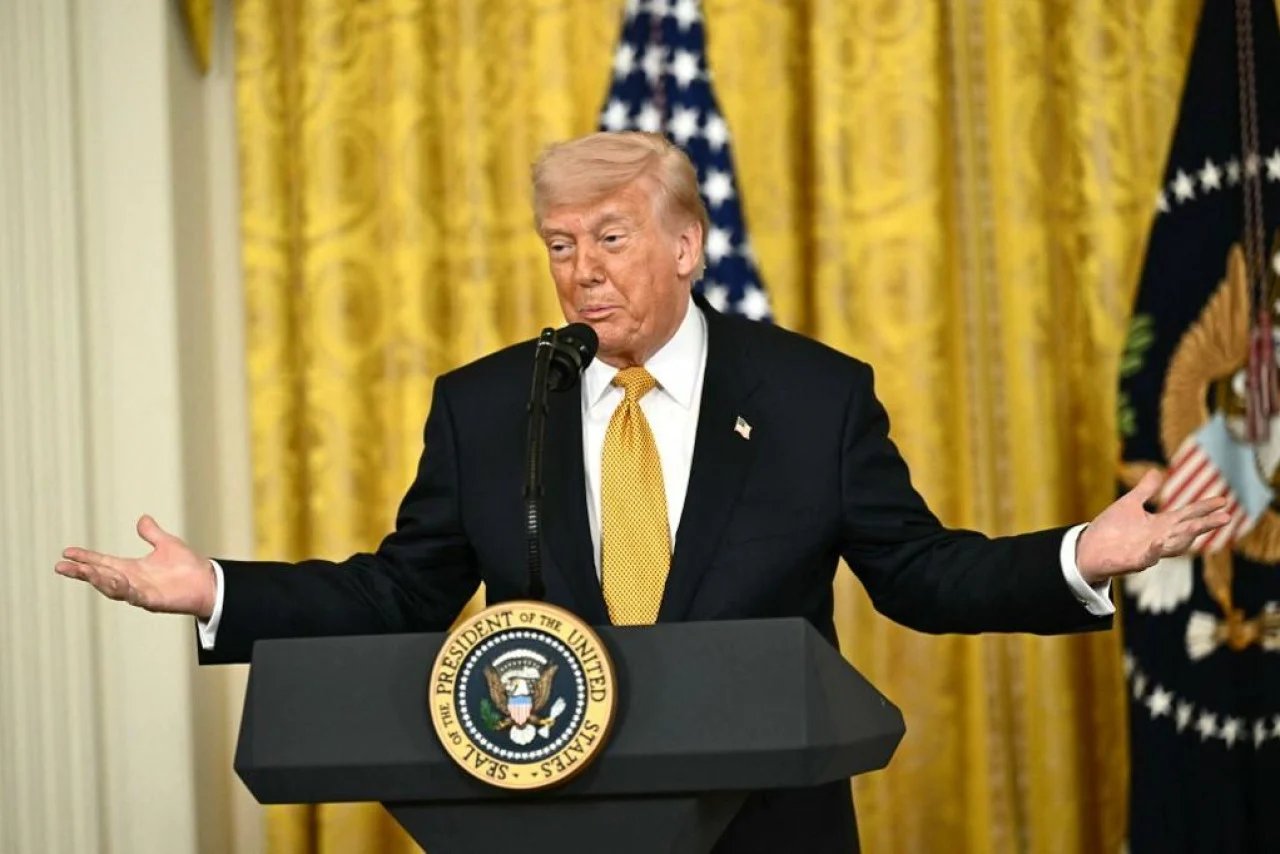
American president Donald Trump temporarily halted the operation to reopen the Strait of Hormuz, less than 48 hours after its launch. Trump cites “great progress” towards the comprehensive agreement with Iran as the reason for the supposedly short pause in “Project Freedom”. But what is really behind this decision and how successful was Trump’s project Morning paper asked the political analyst prof. Ph.D. Žarko Puhovski.
“I kept repeating that the American president will stop the war at some point regardless of the circumstances, which is what is happening now. Trump apparently judged that he had done enough after destroying a large part of the armed forces of the Islamic Republic of Iran, so now he is withdrawing primarily due to the pressure of the financial markets and the rise in fuel prices. A big blow for him and his electorate is that the price of gasoline in the US has risen by more than 50 percent since the beginning of the war. So, Trump won militarily, but lost this war politically,” Puhovski believes.
The Revolutionary Guard shoots what it can
The professor of philosophy and political science draws a parallel with the NATO bombing of FR Yugoslavia, recalling that in Serbia they celebrated the end of the bombing as a victory, even though they suffered serious losses. “This is the case here as well. Iran is now trying to present this pausing of the ‘Freedom Project’ as its own victory,” says Puhovski.
Speaking further about Iran, he reminds that it is a specific system that cannot be easily destabilized: “It is not a regime in which when you kill the leader, the system falls, but a complex structure in which different parts can function autonomously. It is something I call a totalitarian consociation. That is exactly why the resistance did not stop with American attacks, but spread to neighboring countries.”
On the field, this can be seen through the way of acting. Iran, as it says, “attacks what it can hit”, after unsuccessful attempts to strike Israel, has turned to more accessible targets such as the United Arab Emirates, which it officially denies. “Yes, we read in the media that Iran denies these attacks on the UAE, but the reason for that is that the Revolutionary Guard operates partially autonomously. Everything fell on the Guard units who have a general idea of who the enemy is – for them it is everyone who stands by the US – and they target what they can,” says Puhovski.
Despite everything, he is convinced that an agreement is coming. “I am convinced that a real truce is coming. It is a matter of days or maybe weeks,” he says. At the same time, Pakistani sources told Reuters that Iran and the US are close to agreeing on a memorandum to end the war. When asked how Trump could find a way out of the war, Puhovski says it could happen through a deal that would allow Iran to sell oil with international oversight of its nuclear capabilities.
Iran is in a difficult situation
“Trump could find a way out of the war by opening the Strait of Hormuz, and Iran will be militarily disabled for the long term. At the same time, the US will allow Tehran to sell oil again, lift the blockade of Iranian ports, and reach an agreement on monitoring or confiscating their enriched uranium reserves. The Russians have offered to mediate, but I doubt Trump will allow it, as could be deduced from his witty remark to Putin, when he told the Russian president that he would be better off minding his own business war, not theirs”, explains Puhovski.
Why is he so convinced that an agreement will be reached soon and why would Iran agree to it, we ask the political analyst. “First of all, in less than a month, the World Cup in football starts in less than a month, which is partly held in the USA, and I am sure that Trump will want to end this war before that event, which means a lot to him. As for Iran, it is in a really difficult situation, be it economically, socially, communicationally, etc. The regime has lost control over the population; communications are damaged, buildings are destroyed, and people are displaced. In such circumstances, control becomes extremely difficult, and this is a burden that the complex apparatus of the Iranian secret services submits, so the agreement suits them to re-establish control. Second, restructuring is necessary to determine who is where. I do not agree with Trump who says that there are deep internal conflicts within the Iranian authorities, but I am convinced that there are serious communication problems, and the truce will allow them to be solved,” says Puhovski.
Iranian Foreign Minister Abbas Arakçi he was supposed to meet in Beijing with his Chinese counterpart Wang Yi. How much pressure is China putting on Tehran to reopen Hormuz?
“China is playing very smart, it occasionally criticizes the violation of international law, but they are not actually threatened by oil because they have their own reserves, so they act as if it does not concern them. They are comfortable with this military exhaustion of the USA, but they will not splash out on some spectacular moves to calm the situation,” concludes Puhovski for Morning paper.