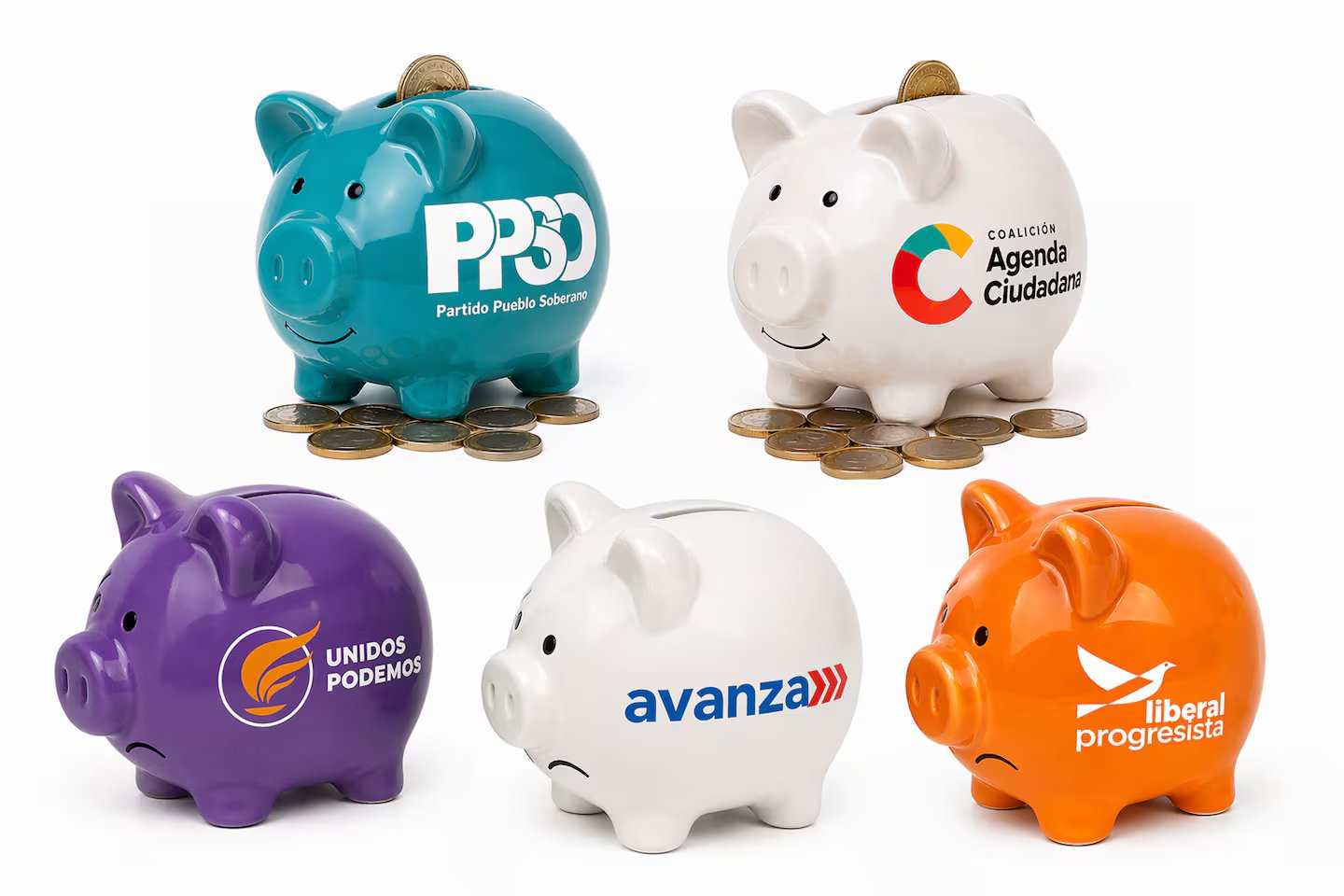
Six people opted to finance more than one political party during the last elections. Together, they contributed ¢50.1 million and in exchange, as an expectation of payment, they received political debt bonds for ¢61.4 million.
That difference of ¢11.3 million is the profit they expected to receive for the money invested, plus an extra amount for interest. However, not all transfer certificates acquired value and, consequently, became a simple piece of paper.
Two of those people lost all the money by financing groups that could not access the state contribution, due to the small amount of votes obtained.
Another three contributed money to a group that will receive political debt and another that will not. Meanwhile, only one financed two parties that did issue bonds that gained economic value after the February elections.
Only the Pueblo Soberano (PPSO), National Liberation (PLN), Frente Amplio (FA), Unidad Social Cristiana (PUSC) and the Citizen Agenda Coalition (CAC) parties can access the state contribution which, for these elections, is ¢39,292 million. Consequently, only the certificates that these groups issued can collect an economic value.
The rest of the political groups failed to obtain 4% of the valid votes cast or elect at least one deputy. By not meeting either of these two variables, they were left out of the distribution of that money.
Under this scenario, these are the six people who financed two parties simultaneously, according to the data sent by the groups themselves to the Supreme Election Tribunal (TSE).
Two lost all the money invested
—Erick Zamora Alfaro: He contributed ¢20 million. ¢17 million were given to the Progressive Liberal, chaired by deputy Eliécer Feinzaig Mintz, and the other ¢3 million were given to the Avanza Party, led by José Aguilar Berrocal as a presidential candidate.
—Juan José Echeverría Alfaro: He gave ¢7.2 million. Of that sum, ¢4.2 million was deposited to Avanza and the remaining ¢3 million to the Democratic and Social Center Party, of the former president of the Constitutional Chamber, Ana Virginia Calzada Miranda.
Echeverría was president of the Municipal Development and Consulting Institute (IFAM) between 2002 and 2006, during the government of Abel Pacheco.
Three won and lost
—Edgar Oviedo Blanco: It contributed ¢12.75 million. ¢8.5 million were transferred to the PPSO, of the elected president, Laura Fernández, and the other ¢4.25 million to Unidos Podemos, of the former presidential candidate and former Minister of the Presidency, Natalia Díaz.
—Cynthia Rebeca Fonseca Molina: He contributed ¢5.95 million. ¢3.4 million went to the bank account of Unidos Podemos and the other ¢2.55 million to the PPSO.
—Diego Rojas Orlich: He contributed ¢1.5 million. Of that amount, ¢850,000 was given to the Citizen Agenda Coalition, of the former first lady and elected representative, Claudia Dobles Caamargo, and the other ¢650,000 went to Avanza.
The person who won-won
—Alejandro José Horvilleur Lau: He contributed ¢2.7 million. ¢1.7 million was transferred to the PPSO and the other ¢1 million to the CAC. In exchange for that investment, he received bonds for ¢3.2 million, meaning he would have a profit of ¢500,000 plus interest.
The electoral legislation establishes that the certificates They earn the basic passive rate plus one point, which today is equivalent to 4.84%. The State pays the interest when the holders cash in the bonds, after the TSE settles the parties’ expenses.