Created by the company that sells DIY DNA tests MyHeritage, the online tool gives information on texts, historical references and interpretations
An old photo found in the cellar, a document written in an unknown language to be studied for a degree thesis, a dense letter dating back to the time when this was the main means of communication. Documents that become historical finds that there could tell something more about our history – personal or universal – are the goal he brought My Heritagea company created to sell do-it-yourself DNA tests, to build a new artificial intelligence system capable of deciphering them.
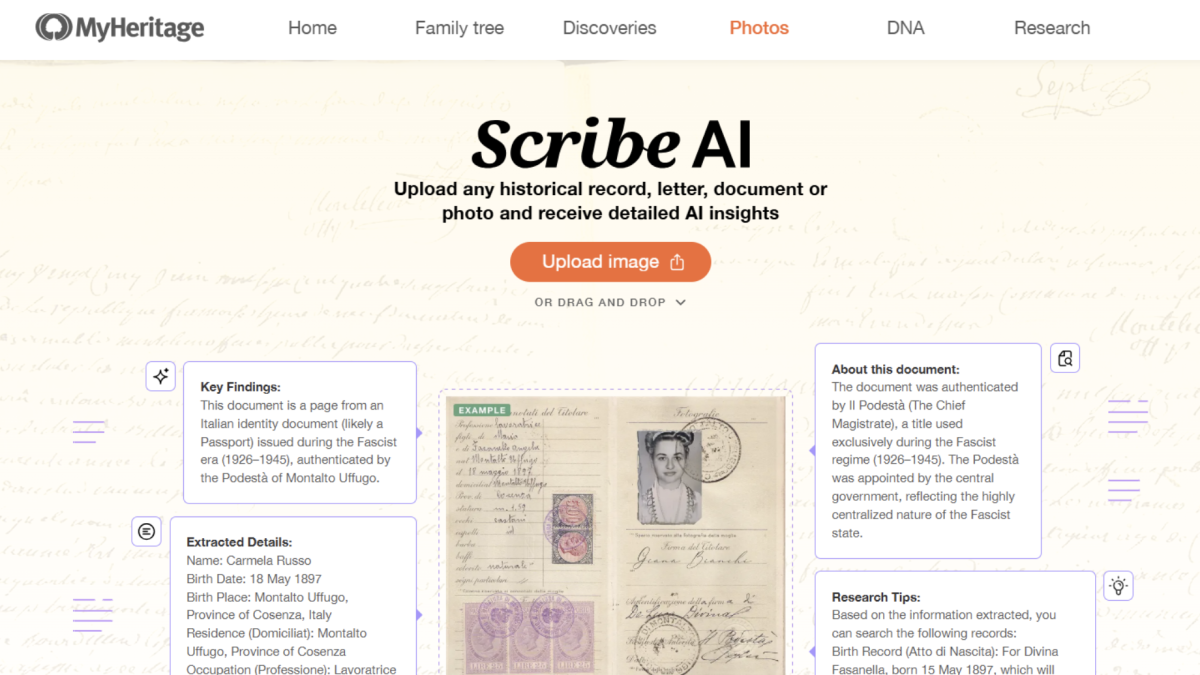
The tool is available online, by subscriptionon the company website. It is based on Google technology and, as stated in the terms of the service, “it allows users to obtain insights, transcriptions and historical analyzes from the materials they upload, such as old letters, documents and photos”. All files that – it is good to know before starting – they will enter, given our consent, into the enormous database that the two companies are building. Which currently matters 39 billion documents. The operation is very simple: take the file and drag it into the dedicated box. You wait a few minutes while the artificial intelligence models, trained to recognize text, visual patterns and historical signals, work. And then you read the results. Who tell the content, translate the texts, support the origin and date, explain the technical details. Very rich details when it comes to documents that are very popular online, but also quite interesting when we upload personal content.

We tried having Scribe AI analyze it the CV that Steve Jobs wrote at the age of 18, in 1973. The tool recognizes it immediately: it also mentions «Hewitt-Packard», a misspelling for the Hewlett-Packard company, and gives the complete translation and transcription. If instead we try to load a photo from the historical archive of the Istituto Lucehere it is clear that the database compiled by Google and My Heritage still includes few Italian finds. The general description: «The black and white photograph shows a large group of soldiers marching in formation along a wide street or square, proceeding from left to right. In the background stands an imposing historic building characterized by a portico with large arches on the ground floor and rectangular windows on the upper floors, with a canopy on the right side. The lighting suggests a sunny day, casting stark shadows on the ground. The atmosphere is martial and formal, typical of a military parade or an official movement of troops.” But he recognizes the place, piazza dei Cinquecento in front of Termini station, e the uniforms of the soldiers: Bersaglieri. Recognizes above all the Istituto Luce logo and the slide number of the image. From here and other details, it dates back to the date: Between 1924 and 1938. The section on technical details is interesting: «It is a black and white analogue photograph, probably taken on film or glass plate, as indicated by the number ‘141’ printed backwards at the bottom left (typical of negatives). The image features a watermark repeated across the entire surface and the official Istituto Luce logo in the lower right corner. The quality and contrast are typical of photojournalistic and propaganda photography of the 1920s and 1930s.” Even regarding one of ours private photography, family, Scribe AI managed to guess the correct decade: «It is a color photograph printed on photographic paper with a silk or honeycomb finish, a very popular texture for amateur prints in the late 70s and 80s. The colors have a slight warm cast and a typical fading due to the aging of the chemical pigments of the color films of that era (such as Kodacolor)”.

The examples of what can be discovered with Scribe AI are the most diverse. My Heritage itself provides some, to demonstrate how this is a tool that can be especially useful for those doing historical research. The 250 letters that a Jewish deportee to the Coroneo prison in Trieste managed to send to his wife – which he kept in his family home for all these years – have given new evidence of what was happening during the Second World War. The letters are not censored: the man, Daniele, sewed them into the clothes that were sent to the laundry, thus managing to leave an authentic testimony from the prison camp. It was Daniele’s children who contacted My Heritage, many decades later, to be helped to recover their father’s last thoughts. Scribe AI has always deciphered what is believed the oldest love letterwritten over 540 years ago by a bride forced to choose between the man she loved and her family. The text dates back to 1477 and is in English. Its author is called Margery Brews and, in the document, she has no doubts: she would have married her fiancé John Paston III even if she had had “half the means of support” she had.