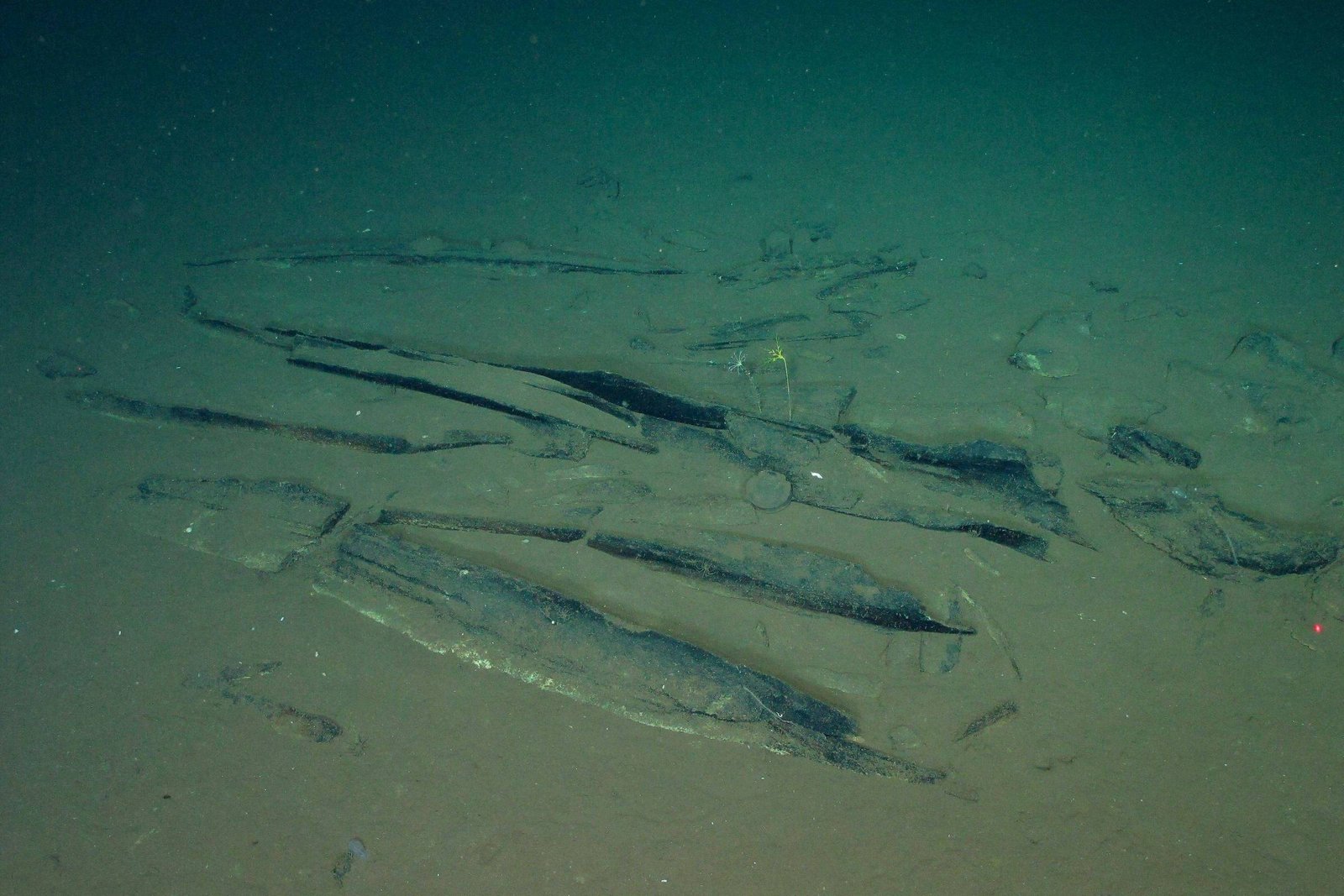
For at least 5 million years, the same area of the depths of the Indian Ocean has functioned as an immense whale cemetery – and, instead of producing macabre scenes, the process has led to the emergence of an entire ecosystem, with unique species, around the remains of the aquatic mammals.
Chinese submersibles have mapped part of the underwater forest of skeletons in the so-called Diamantina fracture zone, west of Australia. Details about the region’s modern and extinct biodiversity are in an article published this Wednesday (10) in scientific magazine Nature.
The study authors, led by Xiaotong Peng of the Institute of Science and Deep Sea Engineering of the Chinese Academy of Sciences, identified almost 500 “whale falls”, the name given to the burial of large mammals on the seabed) in a 1,200 km long strip along the Diamantina area. The peculiar geology of the place was shaped by the process of separation between the Australian continental mass and the Antarctica about 50 million years ago.
The “whale rains” known until now have been found at depths ranging from a few meters to 4,000 m, but Asian researchers have identified “whale rains” considered active – that is, in conditions that support the flourishing of small ecosystems around the skeletons – at almost 7,000 m from the ocean surface. In the case of some fossil whales, the depths are even greater.
Most cetacean skeletons belong to beaked whales, a subgroup that includes animals up to 13 meters long and whose appearance vaguely resembles that of dolphins with an extremely elongated body.
Relatively little studied, beaked whales are excellent divers, hunting invertebrates such as squid at depths of up to a few kilometers. The survival strategy, however, is not without risks, and the pressure it imposes on the physiology of animals (with large variations in pressure, for example) may be part of the explanation for deaths and sinking bodies.
The other reason for the concentration of “whale rains” is the cut relief of the underwater region, a kind of funnel that may have confined the bodies of diving cetaceans in a relatively narrow space. Finally, there is the preservation bias: beaked whales have a skull with particularly massive bones, which decomposes more slowly than that of other whales and also fossilizes relatively easily.
Even so, there are also remains of other species of whales in the underwater necropolis, including that of an Antarctic minke whale (Balaenoptera bonaerensis), five meters long. In the case of the most recent skeletons, the bones are covered with a dense, whitish “carpet” of marine microbes.
Furthermore, a community of invertebrates of different sizes settled around, on top of and even inside the bones – this last possibility is the case of “bone-digging” marine worms of the genus Osedax. When attaching itself to the bone structure, the animal produces an acid that dissolves the external layers and allows it to consume the fat inside the bone.
Along with the OsedaxChinese researchers have identified about 20 species there, most of which are probably still new to science. Among the inhabitants of the area are bivalves (relatives of shellfish) that live in symbiosis with bacteria, different types of ophiura, similar to sea stars, but with “legs” that move differently, as well as sponges and anemones. The latter prefer older bones, which they use as rocks, attaching themselves to them. Another surprise of the study is the abundance of invertebrates in these places – in some points, the population density reaches almost 3,000 individuals per square meter of seabed.
In addition to the probable new species of current marine biodiversity, the researchers also concluded that some of the fossilized whales in the region’s abyss correspond to previously unknown extinct species.
In the Nature study, they named the species Pterocetus diamantinaea type of beaked whale, and at least two other extinct whales, the P. benguelae and the Izikoziphius rossi. In the case of these last two, they managed to date samples of the fossils, using a method that is based on variants of the chemical element strontium, reaching ages of 5.26 million years for the P. benguelae and 2.44 million years for the I. rossi.
Taking into account the relative abundance of “whale rains” and the ability of marine invertebrates to make the most of the resources offered by dead cetaceans, the study authors propose that their findings could provide important clues about how the ocean’s deepest environments are maintained over time.
The idea is that the giants’ carcasses would function as “crosswalks” at depth, allowing invertebrates adapted to these conditions to identify new resources and find mates, spreading these species to more areas of the seabed.