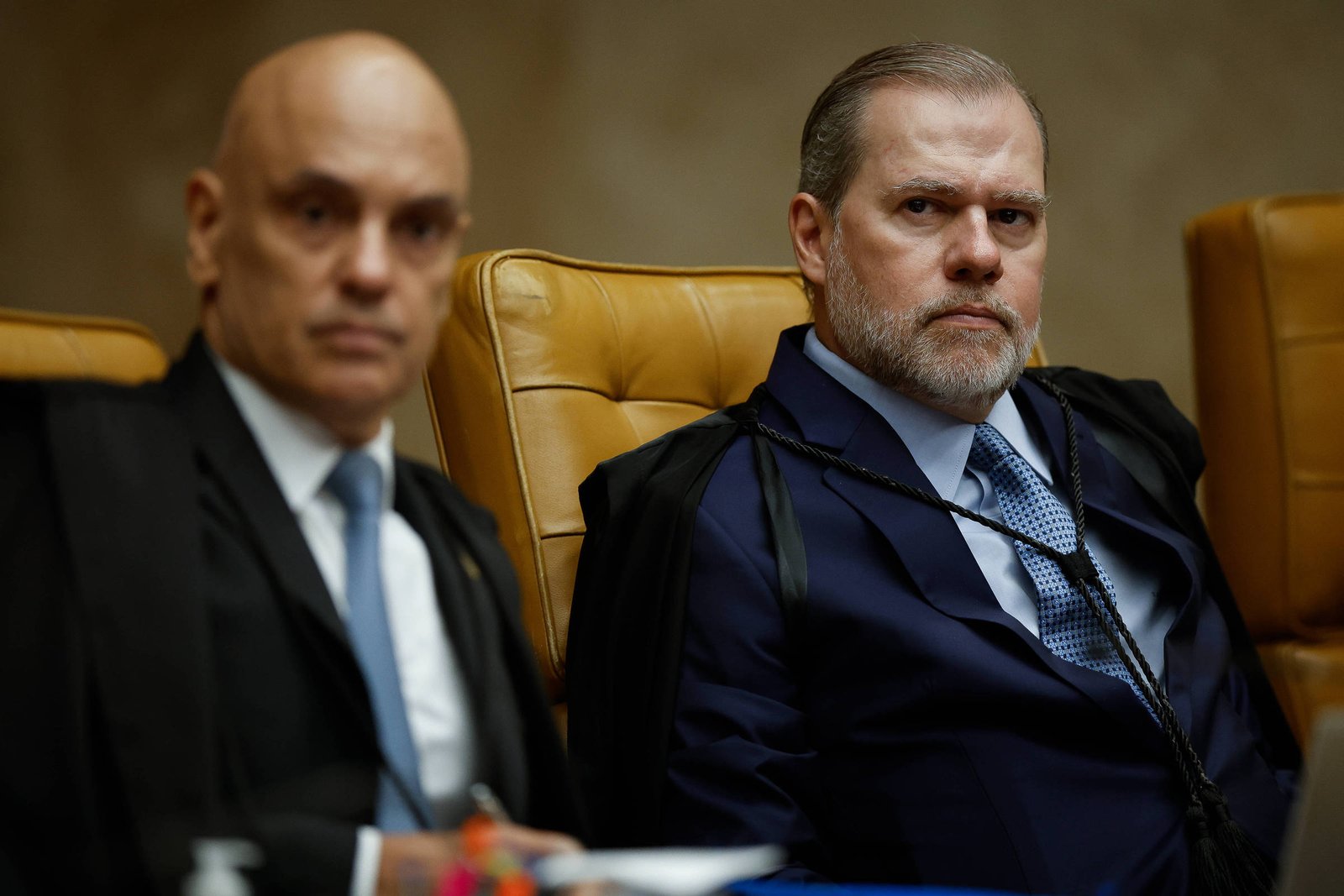
The minister Toffoli Daysfrom STF (Supreme Federal Court), signaled restricting the requirement set by the court to maintain headquarters in Brazil for digital platforms that have an economic interest in the country. With the proposal, Alexandre de Moraes raised concerns about the possibility, and the plenary should debate the topic again.
The court returned to discuss this Wednesday (10) the Civil Rights Framework for the Internet, including parameters for holding companies accountable. The case was resumed a year after the conclusion of the judgment on the merits of the matter, with the analysis of appeals against the decision. At the session, Toffoli began reading his vote in the case.
Alexandre de Moraes He told his colleague that not all crimes committed through social networks are carried out through environments with an economic purpose.
Rapporteur of one of the cases on the topic, Toffoli responded that the topic is delicate and said he was open to debate. For the judge, the need for service application providers to Internet with operations in Brazil, maintain headquarters and representative in the country, aims to ensure compensation to any injured parties due to damages caused in the exercise of their respective economic activity.
“If internet application providers do not carry out any type of economic activity in the country, dedicating themselves solely and exclusively to social, cultural and public utility purposes, such as, for example, the production of knowledge in a collaborative manner and the dissemination of legitimately obtained official data, there is no need to establish and maintain a representative here”, he said.
Moraes, however, defended the original text created by the Supreme Court in 2025. According to him, the broader wording is safer for the country.
“I already raise my concern because, today, crimes committed through social networks, incitement to crimes, are not only those that have an economic purpose, they are those that have an ideological purpose. So, a platform, for example, with Nazi messages, without any economic issue, if it does not have a headquarters here, there is no possibility for the Brazilian Justice to control it”, he said.
Toffoli also stated that he had doubts about this point because, on the one hand, there is a presumption of good faith, but, on the other, there are risks involved.
The minister began the vote by defending the collegiate decision issued a year ago. On that occasion, the magistrates met before the final session to reach a consensus on the announced thesis.
The rapporteur stated that, in the vote, he would seek minimal intervention when he deems it appropriate to improve the wording of the text. The vote has around 75 pages and the minister has not yet finished reading it, which should be done in the session on Thursday (11).
In the vote, Toffoli stated that he understands that the Supreme Court’s decision is valid since the publication of the minutes of the trial, on June 26, 2025. Facebook asks for a period of six months after the final decision to comply with the demands.
The trial was scheduled three weeks after Lula (PT) publish decrees based on the court’s own decision. Node Congress, the opposition moves to try to overturn such texts.
At this point, Toffoli stated that he will still dedicate a portion of his vote to the topic, but said he considered the recently published decrees “quite in line with the court’s ruling.”
In the session, he also stated that providers will not be able to create requirements not provided for by law to receive notification about inappropriate content.
“Internet application providers must issue self-regulation that necessarily covers a notification system, due process and annual transparency reports in relation to extrajudicial notifications, advertisements and boosts”, he said.
The ministers focus on challenges that seek, from different perspectives, restrictions on the rules imposed, as well as more details about the 2025 decision.
At the beginning of the analysis, there are nine resources under analysis, presented both by the companies participating in the process, Facebook and Googleas well as platforms, entities and civil society organizations.
In June 2025, the court expanded the obligations of social media platforms to operate in Brazil. From then on, they became civilly responsible if they do not proactively remove, before a court order, a new list of content, including undemocratic, discriminatory or inciting crimes.
The debate took place around article 19 of the Civil Rights Framework for the Internetin force since 2014 and which says that platforms must only compensate users offended by third-party posts if they fail to comply with a court order to remove content.
The court defined that platforms are responsible for removing content that constitutes the practice of serious crimes such as undemocratic conduct and acts, crimes of terrorism or preparatory to terrorism, crimes of induction, instigation or assistance to suicide or self-mutilation, incitement to discrimination, crimes committed against women, sexual crimes against vulnerable people, child pornography and serious crimes against children and adolescents.
The decision also includes the liability of providers in the case of illegal content when there are paid advertisements and boosts or the use of robots. But platforms will be exempt if they prove that they acted within a reasonable time to make the content unavailable.
At another point, the ministers dedicated a section of the decision to address the presence of legal representatives in Brazil for companies operating in the national territory.
Alexandre de Moraes was involved in clashes with X (former Twitter) and Rumble precisely due to the absence of legal representatives of these companies in the country and the failure to comply with orders given by him.
According to the decision, the legal representation of big techs must be able to respond to the administrative and judicial spheres, provide information about their operation, rules and procedures for content moderation, in addition to complying with court orders.