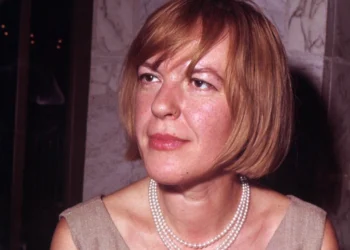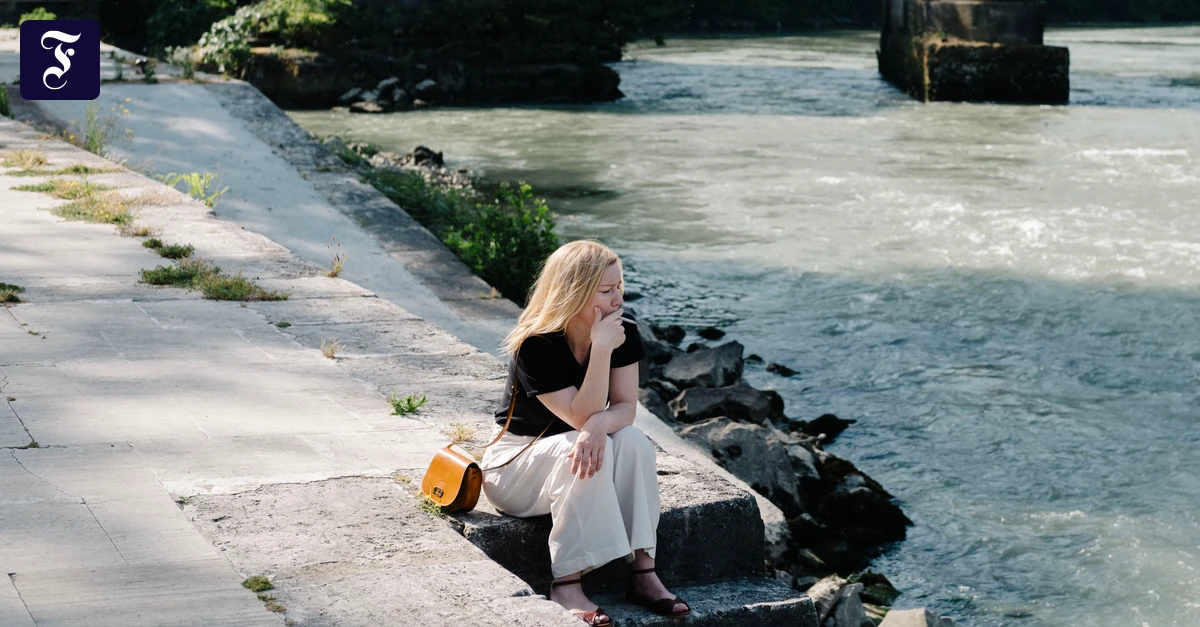
Ms. Hülser, you are playing a kind of interpretation of Ingeborg Bachmann. Ms. Schilling, you directed the film. At the beginning of the film you describe the project as a kind of necromancy or séance. Was there a reaction from beyond?
Sandra Hueller: The viewers can now decide for themselves whether this works. However, I would never talk to you about it. This is far too intimate for me. But Regina sees it differently, I think.
Regina Schilling: In the evening after filming ended, I always had the feeling that Ingeborg was somehow there and said: Yes, everything was good.
It was part of this séance to find an apartment in Rome that was similar to Ingeborg Bachmann’s. They reconstructed the facility and thereby brought their world to life. What materialized in this room during filming?
Sandra Hueller: We spent these ten days in Rome without knowing exactly how we would proceed, believing that we would then have the right ideas and find the right places. It was an adventure that we embarked on that required great trust and that bonded me and Regina very strongly. And I also had the feeling that we weren’t doing this for ourselves, but for Ingeborg Bachmann.

What exactly did you want to do for Ingeborg Bachmann?
Sandra Hueller: We wanted to give her opportunities that she may not have had. We imagined that she was doing very well in the last days of her life and that she enjoyed a freedom that she had not felt before.
Regina Schilling: We wanted to clear away some of the debris and debris that has accumulated around this figure. Because everything we know about her life, her tragic death or her unhappy relationships, have always overshadowed her work. We did it for Bachmann as a writer, the artist. That’s why it was important to us to let the texts shine. We wanted to show that she was a hard-working woman who fought against her psychological dispositions. And that was also noticeable for us in this apartment. The soundtrack from Soap&Skin also contributed a lot to this.
Ms. Hülser, did you have any kind of key to Ingeborg Bachmann’s emotional world?
Sandra Hülser: That didn’t exist for me. I would describe it more as an approximate movement that had no end. This goes on and on. When I see the finished film now, I still discover new aspects in her texts. Working on this film makes her whole body of work even more interesting to me.
They were both Bachmann fans before this project. What did that start with?
Sandra Hueller: There is no exact time. For me it was somehow always there and always a kind of fixed point that I oriented myself towards.
Regina Schilling: I discovered “Malina” when I was seventeen. Until then, my literary canon, from Camus to Tolstoy to Balzac, was classically male. With Bachmann’s “Malina” there was suddenly a female figure who was complex and contradictory, so strange and enigmatic. At the same time, she spoke to everything in me. And that’s when I realized for the first time that perhaps there is a difference whether men or women write. And I also realized that until then I had always identified with male main characters, because they were usually the more complex characters.
The themes in Ingeborg Bachmann’s work remain relevant. Ms Hülser, where do you see yourself in this?
Sandra Hueller: I’m not a writer. But this struggle to create the work and to find the clearest possible expression of what I want to say in my work is something I can identify with. I am also familiar with this investigative approach to topics that continues to have an impact.
Ingeborg Bachmann preferred to stay among men and was recognized by her colleagues as a writer, but still experienced the male chauvinism typical of that time. Does it still exist in your working world today?
Regina Schilling: As I get older, I notice – and it’s actually a bit sad – that since I’ve hit 60, I’ve been treated so much more respectfully by men than before. That says a lot. I come from the literary and film business, and as a young woman I wasn’t always treated as an equal. The fact that things have now changed is nice on the one hand, but actually it’s also bitter.
Sandra Hueller: I think I have always been treated with respect. If it was different, I left or spoke up. However, it’s hard for me to pin that down as a narrative because not everyone has the same experiences. There are cases in my circle of friends where things went differently. In any case, it requires a certain basic effort and basic attention to counteract disrespect from the outset and rule it out.
Ms. Schilling, what makes the special Sandra Hüller magic and her star qualities?
Regina Schilling: Well, first of all, Sandra has never given me the feeling that she is a star. But we have known each other for 15 years. And she wasn’t yet this – in quotation marks – international star. You are also made to do this from the outside, and I can imagine that that can be unpleasant because you don’t declare yourself a star. Sandra has this transparency and she can let literature fly. She thinks and feels at the same time. And for me it is also a kind of medium. Of course, that also fit with this necromancy or séance.
Ms. Hülser, that was a very intimate work with a lot of room for experimentation and improvisation. This is completely different from large productions like “The Astronaut – Project Hail Mary”. How do you always find your playing rhythm?
Sandra Hueller: I think about that often and I can’t tell you exactly. I am currently visiting with a two-year-old child and can see how he is completely immersed in the game. Then only the car that it is currently playing with will exist. Acting is actually nothing other than what we have always done. That’s all that matters in this moment. And it doesn’t matter in which environment it happens.
Can you figuratively always focus on your car?
Sandra Hueller: How do you do it when you write? You also have to concentrate. I think it’s just a question of concentration. There’s no mumbo jumbo there. For me it’s the desire for focus. I find this enriching and fulfilling.
They played theater in a church in Hanover almost immediately after the Cannes Film Festival. Do you need these contrasts to readjust yourself?
Sandra Hueller: It’s not like I’m at the airport and get a call from Hanover. That’s not how it works. This appointment in Hanover had been in place for some time. I didn’t know then that we would be in Cannes. Tom Schneider and Daniel Nerlich, two friends of mine, did the project. I thought it was great and really wanted to be there. Plus, I promised it, and I’ll keep it.
You are now also a brand ambassador for the fashion house Chanel. How did this collaboration come about?
Sandra Hueller: If you want to know this. First of all, it’s really great because I no longer have to worry about a lot of things. This year I have a lot of premieres and public appearances coming up. So we both get something out of it. I like Matthieu Blazy’s work and have worn things from him when he was not yet creative director at Chanel, worked for other brands, and have followed his career a bit. That’s why I’m happy about it, also because Chanel is so involved with cinema and art. Madame Chanel used to be active in artistic circles in Paris. There is a long history in the house that has to do with these issues. That’s also why I think it’s beautiful.
What is your reading tip to get you started in Ingeborg Bachmann’s literary universe?
Sandra Hueller: We’re different, aren’t we?
Regina Schilling: Yes, I especially love her prose and recommend “Simultaneous,” the last volume of stories.
Sandra Hueller: For me it is all the poems from beginning to end.