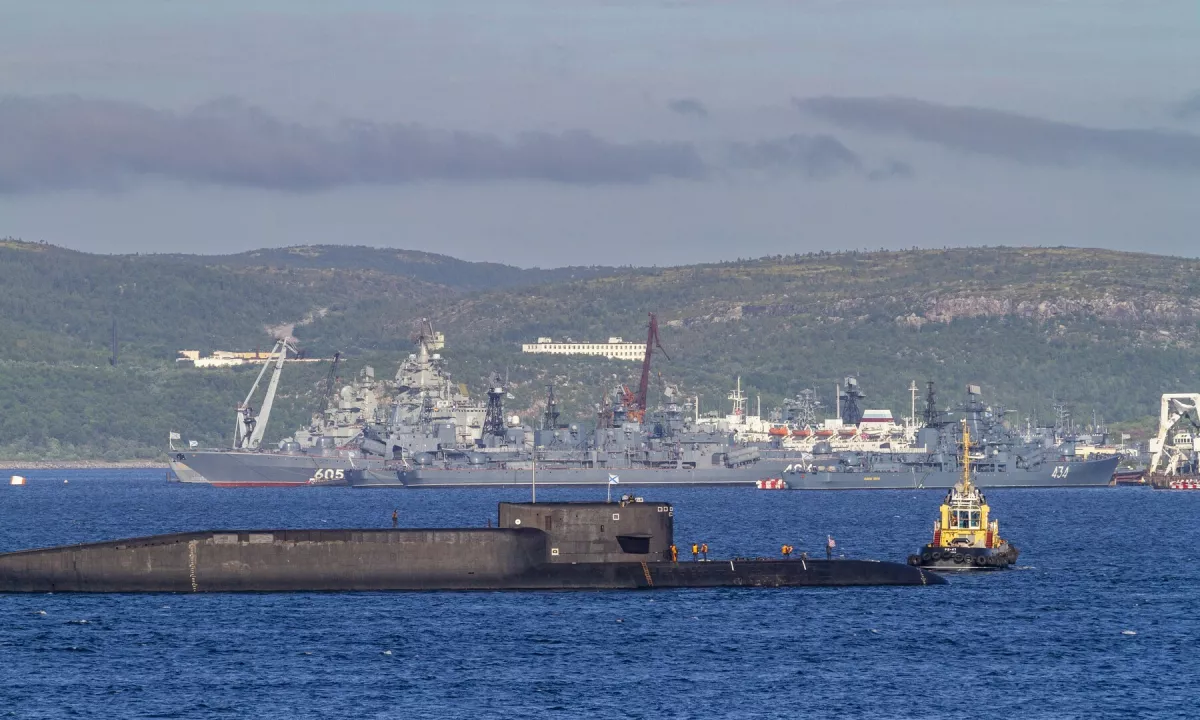
In addition to the new Murmansk, shipbuilders are creating three more vessels in various stages of construction. Symbolic photo: Profimedia
Russia is expanding the most dangerous fleet: they are building submarines with hypersonic weapons
The construction of the new multi-purpose nuclear submarine Murmansk, the ninth vessel of the modernized Jasen-M class, has begun at the Russian shipyard Sevmash in Severodvinsk. The event marks an important step in the modernization of the Russian Navy, as engineers have designed these submarines to carry hypersonic Zirkon cruise missiles, which are practically impossible to intercept due to their extreme speed.
June 24, 2026, 2:23 p.m
mp

The construction of the Murmansk submarine represents the continuation of a large-scale program of strengthening Russian naval capabilities. The shipbuilders thus laid the keel for the first vessel of this class after a six-year hiatus, indicating the strategic importance Moscow attaches to these advanced vessels. According to the Commander-in-Chief of the Russian Navy, Admiral Alexander Moiseyev, the ministry will complete and hand over the entire fleet of Jasen-M class submarines to the Navy by 2035, replacing the older third-generation submarines, the German focus.de.
In addition to the new Murmansk, shipbuilders are creating three more vessels in various stages of construction. The submarine Ulyanovsk is already being prepared for launch, while Vorohezh and Vladivostok are still being assembled. The fifth submarine of this class, the Perm, is currently undergoing final tests and will join the Pacific fleet after the tests are completed in 2026. The Russian military expects the Perm to become the first submarine to be serially equipped with hypersonic missiles.
Big, silent and deadly
The Jasen-M class submarines, developed by the Malahit design bureau, are technically extremely advanced vessels of the fourth generation. They measure about 130 meters in length and about 13 meters in width, and their underwater displacement is 13,800 tons. Due to their advanced design and silent operation, they are considered one of the quietest vessels in the Russian Navy, and the crew can dive with them to a depth of 600 meters. It is powered by a nuclear reactor of the OK-650V type, which allows the submarine to reach a speed of up to 31 knots underwater. Sailors can stay on operational missions for up to a hundred days, and the crew consists of 64 members.
Devastating weaponry with a focus on Zircon missiles
The main striking power of these submarines remains their armament, which engineers install in ten vertical launch systems. Armament can consist of a combination of Onyx anti-ship missiles and caliber maneuvering missiles. According to defense industry sources, the vessels can carry up to 40 Kalibr missiles or up to 32 Onyx missiles. Newer vessels, including the expected Murmansk, will also carry Zircon hypersonic missiles.
Zircon rockets are considered to be game-changing weapons at sea. They can reach speeds of up to Mach nine, or nine times the speed of sound, and have a range of around a thousand kilometers. This combination of speed and range makes them extremely difficult for existing air defense systems to detect and intercept. The Russian military successfully tested the Zircon missile from a nuclear submarine as early as October 2021. Military analysts warn that the combination of the stealth of the Jasen-M submarines and the destructive power of the Zircon missiles poses a serious threat to enemy ships, including aircraft carriers.
Broader strategic context
The Russian authorities are continuing the program of building new nuclear submarines despite the financial and industrial strains caused by the war in Ukraine. Russia is thereby strengthening its military presence in strategically important regions such as the Arctic. At the same time, the design bureaus are already planning fifth-generation strategic nuclear submarines, which will replace the current Borej-class submarines after 2037.
The development of hypersonic weapons is not only limited to Russia, as the United States and China are also rapidly developing their own versions. This clearly points to a new arms race in advanced military technologies, raising concerns about future strategic stability and the potential for new forms of military conflict.