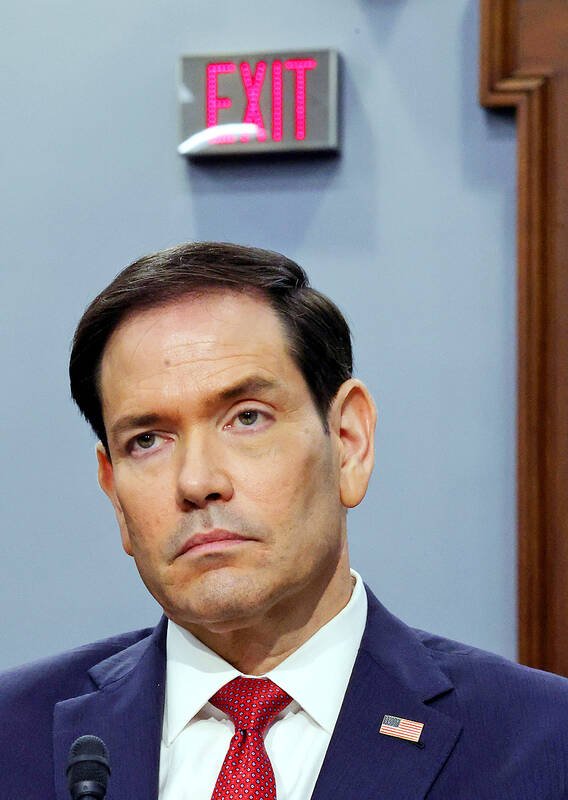
US Secretary of State Marco Rubio on Tuesday told lawmakers that the US is still in discussions with several countries to resettle more than 1,000 Afghans who assisted the US’ “War on Terror,” while he defended US President Donald Trump’s decision to green-light refugee admissions for tens of thousands of white South Africans.
Rubio’s testimony comes more than a month after reports that the war-torn Democratic Republic of the Congo (DR Congo) was among the countries where the US was considering sending the 1,100 Afghans and relatives of US service members who have been stranded in Qatar for more than a year.
Advocates have said the other option would be for the refugees to go back to Afghanistan, where they face reprisal from the Taliban.
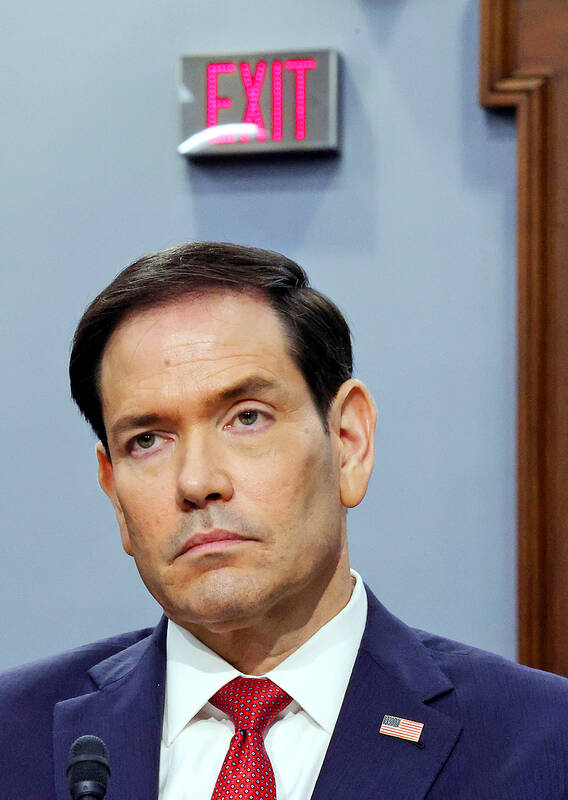
Photo: AFP
Democrats on House and Senate committees questioned Rubio during an annual budget hearing about why the US has not followed through on its promise to take in the hundreds of allies who had been rigorously vetted before US President Donald Trump signed executive orders in January last year that targeted asylum and refugee cases.
“We’re obviously operating right now under a directive that prohibits the entry of Afghans into the United States,” Rubio said.
Despite the restrictions, he said officials had been “engaging every single day” on this issue and that several countries have already indicated their willingness to take in some of those waiting in limbo.
US Representative Grace Meng told Rubio that regardless of US immigration policy, DR Congo would be “a death sentence” for those living at the camp in Doha, including Afghans who served as interpreters and with special operations forces as well as the immediate families of more than 150 active-duty US military members.
The DR Congo has been battered by decades-long fighting between government forces and Rwanda-backed rebels in its eastern region and is now at the heart of an Ebola outbreak.
“Can we rule out deporting people to conflict zones?” Meng asked Rubio.
After attempting to deflect, he said that he did not think any of the countries being discussed would be conflict zones. He said that the issue remains how many Afghans other countries would take.
“I don’t think there’s one country that’s going to take all 1,000, but it has to be countries that are willing to assume some of this responsibility and numbers that are manageable to them, but also places that give more options to these individuals that they would be comfortable going to,” Rubio said.
Negotiations between the US and countries, including Botswana and Malaysia, started months ago, said Shawn VanDiver, a US Navy veteran who heads a coalition that supports Afghan resettlement efforts called #AfghanEvac.
VanDiver and other advocacy groups have blasted the administration’s handling of Afghan allies over the past 18 months, saying the US is abandoning those who served alongside US forces during the longest war the US has yet fought.
“These are not strangers. They are the spouses, the children and the parents of men and women wearing our uniform right now,” VanDiver said in a statement on Tuesday. “We told them, with the full faith of the United States, that if they stood with us we would stand with them.”
“That promise did not come with an expiration date, and it did not come with conditions,” he added.
Rubio defended some of those conditions, including why Afghans, who have gone through extremely rigorous vetting and biometric tests, are facing hurdles while the administration has made the US refugee program a vehicle to allow in Afrikaners — a group of white South Africans descended mainly from Dutch settlers.
“Everything we do has to be geared by the national interest, and it is in our national interest if we are allowing people to enter our country — be people who can quickly assimilate into society and be successful,” Rubio said.
Meng pushed back on that notion, saying there is a large Afghan population in her district in Queens, New York, who have assimilated, contributed and paid taxes.
“We’ve already assumed a lot of Afghan refugees, as you said, you have them in your district. We’ve already assumed a large number in the past,” Rubio said.