ACTIONS AND REACTIONS:
Conservative opposition party the PPP has taken several hard hits since the party head attempted to declare martial law and was impeached
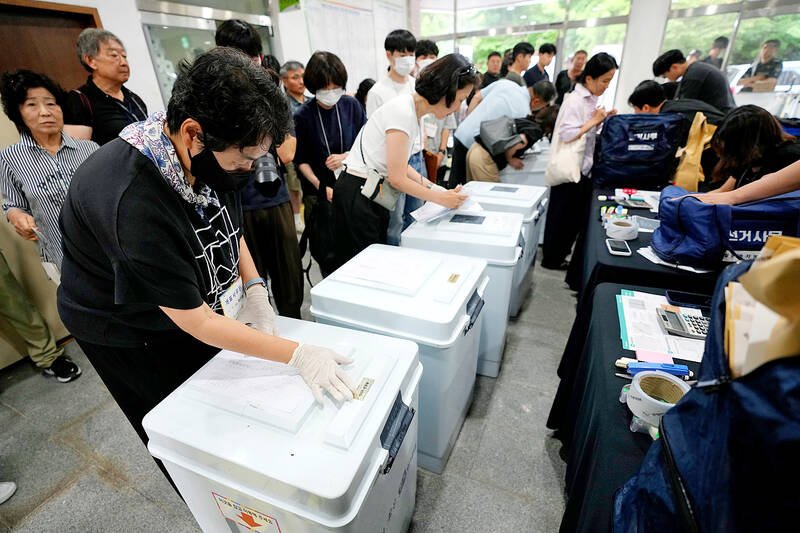
South Korea’s ruling Democratic Party (DP) is on track to win a clear majority of key local offices in a nationwide vote, providing President Lee Jae-myung a boost as he enters his second year in office.
The DP is projected to secure 11 of 16 major posts in elections held yesterday for provincial governors and mayors, according to a joint exit poll by South Korea’s three broadcasters — KBS, MBC and SBS.
The party is leading in the race for mayor of Seoul, a position currently held by the opposition People Power Party (PPP).
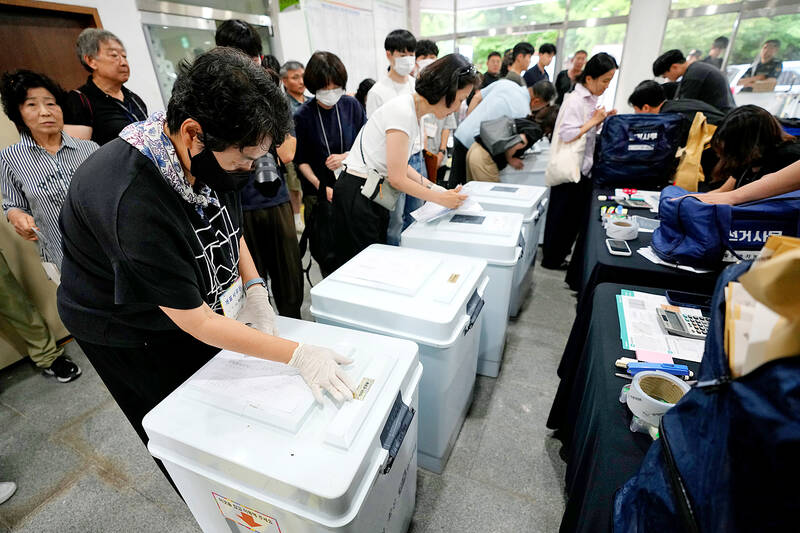
Photo: AP
The PPP, which took 12 of then 17 posts in the last election four years ago, is so far estimated to win just one post. Still, the votes for four positions, including mayor of Busan, are too close to call, the poll showed.
Lee’s DP has been leading in many of the opinion surveys in the run-up to the election. Expanding his party’s control of regional posts would leave Lee with fewer hurdles at the local level to push ahead with his policy goals. His party already holds a majority in the parliament.
“Conservatives are no longer the mainstream in South Korea,” said Kim Joo-nil, a political analyst, pointing to the continuing disarray in the opposition conservative party. “The People Power Party camp is increasingly left with only its most hardline supporters, and the ideological territory they occupy is becoming ever narrower.”
The election results could “demonstrate the reality that, if conservatives continue on their current path, they will have little choice but to remain a long-term minority party,” Kim said.
According to the poll, the DP is expected to take control of the Seoul metropolitan area, not just the capital, including the mayoral and governor posts in the nearby Incheon and Gyeonggi Province. Together, about half of the country’s population live in the area.
Since taking office a year ago, Lee has been riding a wave of support that has consistently hovered at about 60 percent in opinion polls. His administration has benefited from a surge of global demand for artificial intelligence technology that has propelled South Korea’s semiconductor exports, helping power the nation’s economic growth and sharp gains in its booming stock market.
The expected victory symbolizes the strength of Lee’s popularity. It highlights how the PPP is struggling to rebuild itself after a short-lived attempt to impose martial law by its former leader, president Yoon Suk-yeol. He was impeached in December 2024, paving the way for Lee’s rise to power.
It remains to be seen how, or if, the PPP can manage to win back voters by the time South Korea holds its next major election in 2028.