-
By Lisa Wang
/ Staff reporter
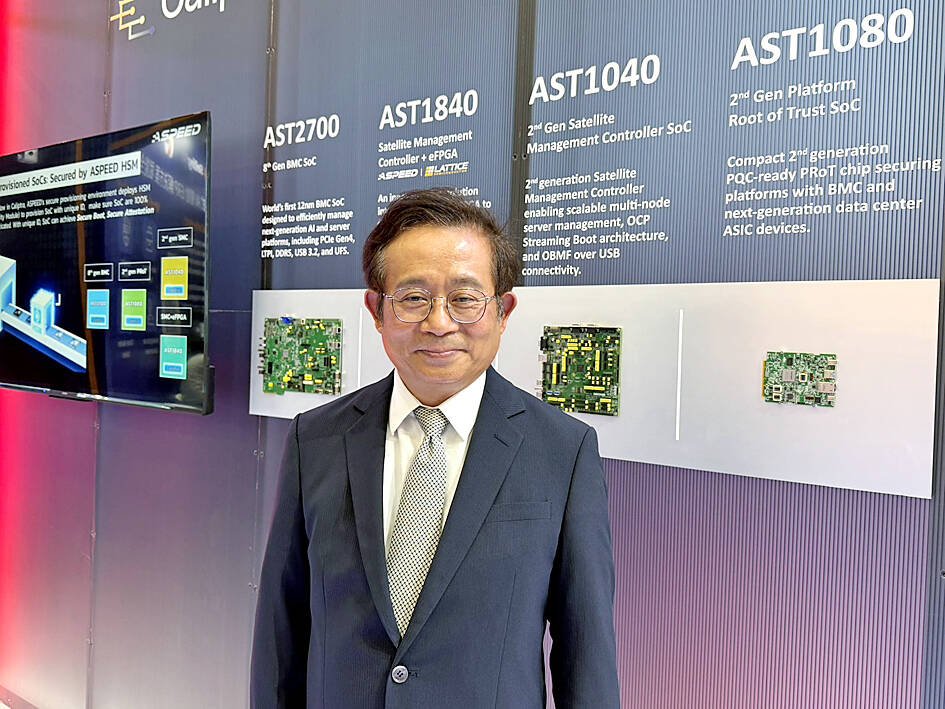
Aspeed Technology Inc (信驊), a supplier of baseboard management controllers (BMCs), expects revenue to grow significantly this year and next year, chairman Chris Lin (林鴻明) said yesterday, citing skyrocketing server demand as agentic artificial intelligence (AI) applications such as OpenClaw gain traction.
The company has secured big orders from customers, Lin said on the sidelines of the Computex Taipei trade show.
It is rare for customers to place such large-scale orders so early, he said.
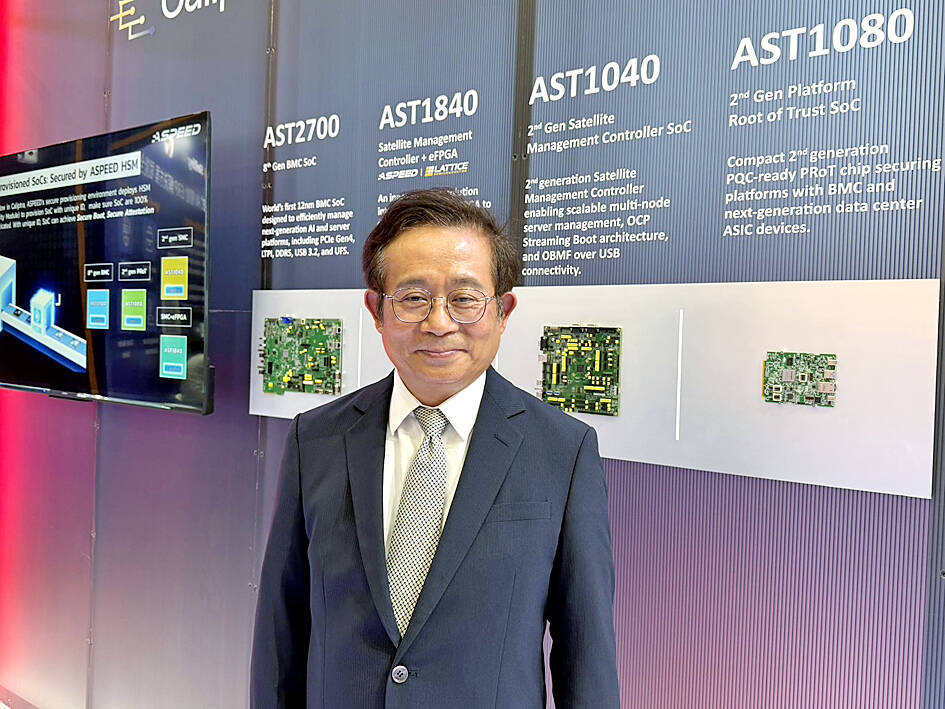
Photo: Vanessa Cho, Taipei Times
“Compared with the shipment forecast provided by customers at the end of last year, the volume doubled in January,” Lin said, linking it to the adoption of agentic AI applications and the OpenClaw craze.
“General-purpose servers and AI servers show strong momentum,” he said.
BMC is a dedicated service processor used for remote, out-of-band management and monitoring of the server’s physical state. Aspeed products can be used in servers powered by Arm Holdings PLC-based architecture, x86-based processors or custom AI accelerators.
“The more cloud service providers spend on servers, the more BMCs are needed,” Lin said. “The company’s revenue in the second half of this year will be higher than that of the first half. Next year will be much greater than this year.”
The more cloud server providers spend on AI infrastructure powered by their in-house AI accelerators, the more investment would be allocated to server deployment and therefore BMC purchases, he said.
In-house AI accelerators tend to be less pricey than Nvidia Corp’s chips or other major suppliers.
The company’s revenue momentum also gains support from the faster adoption of its new and higher-priced BMC product, codenamed AST2700, Lin said, adding that Aspeed ramps up the product in two years, rather than the three years typically needed for other products.
However, supply constraints of key components, especially substrates, have led to the postponement of some shipments to next year, Lin said.
Aspeed plans to replace T-glass-based substrates with E-glass-based substrates entirely because of supply shortage, he said.
“We thought the supply issue would be significantly improved in the third quarter. Now we have to wait until the fourth quarter,” Lin said.
To solve this issue, Aspeed has added a new supplier to help source substrates, he said.
Higher component costs add pressure to Aspeed’s gross margin this year, as the company aims to keep its long-term gross margin target at about 70 percent, Lin said.
Gross margin stood at 69.18 percent in the first quarter, the company said.