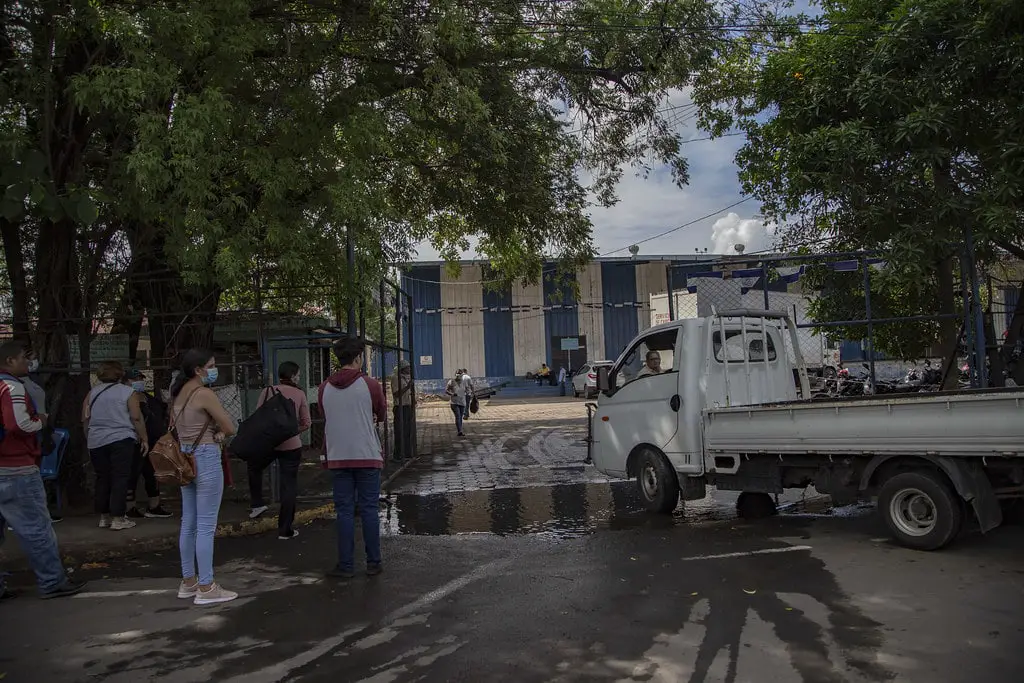
The administrator of the Central Air Customs summoned the external managers who come to those offices every day to “clear customs” the merchandise of various private companies, and warned them that they should stop offering money to the public employees who work there. Consistently, the private sector has denounced the existence of an extensive corruption scheme in Nicaraguan customs, which forces them to pay more than the law requires to obtain their merchandise.
The meeting occurred on Monday, March 16, 2026. There, the administrator of the Central Air Customs, Ernesto Torres, warned the thirty customs agents who were present at the premises that day, that they would not be allowed to offer money to the public employees under their command. He also told them to take care of their jobs, because if they were caught offering money, the agencies they work for would close.
Torres’ warning seems to imply that at the Central Air Customs, unauthorized corruption will not be allowed. In the regime of Daniel Ortega and Rosario Murillo, the concept refers to any form of economic crime that is committed on one’s own account, without consulting with the local authority, and without sharing the profits “with those above.” The administrator’s warning occurs after multiple complaints and publications about the system prevailing in that government entity.
The problem is the mechanism designed to promote illegal charges, which prevails in Nicaraguan customsas reported to CONFIDENTIAL people who were present at the meeting. Businessmen who depend on customs work to import merchandise, or medicines, or spare parts, etc., also They have complained about that corrupt schemewhich causes them economic damages.
The managers consulted explained that customs officials impose doubts on value and extraordinary charges; or they ask for bribes so as not to impose fines without reason. Or to remove them, when they have already been imposed. Or they stop doing whatever they are doing, to attend to the special cargo that they receive, property of those close to the regime who run privileged businesses. Like those in the parcel.
The special cargo It is “property of some special businesses. It is not reviewed, nor delayed, nor are taxes charged. It is not until they finish ‘clearing customs’ completely, and the work spaces are free, that the gaugers begin to serve the customs managers who are paying according to the law,” the sources explained.
200 córdobas to do their job
As in any modern tax system, customs are an important part of a State’s fiscal effort. In the case of Nicaragua, they collect about a third of the total taxes collected each year. Hence, the issue of probity is decisive for the well-being of the Republic’s budget.
The sources explained that, although several topics were discussed, there was one that was given the most importance: to the cessation of the bribe payment system.
Every day, customs agencies send their staff to manage the removal of merchandise imported by their clients. As part of their work, these managers must present declarations to the customs authority to define the amount of taxes to pay for that merchandise.
The problem is that the gauges work at such a slow pace that, many times, Managers have to offer them money to do their work faster. Precisely what administrator Torres says he wants to avoid, stating that “they should not make payments under the table.” The problem, the managers justify, is that the system is designed to cause these delays.
The simplest scenario is to have a declaration whose resolution is urgent, which is arranged by delivering “up to 200 córdobas” to the official in charge of processing it. Once the payment is made, “that official stops what he is doing, receives the manager’s statement, and hands him the document.
It is possible that that day, that manager has only submitted one return, but it is not unusual for him to submit up to 20 in a single day. If the decision is oil the mechanism with the 200 córdoba bills, that implies that you will have to pay a bribe of 4000 córdobas to the gauger in charge of serving you.
The silence of the guilty
Sometimes there’s more than just a long line at play. The first is that Customs is authorized to charge for each extra day of storage. It does not matter if Customs itself is responsible for ensuring that the merchandise remains in the warehouses or in its refrigerators, instead of being in the warehouses (or displays) of its owner, the importer.
If there are many days of delay, there is a risk that the merchandise will be declared ‘abandoned’. In that case, the law allows it to be sent to auction. To avoid this, an administrative fine of one hundred dollars must be paid, which does not necessarily prevent the merchandise from going to auction. The reason is that the managers must physically locate it and inform the gaugers, so that the normal “customs clearance” process continues.
“They delay us with their corruption; they cause the merchandise to fall into abandonment, and they force importers to pay fines, while the cost of storage is added,” said one of the sources. Given that he knows how his clients operate, he does not hesitate to affirm that importers lose little, because their option is to try to pass this extra cost on to their end clients, when that is possible.
Part of Administrator Torres’ threat is that the agencies for which managers who offer bribes work will be closed “for being corrupt.” Given that no gauger has ever complained about receiving money, nor has he denounced any manager for that reason, sources doubt that something like this could happen. “They are not going to do it because whoever says that knows that they lose a lot of money. It is 200 córdobas – for each statement – that they are not going to reject,” he illustrated.
They criticize double speech
“It is disgraceful to have to pay them for doing their job. They should organize themselves to receive and process the statements, but they choose to delay the entire process because they know that the more they delay the managers, the slower the line moves, the more they will collect those 100, 200, and even more,” details one of the complainants.
He explains that they are not surprised by the double standard that involves threatening small acts of corruption, while encouraging acts that generate large profits for those who protect the system. The novelty is that, this time, he said that “the manager and the official” who were found committing these acts of unauthorized corruption would be expelled.
What they do appreciate is the unexpected honesty that Torres showed when he threatened them at the impromptu meeting. The official told them to “take care of your jobs. The basic basket is very expensive, and you do not even earn enough to purchase a basic basket. They earn less than half”.
The reaction of those present was to remain silent in most cases. When faced with a proposal to urgently improve the facilities, Torres only responded that they send him the proposal by mail. Those present understood that the official was simply ignoring the request, and they continued to maintain a prudent silence.