There is no doubt that to be president of a country you must have a good dose of egocentrism. At the very least, you must believe that you have the formula to fix the problems of your country, and even the world. There are, however, pathological cases of narcissism among powerful presidents. And this makes these unique characters break with protocol, with written and unwritten rules, and, today, thanks to digital technologies and AI, they project their image publicly with spiritual and quasi-theological elements.
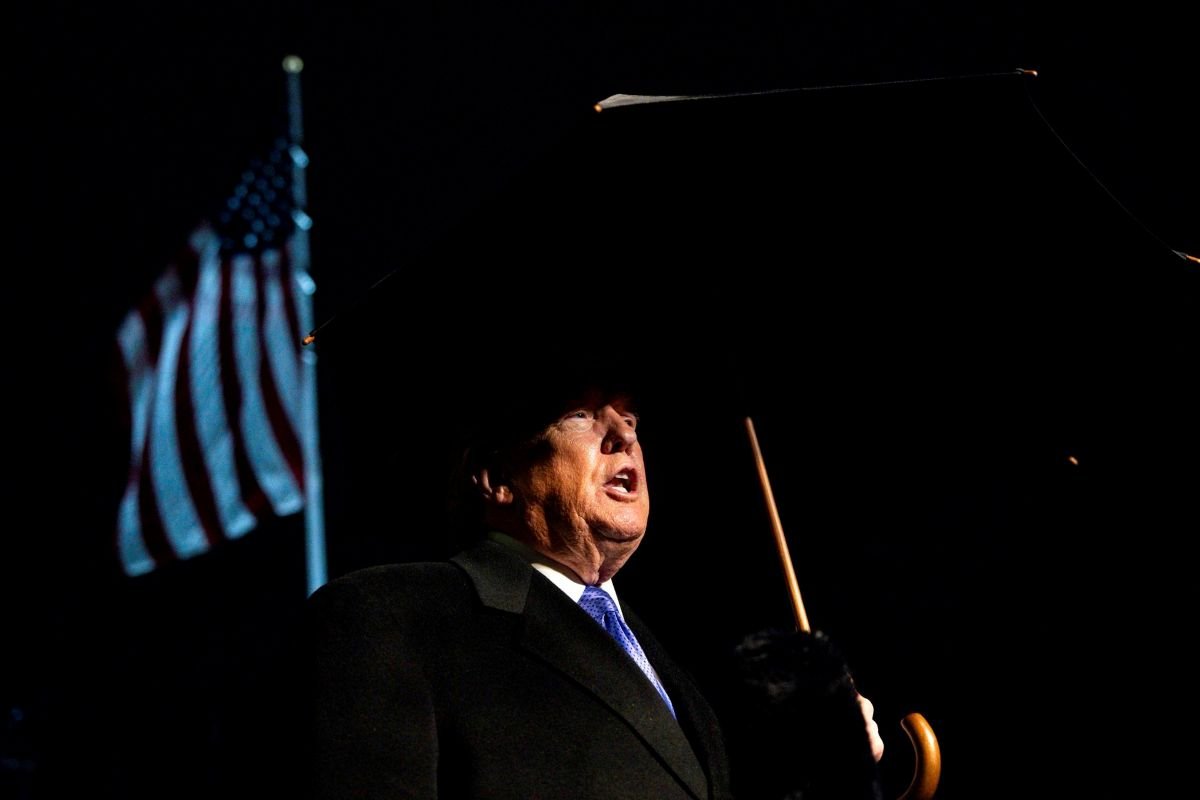
President Donald Trump and his recent controversy with Pope Leo XIV come to mind. The head of the Catholic Church has advocated peace, as might be expected. Trump has taken it as a criticism of his policy towards Iran. Vice President JD Vance has jumped into the fray to tell the Pope to be “more careful when talking about theology.” And to make matters worse, Trump had decided to publish a stamp on his digital network where he appears dressed in a Christ robe healing a convalescent man with the “power” of a little light that comes out of his hand, in a celestial-apocalyptic scene. The president of the United States had to erase the controversial stamp. Then he spread another image in which he is seen next to a Jesus who embraces him.
In Latin America, deified presidents have a history. Although she was not president of Argentina, Eva Perón, the Saint Evita to whom the journalist Tomás Eloy Martínez dedicated an excellent novel, lived her passion and death in full view of the fans of the “Lady” as they called her. Evita was, in her own way, a product of popular culture. Radio soap opera actress, she understood very well the importance of the media in politics. As Jorge Luis Borges wrote, the presidency of Juan Domingo Perón and Evita (they were a political-mythical duo) was marked by
“(…) years of opprobrium and nonsense, the methods of commercial propaganda and literature for concierges were applied to the government of the republic. Thus there were two stories: one, of a criminal nature, made up of prisons, torture, prostitution, robberies, deaths and fires; another, of a scenic nature, made of nonsense and fables for the consumption of idiots (…)”
Another more recent example is that of Hugo Chávez in Venezuela. He assumed demiurge roles on several occasions. The most notable of these occasions was the opening of the sarcophagus of Simón Bolívar on July 16, 2010. The transmitted Urbi et Orbi on television, an event between the grotesque and the ritual, in which Chávez intended to assume the role of new Liberator by showing the world the skeletal corpse of the patriotic hero, whom the president had symbolically taken down from the altars to lower him to the pit of death.
The other moment was when Chávez assumed the role of a Catholic priest in a quasi-homily he gave, between tears (he implored for healing from the cancer that killed him) and jokes (he remembered his parents’ courtship), at a Holy Thursday mass on April 5, 2012 in Sabaneta de Barinas (his birthplace). Broadcast on television, Chávez’s improvised speech showed him many times in front of a Nazarene carrying the cross. Once again, the president-commander sought to be confused with a religious figure (on this occasion with the most important religious figure in a mostly Catholic Venezuela).
Mixture between politics and religion
The convergence between politics and religion marks several of the world’s conflicts today. The ayatollahs of Iran base their ideology on an eschatological Shiism based on the idea that there would be a twelfth and last mahdi (equivalent to a messiah) who would be hidden. So that he mahdi is revealed, the Iranian religious believe, the End Times would have to be accelerated, unleashing a war of apocalyptic proportions against what the Iranian leaders call the Great Satan (USA) and the Little Satan (Israel).
In Israel, some of the factions of the current government headed by Benjamin Netanyahu are inspired by a nationalist messianism with an eye also on final redemption. This is the case of the controversial minister of national security, Itamar Ben-Gvir (party Otzma Yehudit“Jewish Power”) and the also controversial finance minister, Bezalel Smotrich (Religious Zionist Party), who propose an ideology of maximalist aspirations according to which Israel should exercise sovereignty over the entire territory from the Jordan River to the Mediterranean Sea.
In India, Prime Minister Narendra Modi’s ruling party, the so-called Indian People’s Party, combines nationalism with Hinduism. Its program vindicates the socio-religious values of Hinduism, maintains problematic positions on India’s Muslim minority (around 14% of the population), and maintains belligerent positions against its Muslim-majority neighbor, Pakistan.
It seems that the advent of modernity has not clearly ensured the separation between “church and state.” The republican principle derived from the 18th century revolutions of a division of earthly and heavenly powers has been tested several times in the 21st century. After the terrorist attacks of September 11, 2001, the crusade against the enemies of the United States and the West has been invoked (as did President George Bush), Huntington’s thesis on the clash of civilizations has resurfaced, and populists on the right and left have played conveniently with a second-hand theology to justify their warlike or revolutionary actions.
Already in 1978, in the run-up to the Islamic revolution in Iran, the French intellectual Michel Foucault had enthusiastically observed the “spiritualization of politics.” An atheist like him, anti-disciplinary and anti-power, he saw in the Islamization of Iran under the leadership of Ayatollah Khomeini, an explosive mixture that would forever change power relations in the Middle East and in the Islamic world in general. Foucault was right. However, the explosive mix between religion and politics does not ensure peace or stability. The results are visible.
*This article was originally published in Latin America 21.