
Online Economy – Meshya Heydarian; Bitcoin is back in the headlines once again, but this time not with record highs and new highs, but with one of the heaviest and most breath-taking price corrections in recent cycles.
The king of cryptocurrencies, which had reached new historical highs a while ago in the heat of the climb, fell below the psychological level of $60,000 during the past few days. At the time of writing this report, the price of Bitcoin in the global markets is changing hands in the range of 61 thousand dollars (equivalent to about 52 thousand and 800 euros) after experiencing extreme fluctuations.
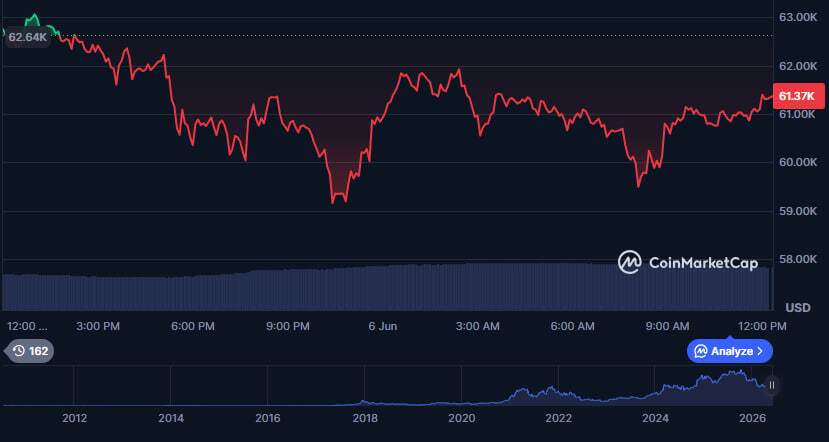
This sudden drop turned into a full-scale “bloodbath” on the derivatives trading board, pulverizing nearly $3 billion of long positions in less than two days. But beyond the panic ruling the market and the emotional behavior of retail traders, what is the current circulating in the veins of this network? To understand this, we need to put the pieces of the puzzle together in terms of on-chain data, the behavior of big players and macroeconomic variables.
War of narratives; When artificial intelligence swallows liquidity
One of the fundamental differences between the recent collapse and the previous reforms lies in the significant change in investment geopolitics. At a time when American stock market indices such as the S&P 500 are setting historical records due to the unprecedented boom in the artificial intelligence sector, Bitcoin has faced an unprecedented outflow of liquidity. Institutional giants, which were the driving force of the crypto market, are now directing some of the capital towards massive AI infrastructures.
This change of strategy shows itself clearly in the balance sheet of exchange traded funds (Spot ETF). US Bitcoin ETFs, once a symbol of uninterrupted capital inflows, have now lost more than $4.4 billion in liquidity, recording a 13-day streak of net capital outflows; BlackRock is also seen at the head of managing this capital outflow.
In this regard, the financial report of the Strategy company regarding the trial sale of 32 units of Bitcoin for the first time after years caused a severe psychological shock to the market. Although this sale is small compared to the company’s massive 843,000-coin reserve, the currently jaded and sensitive market interpreted it as the first sign that Bitcoin’s biggest corporate backer might take a profit, fueling public panic.
intra-chain secrets; The dirty game of the whales in the zone of extreme fear
With the price drop, the fear and greed index of the market reached the number 22 with a free fall, which shows the state of extreme fear. But just as short-term traders are selling at a loss for fear of losing their assets, the data tells a different story. The Bitcoin outflow index from exchanges shows that a huge amount of assets are being transferred to cold and secure wallets; A behavior that shows silent accumulation (Accumulation) by veteran whales.
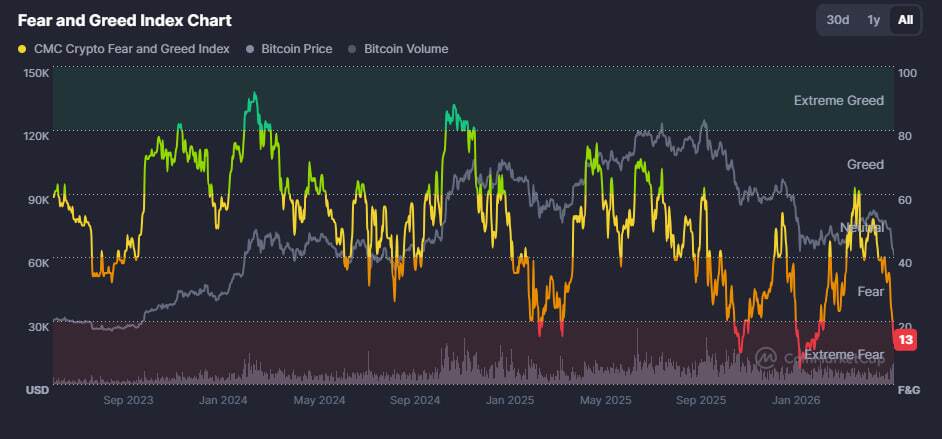
An examination of the consumed output profit ratio (SOPR) shows that the amount of short-selling by retail traders has reached its deepest level in recent years. In fact, by leveraging the negative news, the Walls drove the price towards liquidity pools in the $59-$60k range to clear leveraged positions and be buyers themselves at lower prices.
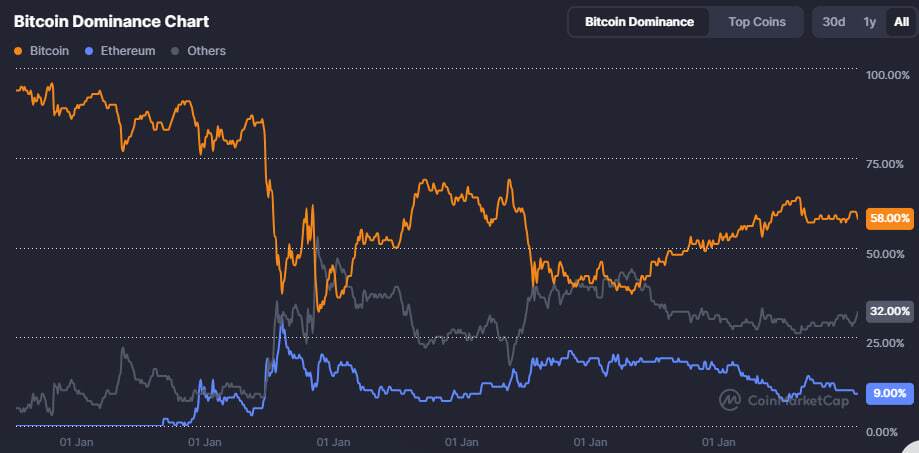
In the meantime, the Bitcoin dominance index (BTC Dominance) has also faced a relative increase. This shows that during the crash, the fall of altcoins was much more severe, and investors again sought refuge in the relatively safer haven of Bitcoin to preserve the value of their assets, which keeps the macro structure of the market still in the hands of the king.
Confluence of the technical front and the macroeconomic front
From a technical and chart perspective, Bitcoin challenged its medium-term uptrend by missing the 100-day moving average and headed straight for the big demand zone in the $60,000 range. The relative strength index (RSI) on the daily timeframe has reached the oversold range (number 18), which technically creates a high potential for a corrective bounce. The limit of 60 thousand dollars is not only a mental barrier, but also the limit of profitability and production cost of many miners after the recent halving; Sustained breaking of this level can force old miners to shut down their devices and capitulate.
This technical pressure was also aligned with the hot US macroeconomic data. The recent report of the US labor market (Non-farm Payrolls) was much stronger than Wall Street’s forecast and the unemployment rate remained at 4.3%. This unexpected strength in the macro economy delayed speculation of a rate cut by the Federal Reserve and pressured risk-averse markets such as crypto.
In addition, the recent escalation of geopolitical tensions in the Middle East and the shadow of conflicts have caused a jump in oil prices and the return of fear of inflation, which has pushed global liquidity towards safe assets, such as gold.
upcoming scenarios; Where is Bitcoin going?
Considering the compression of the price at the border of the $60,000 channel, two fateful scenarios are envisaged for the coming weeks:
Upside scenario (back from the edge of the abyss): In this assumption, the $60,000 range acts as a valid double bottom. With the RSI oversold, the Walls have completed their step-buying and the outflows from ETFs have stopped. By breaking the first resistance at $65,000, the price paves its way to reclaim the $70,000 channel. The confirmation of this scenario is the closing of the authoritative weekly candle above the $62,500 mark.
Descending scenario (falling into darkness): If the institutional selling pressure continues and the daily and weekly candle stabilizes below the $60,000 mark, the Bulls (buyers) defensive fortress will collapse. In this case, with the activation of a new wave of limit losses and the surrender of miners, the price will fall to the next support areas in the channel of 54 thousand and then 52 thousand dollars to hunt for older liquidity.
Bitcoin now stands at one of its most critical decision-making stations; That is, where the war between artificial intelligence liquidity, the contractionary policies of the Federal Reserve and the strategy of accumulating walls will determine the next path of this rebellious asset. What is important in the coming days and weeks is the price reaction to the key range of $60,000, as well as the inflow and outflow of capital from ETF funds. Holding this level could turn the recent correction into a temporary break in the uptrend, but losing it would increase the probability of the market entering a deeper phase of the correction. For this reason, traders and investors are more than ever looking at such data, macroeconomic developments and the behavior of major market players.