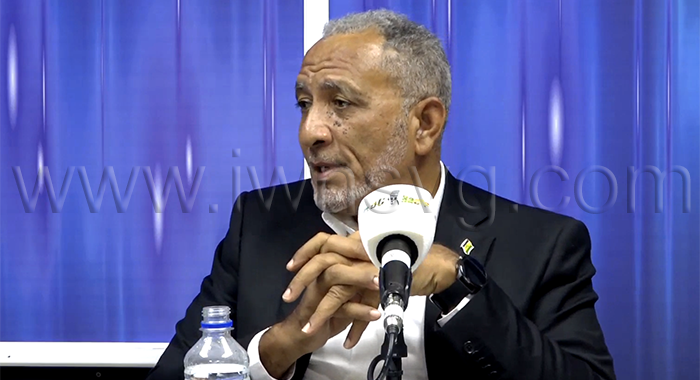
Prime Minister Godwin Friday is standing by his government’s plan to establish a national development bank (NDB) in St. Vincent and the Grenadines (SVG) despite objections by the Washington-based International Monetary Fund (IMF).
He argued on NBC Radio on Thursday that an NDB is essential to reversing economic stagnation and addressing the country’s high debt.
Friday, who is also the minister of finance, legal affairs & justice, economic planning, and private sector development, said the proposed bank is a response to long-standing structural constraints in access to credit, especially for small and non-traditional businesses.
The NDB was a central plank of the campaign of Friday’s New Democratic Party (NDP), which came to office in the November 2025 general election, winning 14 of the 15 parliamentary seats.
However, the IMF has urged the government not to proceed with an NDB, with its IMF mission chief for SVG, Sergei Antoshin, warning on April 28 about the risks of new quasi-fiscal institutions in an economy with already elevated public debt and a record of weak performance by development banks in the region.

The prime minister, however, said that the starting point is a “stagnated” economy with already high public debt, at 113% of GDP, and projected to rise further without policy change.
“If we continue the way we are, … it could get to as high or higher than 145% in the next five years. That’s unacceptable,” Friday said.
The prime minister said the government accepts that the debt profile is “serious” and needs to be managed, but argued that economic growth is the quickest path out of the current situation.
“… in our discussions with the IMF and other bodies … they understand that growth is really the thing that will get us out of the debt situation the fastest,” he said.
The IMF has said that economic growth in SVG moderated to 3.7% in 2025 as the post-pandemic rebound faded, although tourism and construction remained strong.
The IMF said in April that it expects growth to decelerate further in 2026-2027 in light of higher oil prices, a weaker global outlook and the normalisation of construction activity, converging to 2.7% over the medium term.
The prime minister said this is the right time to pursue the NDB “because this is the way we get out of the difficult situation that we [are in] and we have to transform our economy…
“We have to unleash the creative and business potential in our economy and to make it available to ordinary people to start doing things to grow our economy.”
Friday rejected suggestions that the NDB is driven by ideology or by an attempt to revisit old political projects.
He acknowledged that SVG had an earlier development bank, created under a previous administration in the 1970s–80s, which was later folded into the National Commercial Bank, and that critics see that experiment as a “stillborn” project.
“First of all, this is not an ideological thing, and this is not a redemption project,” Friday said.
“Everybody identifies the problem, and we come back to the same thing — is to try to deal with what we have as if that is the perfection that we’re seeking. It doesn’t work. That’s what we have seen.”
He argued that the question now is strictly what institutional design best addresses the credit constraint.
“What we’re saying is what is the best way in which to achieve this, and that is why we are pursuing this objective, because we believe that, properly managed, properly established, that it can meet that need.”
The prime minister noted that there was a more detailed discussion with the IMF before the joint press conference with Antoshin on April 28.
He said the IMF’s two primary concerns related to debt sustainability and contingent liabilities and quality and politicisation of management.
Friday said the IMF warned that where development banks have struggled, governments have sometimes had to inject additional resources, thereby increasing the public debt burden.
“Historically, there [has] been politicisation of these institutions in some places that may have resulted in poor performance, you know, high non-performing loans and so forth.”
Friday said his administration intends to “take on board those concerns” and design the NDB to avoid the pitfalls highlighted by the IMF.
“Any enterprise that is developed will fail if you don’t manage it properly, whether it’s a business, whether it’s a commercial bank or a national development bank,” Friday said.
“It is not written in stone that these institutions can’t function properly, because there are examples even in our own region, where they have provided benefits to the economies of those countries.”
Asked directly about the risk of political lending and “loans … granted based on affiliation rather than viable business plans”, Friday said the bank’s survival depends on clear, consistently applied standards.
“For it to survive, for it to achieve its objective, it has to function on set principles that everybody understands,” the prime minister said.
“You want to be generous and supportive of small investors and so forth… but the only way you can sustain that is if you’re also rigorous in terms of the standards that are applied to the… lending of the money and the ways in which they are monitored and required to pay back.”
He added:
“If you’re going to do it on [a] political basis, then … you are not serious about the development of the country…”
He said people will have to have a good idea, good plan and willing to work.
“It’s not just a matter of coming and showing a party card and say, ‘Listen… I come to collect.’”
Friday said the measure of success will not be profit maximisation but the performance of the borrowers themselves.
He argued that the government is already involved in targeted lending and support schemes, but these are scattered across multiple entities and presented the NDB as a way to consolidate and professionalise those functions.
The prime minister mentioned, as examples, the Farmer Support Company and the National Student Loan Company, noting that they provide loans to individuals who would not get them from the commercial banks.
“These are things that we could bring together under one head, have proper management, reduce overhead and make it more efficient.”
Friday said the NDB will also provide support services and not just disburse funds.
“It’s not just a matter of lending money and stepping back and saying it’s up to you to sink or swim,” he said.
On capitalisation, Friday said the government has already identified initial seed funding in the national budget and has been in talks with external partners.
“We have had conversations with … international financial institutions, some of them are agencies that provide private sector funding, others that provide the traditional concessional loans…
“We have had conversations with… bilateral [partners] with countries, friends, saying ‘These are things that we plan to do, and how can you help?’ And the response has been extremely positive.”
He said the government has already re-allocated approximately EC$1.5 million as seed funding and is targeting a significantly larger capital base over time.
“In the last budget, we put in about $500,000 and they said, ‘Oh, only $500,000 to fill the bank.’ But in fact, we’ve located about $1.5 million within the current [budget] that can be used initially as seed funding,” Friday said.
The prime minister also spoke of his government’s plan to implement a citizenship by investment programme, saying it will be rolled out “soon”.
“Capital that is raised in that programme will also be used to seed the funding, because that comes with no interest … that is money that is essentially no interest funding that [we] could use as well to help the finances.”
He said the government is hoping to raise at least $10 million by the end of the year to capitalise the NDB.
“I think that’s feasible,” the prime minister said, adding that resources would not be built on costly borrowing.
“What we can’t do is borrow money at 5, 6 and 7% and then put in the bank and you have to lend [at] 12%. That is not going to work.”