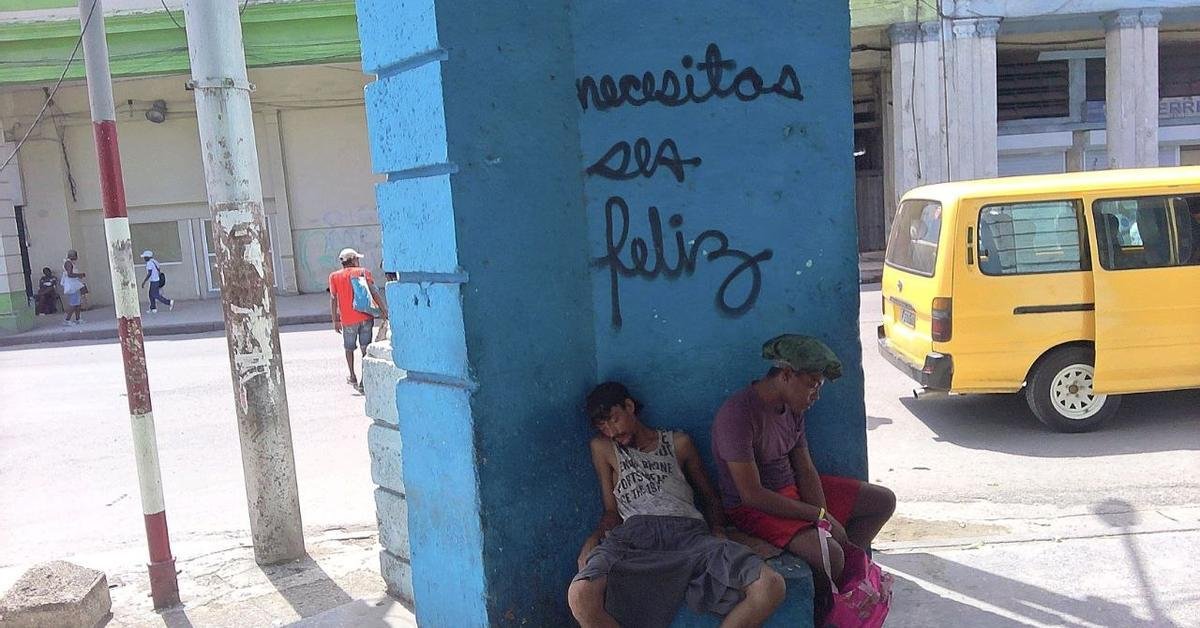
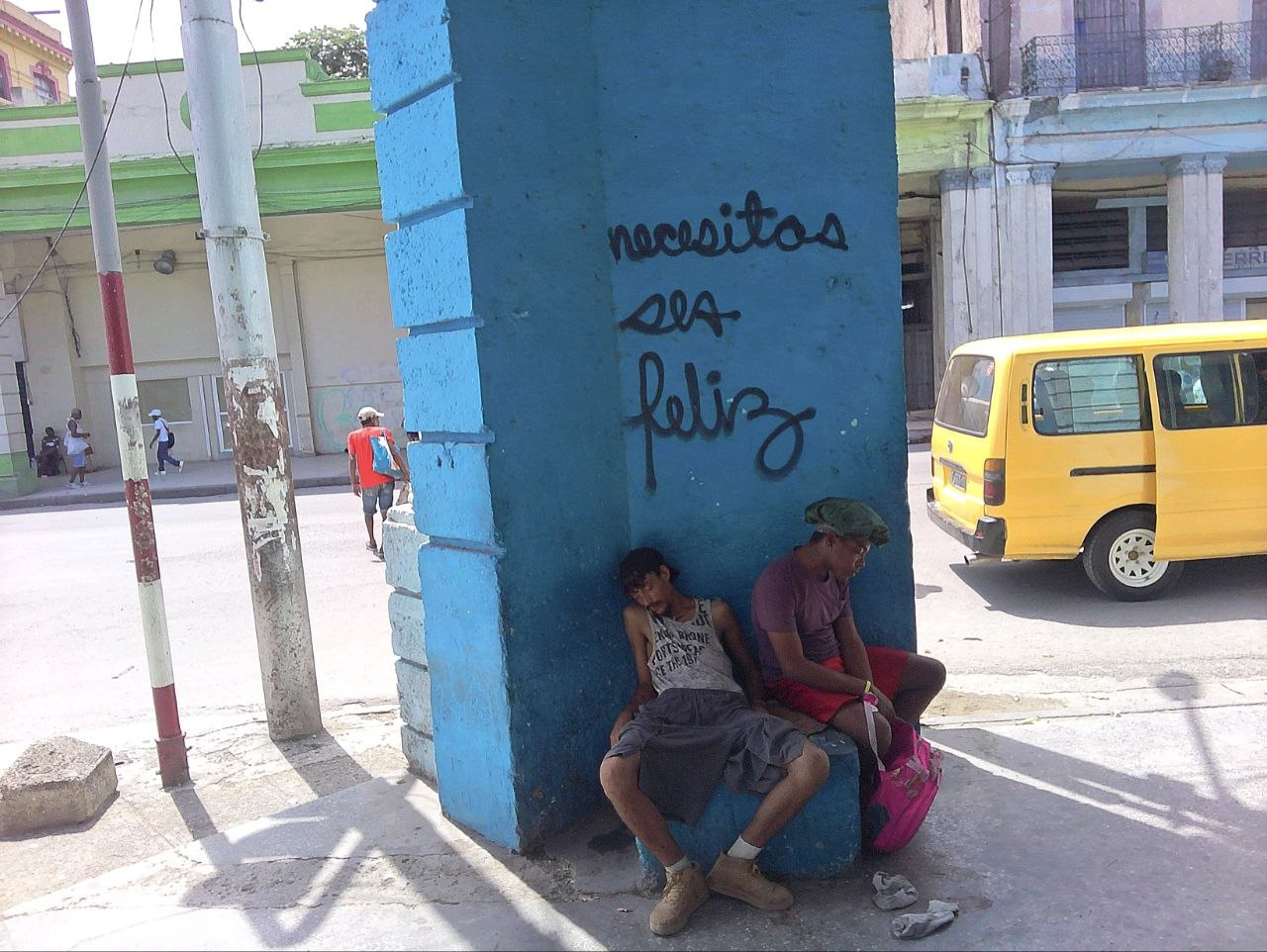
Havana/The phrase “You need to be happy,” which the graffiti artist Abraham Echevarria has multiplied by the streets of Havana, it works in itself, wherever it is recorded, as an eloquent photo caption or a desperate call. Whether on the props of a building about to fall, on the door of a bookstore, in a trash can or in the ruins of the old Higher Institute of Industrial Design (ISDi), the three words automatically challenge whoever passes in front of them.
“The idea is to highlight the obstacles that there may be to happiness,” the artist himself said of his work a few months ago, in an interview with 14ymedio. This same Wednesday, a scene under one of his posters highlighted his intention.
On the blue column on Reina Street on the corner of Galiano, in the heart of Centro Habana, where the prayer was erased and later rewritten, two young people were sleeping the unequivocal dream of chemical in your body. He synthetic cannabinoida workhorse of the authorities in recent years, had left one – a dark-skinned man with a mustache – leaning back, the other – a hairless man with a green cap – leaning forward.
“There is not even a police officer to turn to when you need it,” said an elderly woman sadly when she saw the scene.
The latter was holding a pink backpack that, in a swing, came loose from his hands. The first, who was also carrying a backpack, had simply been left unconscious. At that moment, a third man, fast and impassive, passed by and stole the brunette’s backpack, before crossing Reina and getting lost in the crowd.
Some passerby shouted, another threatened to run after him, but gave up immediately. “There is not even a police officer to turn to when you need it,” said an elderly woman sadly when she saw the scene. “And that just yesterday there was an anti-drug operation throughout Reina Street.”
In effect, the regime’s efforts against a drug against which it remained impassive for too long. Last July, the General Customs of the Republic of Cuba seized a shipment of chemical hidden in two food boxes coming from the United States.
In April, Customs seized 22,800 doses of the synthetic cannabinoid, also from the US, inside a cereal box. On both occasions, the authorities highlighted that that country is “the main origin” of the substance, seeing the opportunity to blame the usual enemy. and boast of effectiveness.
The Government has for some time, however, recognized an increase in drug consumption, unlike what happened in the past, and has shown concern about its circulation on the Island, especially among young people. The crusade, in fact, has reached other products that do not qualify as drugs per seas is the case of Shaka, an energy drink mixed with alcohol that has already caused several serious poisonings.
At the same time, it insists on stating that the Island “is not a country that produces or transits illicit drugs” and that the official policy is “zero tolerance.” Although the Cuban Penal Code punishes the possession and trafficking of illicit drugs with penalties ranging from four to 30 years in prison, even life imprisonment and even the death sentence, consumption continues to increase. In a country where the most basic things are scarce, the sad reason can be found in the phrase of the graffiti artist Echevarría: “You need to be happy.”