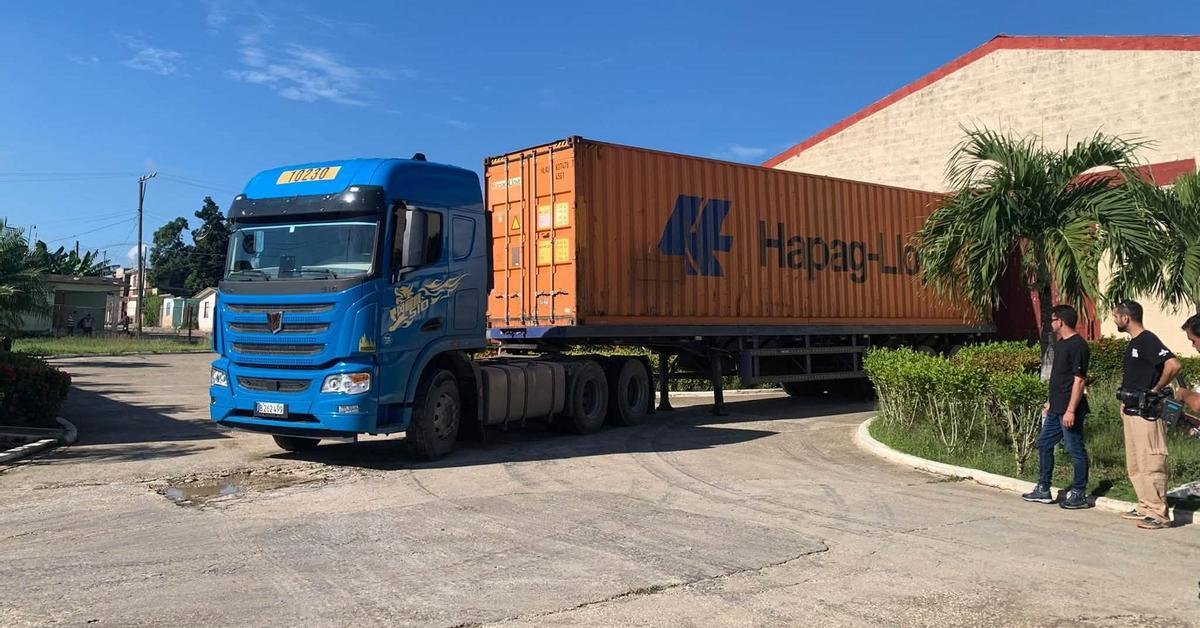
Havana/The first thousand photovoltaic kits destined for coffee-growing families in eastern Cuba have arrived to Santiago de Cuba in a container with the logo of Hapag-Lloyd, the German shipping company that last May announced the suspension of its services with the Island for fear of US sanctions.
The photographs spread by BioCubaCafé – a Cuban-Italian joint company – show several workers unloading boxes from an orange container with the name of the European company, a striking detail amid the Government’s repeated complaints about the thousands of shipments supposedly stranded in foreign ports.
On May 18, Hapag-Lloyd and the French CMA CGM They suspended their services with Cuba. These are two shipping companies that concentrated around 60% of the island’s maritime traffic. Both justified their decision due to the risks associated with Washington’s new sanctions. Since then, Cuban authorities have reported that more than 7,000 containers remain immobilized in different ports in the Caribbean.

/ Facebook/ Biocubacafé
In August, the derailment of a freight train in Camagüey exposed several containers of CMA CGM, supposedly prevented from operating with Cuba. In September, Deputy Prime Minister Óscar Pérez-Oliva Fraga then admitted that the French shipping company had partially resumed its servicesalthough limited to food, medicines and medical supplies.
On this occasion, the merchandise consists of small solar systems that BioCubaCafé will distribute among producers in the mountainous areas of Santiago de Cuba, Granma and Guantánamo. The thousand pieces of equipment received constitute half of a program of 2,000 units, the cost of which will be partially financed by the Food and Agriculture Organization of the United Nations (FAO), as announced by the company.
The kits will not be free. Each one has a declared value of $360, of which the international organization would cover half. Coffee growers will have to pay the other $180, although they will not need to disburse it immediately, since the amount will be deducted from a part of the foreign currency income they receive from the sale of their crops.
BioCubaCafé assures that during the 2026-2027 campaign it will pay 60 cents for each can of top quality Arabica coffee and 30 cents for robusta. With those rates, the price of the equipment is equivalent to the revenue for 300 cans of Arabica or 600 of Robusta (one can contains between 4 and 6 pounds of clean coffee, depending on the variety).
/ Facebook/ Biocubacafé
The systems have modest features. They work with a 12 volt direct current panel and do not need an inverter. They include a distribution box, five light bulbs, two USB ports, a fan with a lamp and a battery to store energy at night. They also include 20 meters of cable and basic tools for assembly, which, according to the company, can be carried out by the family itself without specialized help.
However, the equipment does not have the capacity to sustain the usual consumption of a home or power a conventional refrigerator. BioCubaCafé claims to be working on a more powerful version, with two batteries, but has not announced when it will be available.
Distribution will also not depend exclusively on the electrical needs of families. Priority will be given to producers who exceeded their coffee delivery commitments during the previous harvest, a formula that the company presents as a stimulus to productivity.
The initiative comes at a particularly difficult time for the sector. Santiago de Cuba, the country’s main coffee-growing province, expect to pick up just 1,390 tons during the 2026-2027 campaign, compared to the nearly 4,000 it projected just two years ago. The collapse occurs despite international cooperation programs and million-dollar investments aimed at recovering the coffee plantations.