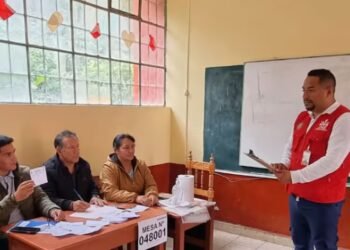
Almost 28 million Peruvians go to the polls this Sunday to elect the next president of the Republic and new members of the bicameral Congress. This process occurs after a five-year period in which the country was immersed in a deep political crisis, which worsened citizen rejection and distrust of the authorities.
These elections are characterized by the unprecedented number of 35 presidential candidates and having the largest and most expensive ballot in history. Of the total number of candidates for the red seat, only two will go to the second round.
In dialogue with The Commercepolitical analysts César Campos, Katherine Zegarra and José Carlos Requena analyze the panorama of the country after these historic elections and the main challenges that the new ruler will have to face.
1. What awaits the country after these complex elections?
Cesar Campos: The country needs to have a president who will pacify it because we are very polarized. There has to be a much more constructive and more pacifying language. This is what is required because if we are going to continue polarizing we are not going to achieve any objective.
Katherine Zegarra: In many cases, Peruvians are faced with hopelessness and perplexity in the sense that not many understand the results (…) There will be feelings that more than a democratic party, it is finally an election between what many consider to be the lesser evil and that will deepen further in the second round. This is because there are no candidates who generate hope, who have citizens who support them in an important way.
Jose Carlos Requena: This will depend a lot on the results of this first round. This will allow us to see how much margin of reasonableness there could be. After today we will see how divided the country is or if the situation is more homogeneous. There we will only know if we are facing the possibility of breaking this cycle of instability or if this trend of recent years is going to be reversed. From what we see, until now, it is not very clear. The only thing is that we will see which candidates or parties will have a presence in Congress, which is a fundamental space.

General Elections 2026. (Photo: Andina)
Read also | Keiko Fujimori closes her fourth campaign: “I have not been president yet, others have governed”
2. What challenges does the new president of the Republic face?
Cesar Campos: The main thing is the fight against informal economies: illegal mining, drug trafficking, illegal mining, logging, human trafficking, land trafficking. We have an accumulation of de facto powers that move in Peru, which I believe is necessary to combat, because that is where the issue of citizen insecurity arises, with the rise in organized crime in our country.
Secondly, have definitions about the economic model, not enter into contradictions. We need regulatory bodies to be strengthened. Also put an end to the enormous paperwork and permitting that exists for mining investments, especially in a cycle that awaits us until the next ten years, of rising metal prices. Peru has very good projects and initiatives underway that must move forward and that are in the process of exploration. The latter has had sustained growth in recent years, but greater effort is required.
Also a big challenge is to have a definition on the issue of Petroperú, we see how it advances and retreats around it and that is definitely something so that there is a very clear voice to define its destiny. Finally, defend the autonomy of the Central Reserve Bank.

José María Balcázar assumed the Presidency of the Republic after the fall of José Jerí.
Katherine Zegarra: He is probably a president without a majority in Congress. So your first big challenge will be to maintain it for five years, which is already a big enough challenge and one that wasn’t there before. This possibility of not knowing how long your mandate will last generates a feeling of vulnerability and a constant short-term vision instead of the search for complex medium- and long-term public policies. We will probably have a president without a majority, with the need to seek support (in Congress) for his government to be viable.
Jose Carlos Requena: The fundamental thing is to obtain parliamentary support on which you can support your management: your first challenge is to last. When the possible result is already in place, many people begin to see who the vice president is because eventually he would be the one who can replace him. This is a realistic and very negative view because we should aspire for whoever is elected to complete his term.
Read also | What cannot be done in Elections 2026? These are the restrictions and since when they apply
3. What should be your first political gestures?
Cesar Campos: Make a call for the unity of the country. To do this, I reiterate, there must be less violent and confrontational language and rhetoric. At the end of the day, it is all Peruvians who need to unify around very precise ideas and very clear policies about what our destiny should be. If we ramble or get into too many fights and conflict we are not going to get anywhere.
Katherine Zegarra: It would be very significant for citizens to take concrete measures, based on evidence and accompanied by experts, in the fight against insecurity. Instead of states of emergency, which have been of no use, multi-ministerial, inter-organic measures. Talk not only to the police but also to the Public Ministry. Strengthen the police and the Judiciary as well. These measures are the ones that citizens would value most. Likewise, commit to making important changes in the health, education and transportation sectors, which greatly impact the lives of Peruvians.

Police officers during an operation in Callao. (Photos: GEC)
Jose Carlos Requena: To prevent this cycle of instability is to present a bill that has to do with the role of vice presidents, an initiative that Víctor Andrés García Belaunde promoted when he was a congressman. We have seen that in recent years this position has been key, as in the case of Martín Vizcarra and Dina Boluarte. What this project proposes is that if the president falls, the entire government falls and elections are called. That could have a force similar to the famous cross death in Ecuador and could inhibit the voracity of some parliamentary actors or the ambition of the eventual vice president. The rules called procriminality, such as the one that has to do with raids, would have to be reviewed on a case-by-case basis.
4. What could you do to regain citizen trust?
Cesar Campos: Act with absolute transparency. We have had the last heads of state with too much obscurity, too many shades of gray in their actions, both public and private, that a president is required who is open-door, with an impeccable and clean conduct, not only in personal terms but in public execution. Don’t be tempted to only appoint close friends to public positions but rather qualified people. To do this, he must be a person with broad appeal, who can even include people from other political movements. Additionally, promote the construction of citizenship.
Katherine Zegarra: It is a complicated process because this degradation of trust has been maintained by many leaders, for a long time. So, having enthusiasm for representatives again depends on a fairly strong showing that they work for the common good and not for particular interests. The position requires a very high level of transparency and, to achieve this, the next president must be willing to be accountable even in private matters.
Jose Carlos Requena: That has to do with consistent, constant work and closeness to people’s problems. Sending important signals, such as that the Ministry of the Interior stops being the president’s bodyguard and, rather, worries about safeguarding citizen security. In the time of Pedro Castillo it became customary for the Minister to become the presidents’ bodyguard and that should be reversed. This sector must be given the political weight it should have, taking into account that it is such a high concern among citizens.
5. What mistakes should you avoid to avoid repeating history?
Cesar Campos: In addition to transparency, not having private, private, hooded or unhooded cenacles; not receiving gifts from governors, Rolex watches; and appear distant from any temptation to take public coffers for private benefits. He should not repeat the issue of promoting negotiations with family members, as Pedro Castillo did. Do not be incoherent, declare in one line and follow another, that happened, for example, with Petroperú. You must have a lot of firmness and conviction in the things you do and not have double standards. Finally, with Congress it must seek consensus, but not in exchange for perks but rather for fixed points of open public policies, which are useful and beneficial for Peru, not for particular groups.
Katherine Zegarra: The president and his elite must understand that they should not act in favor of their own interests and rescue the dignity of the position of president of the Republic as the most important. This is related to political leaders behaving at the level of the position they represent. Have an openness to your personal life. You have to understand that this position is the one with the least privacy and, in this case, there will be a lot of scrutiny because there is a lot of responsibility at stake. Then you should avoid events such as meetings at night, in secret, hooded. Stay away from and suspend friendships with State suppliers and not receive any type of handouts.
Jose Carlos Requena: Both the Executive and Congress should strive to restore the balance of powers. It will be important to have a president without complexes, with a real agenda and who knows how to contain the populist appetite that comes from Parliament. What we have had, especially in the government of Dina Boluarte, are subjugated presidencies. That does not necessarily require a particular change but rather a willingness and awareness to level the playing field again. Whoever is elected president must be aware of this. In addition, looking for a group of competent and respected ministers in their sectors, there has also been a deterioration in that function, ministries have been distributed according to sympathies and not with meritocratic criteria.