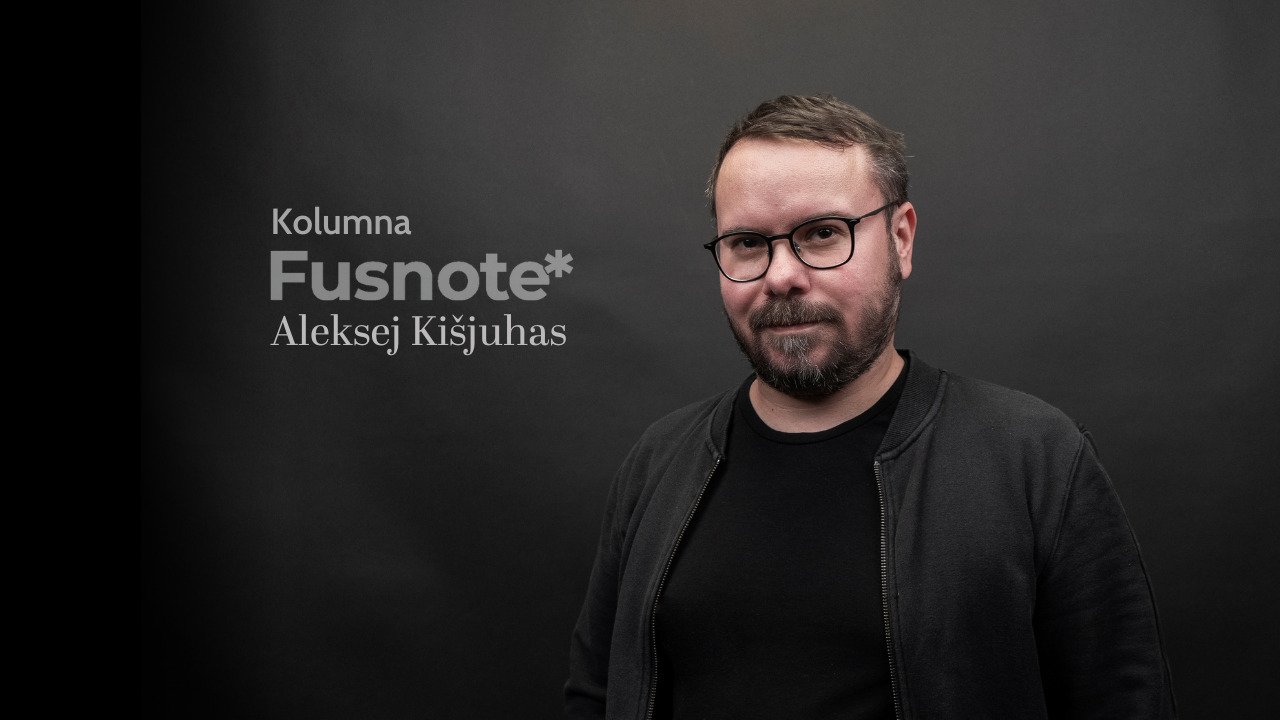
That also happened – I was the subject of a disgusting tabloid hunt, that is, an orchestrated campaign of deception and lies. Before that, three hours of harassment at the border crossing. And I don’t know how the dildo from my trunk got to the mouth of the propagandist of the regime. The goal, of course, was moralistic denigration, defamation, that is, a pure violation of reputation and honor, as well as privacy.
The point was to publicly embarrass myself, self-censor, to question myself and my life, as well as to attack my family – all standard security tools. And family, friends and colleagues are just fine, thanks for asking. All this unpleasant silliness only brought us closer and, in fact, made us giggle. (“That fortress will be a little more difficult to demolish,” in the words of Stoic philosopher Đorđe Balašević.) Messages of support poured in like a monsoon. And after that pre-planned and extremely detailed search with the removal of all underwear and confiscation of the phone, I did not receive any report or fine – because I did not commit any wrongdoing. And they asked a lot about my lectures in Croatia, about my books (a collection of “University in Rebellion” columns), red hand stickers, business cards of “foreigners” from my wallet, and the like. The only thing that was packaged and spun for me at the end, or my only sin, was a supposedly exciting sex life. The policeman then apologized in a whisper, and extended his hand to me with the words “What can I tell you? You know the situation in the country best. And it’s a shame that I’m saying it in this uniform.” Then who should be ashamed?
The whole fuss was about ruining my reputation. As a professor, columnist, and even Homo sapiens. But what exactly is that reputation? “Honor and reputation”, in legal terms? Well, let’s think about the following. Which would we rather choose? To be the most intelligent person in the world, but to be considered the stupidest? Or the stupidest person in the world, but to be considered the most intelligent? Many would choose the former, but many the latter.
So, what is more important to us as individuals – external or internal recognition, so to speak? Swiss publicist and entrepreneur Rolf Dobelli (“The Art of the Good Life”, 2017) illustrates this with a couple of anecdotes. When Bob Dylan won the Nobel Prize for Literature in 2016, he didn’t advertise for weeks. There were no announcements, no interviews, he didn’t even respond to calls from the Swedish Academy. Criticism poured in from all sides – how could anyone be so ungrateful? Indifferent? Arrogant perhaps? When Dylan finally referred to his Nobel in the media, he barely managed to say, “I really appreciate this honor.” He didn’t come to the award ceremony (that is, he was three months late), and he probably really wanted to win the most prestigious award in the world.
Similarly, Grigory Perelman is one of the greatest living mathematicians on the planet. In 2002, he solved one of the seven greatest problems in mathematics (the remaining six are still unsolved), and was selected to receive the Fields Medal (the “Nobel” for mathematics), which he declined. In 2010, he also refused an award of up to one million dollars. Despite invitations from all major universities, Perelman is unemployed and lives with his mother in an apartment building in St. Petersburg. Mathematics is the only thing that matters to him, and he is completely indifferent to what the world thinks about him and his achievements. When I started writing myself, and columns for newspapers, and books and scientific papers, it was important for me to know what others thought about it. I looked forward to every complimentary email, even the comment under the column – and worried about those who were negative. I took other people’s applause, not my own satisfaction, as a measure of my success.
However, sometime after the age of thirty, I realized the following truth – public perception has little to do with the quality of my work. It does not make my texts better or worse. Some of the best columns I’ve written have gone relatively unnoticed, and vice versa: some of the (to me personally) banal and average have turned out to be the most “viral”. It is the same with the publication and citation of scientific papers in journals. And that knowledge seemed like I had been released from the prison or cage of reputation. And I completely stopped reading or paying attention to (positive or negative) comments about myself.
It is not arrogance (Serbo-Croatian: kurcobolja), but maturing. Carl Gustav Jung believed that life in the true sense begins around the age of forty. He viewed the first four decades as a kind of “research” – a preparatory phase in which an ego is built, a career is formed, and social expectations are met. The second half of life, which begins around forty, is intended for inner research, authenticity and the realization of one’s own true being (so-called individuation) instead of the search for external recognition. Fuck your reputation, when you really mature.
And then, back to Rolf Dobelli’s original question, which he “picked up” from Warren Buffett. Would we rather be the best lover in the world but have everyone think we’re the worst? Or would we rather be the worst lover in the world but have everyone think we’re the best? It is an important difference in terms of the quality of our life – that between internal and external evaluation criteria. What is more important to us: how we evaluate ourselves and our work, or how the outside world evaluates us? What do we emphasize in raising children? On how they really behave, or on what the world will think of them?
In collectivist cultures like ours, too much attention is paid to external evaluation, and to trinkets like honor and reputation (“The face has no price”, “Only the face cannot be washed”, etc.). Of course, the drive to present ourselves in the best possible light is deeply rooted. Sociologists such as Erving Goffman wrote fantastically about him (“The Presentation of the Self in Everyday Life”, 1959). What do we think was more important to our hunter-gatherer ancestors: intrinsic or extrinsic valuing? Of course, this external, that is – reputation. Their lives depended entirely on what other people thought – whether they would cooperate with them in hunting the mammoths, or perhaps throw them out of the group to starve. Our ancestors who did not pay attention to their “reputation” quickly disappeared from the genetic pool.
The first cities and villages were created about ten thousand years ago. Since it was no longer possible for everyone in these settlements to know each other personally, the concern for “reputation” became increasingly important. Gossip took over the function of personal acquaintance, and conquered the world. That is why even today we take into account “what the village will say” or the bazaar. When we meet with a friend, 90 percent of the time will be spent talking about other people. By the way, this sociologist and columnist has published two scientific papers on gossip in international journals (“The sociology of gossip and small talk: A metatheory” from 2020 and “Small talk grooming: Social and evolutionary functions of gossip” from 2019). So there are understandable evolutionary reasons why we care so much about how we appear to other people. But that does not mean that this still makes sense today, on the contrary. Whereas, in a rude society, a bad reputation implies only correctness of thought and action.
The opinions of others are far less important than we think. And if we are emotionally (too) sensitive to changes in our image, appearance or reputation – we are still mentally in the stone age. Whether someone elevates us to the heavens, or our name is smeared in the tabloids – that real impact on our life is incomparably smaller than the emotions (pride or shame) that we may feel tell us.
Dobeli correctly says: the world will write, tweet and joke about us whatever comes to mind. People will gossip and gossip behind our backs. They will shower us with praise and drag us through the mud, all of which we cannot control. Fortunately, we don’t have to. So let’s stop Googling ourselves and worrying about our reputation. Instead, let’s accomplish something. We live so that we can look at ourselves in the mirror. Let’s get rid of reputation terror once and for all. Despite cheap defamation and false moralizing – I am a free and happy man. And you, security guards, propagandists and moral police?
The views of the authors in the Dialog column do not necessarily reflect the editorial policy of Danas.
Follow us on our Facebook and Instagram page, but also on X account. Subscribe to PDF edition of Danas newspaper.