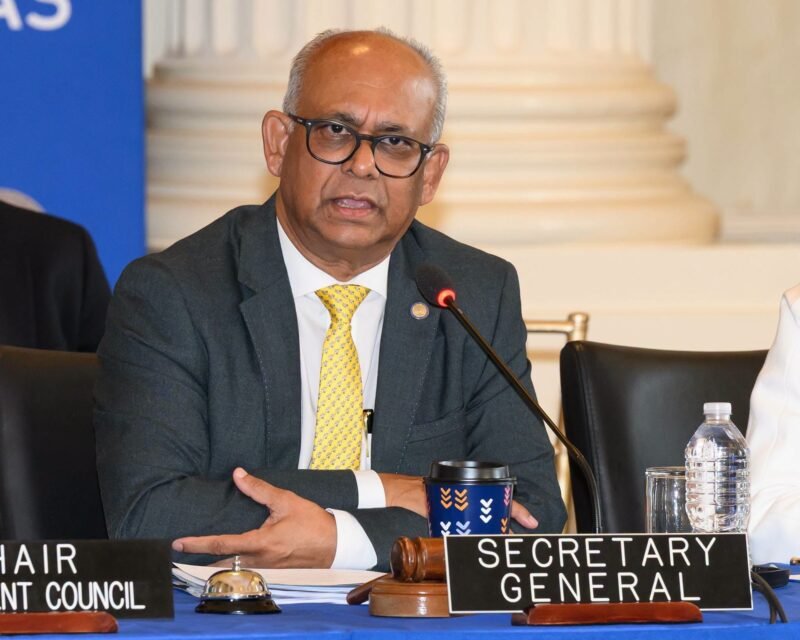
Global conflicts, increasing political polarization and pressure on democracy also affect the countries of the Western Hemisphere. Albert Ramin, Secretary General of the Organization of American States (OAS), warns that greater regional unity and cooperation are necessary to address these geopolitical challenges.
Image OAS
He said during a press conference with Caribbean journalists that the Americas should not be separated from the instability elsewhere in the world. According to Ramdin, international conflicts have a direct impact on the economies of the region, including through higher costs of living, fuel prices, inflation, export problems and declining incomes. “We live in a political climate globally and regionally that is rapidly changing,” the OAS CEO said.
“Democratic governance requires that leaders also remain democratic”
In addition, the Western Hemisphere is dealing with its own political tensions. Ramdin spoke of an “unhealthy polarization” at the highest political level, with many government leaders being diametrically opposed to each other. However, he believes the changing political landscape can also offer new opportunities to reach consensus on certain issues.
Talking to each other
Ramdin argues that it is precisely in these circumstances that the OAS must strengthen its position as a political and multilateral platform. He acknowledged that the relevance of the organization had previously been questioned, but believes that the OAS has proven its worth in the past year in the areas of political consultation, democracy, human rights, security and development. Announced cuts to the organization have not yet materialized. Ramdin says that he has succeeded in convincing the member states of the importance of the OAS.
An important task now is to reduce political division. To achieve this, leaders must meet each other more often, talk to each other and be prepared to hear each other’s points of view. Even if they ultimately disagree, it is a gain if they listen to each other respectfully, Ramdin argues.
Peace and prosperity
The OAS is therefore also intensifying cooperation with institutions and regional organizations, including the Inter-American Development Bank, Pan-American Health Organization, the Central American Integration System and CARICOM. “Unity is essential,” the Secretary-General emphasized.
He links this approach to a broader vision of “peace and prosperity”. That means stronger democracies and free and fair democratic processes, combined with increased employment, trade and investment within the Western Hemisphere.
Ramdin acknowledges that this cannot be achieved within one term. His term lasts five years, of which about a year has now passed. He therefore mainly wants to lay a foundation on which to build further.
The OAS does not want to focus exclusively on governments. Civil society organizations, the business community, political parties, parliamentarians, young people, universities and media must also be involved. The course rests on greater unity, better interconnections and a shared vision of peace and prosperity. “We need to do much more,” Ramdin acknowledged.
Continue to govern democratically
He also warned about the decline of democracy in parts of the region and sees an important difference between being democratically elected and then actually governing democratically. The Charter protects representative democracy, but additional instruments may be needed to respond when democratically elected leaders abandon democratic principles during their governance. “Democratic governance requires that leaders also remain democratic,” he said. They must respect the rules of the game and provide space for dialogue and social development.
Ramdin also mentioned cross-border organized crime, limitation of space for civil society organizations, problems faced by journalists in different countries and people being held in custody without due process of law as challenges facing the hemisphere.
Worries about Haiti
Meanwhile, Haiti remains one of the major concerns of the OAS. Security and credible elections are the most important priorities. Preparations for the elections must be accelerated, including voter registration, education, training of poll workers and the creation of safe polling locations.
Ramdin believes that people with ties to criminal organizations should not be allowed to vote. However, it is up to the Haitian authorities and the provisional Electoral Council to determine who is eligible.
With bilateral sanctions the situation is more complicated, because the Haitian authorities must decide for themselves what meaning they give to them. United Nations sanctions do have international validity. The OAS itself cannot determine who may be a candidate, but expects candidates to have integrity.
According to Ramdin, if a significant number of politicians with ties to criminal organizations or gangs are ultimately elected, this will cause discussion within the OAS. He described them as “tainted politicians”.
Treatment of migrants
The humanitarian consequences of the Haitian crisis also worry him. Women and children are especially vulnerable. Ramdin pointed to reports of abuse and rape in reception and displacement camps. The Inter-American Commission on Human Rights also monitors developments in human trafficking.
According to him, some solidarity can be expected from countries that receive Haitian migrants. At the same time, the OAS cannot oblige states to admit people without valid residence status if their national law does not allow this.
According to Ramdin, two conditions must apply to repatriation: migrants must be treated humanely and with respect for their rights and prior consultation must take place with the country that takes them back. “They don’t leave because they want to. Circumstances force them to leave,” he emphasized about Haitians fleeing their country.
Ramdin notes that the various crises ultimately converge on the same challenge: ensuring that countries continue to talk to each other in an increasingly polarized and geopolitically uncertain world. The OAS wants to play a unifying political role in this and at the same time strengthen democracy, security and economic cooperation within the Western Hemisphere.