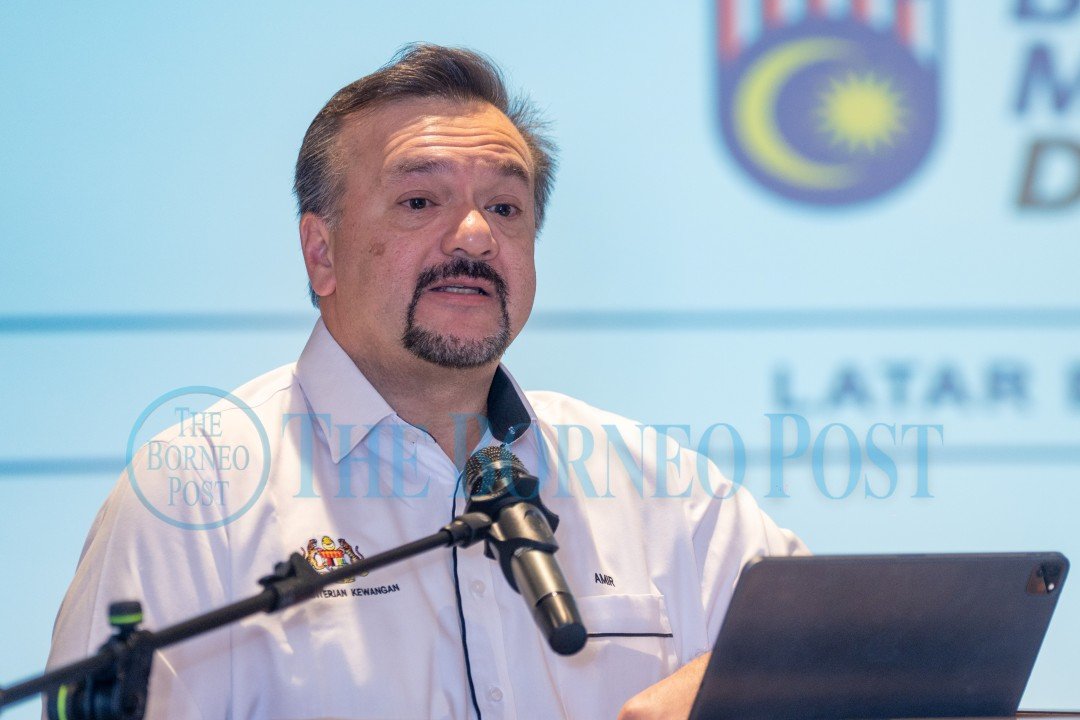

Amir Hamzah briefs the media on the implementation of diesel subsidy reforms. – Photo by Chimon Upon
KUCHING (June 24): There is no fixed deadline for applications for the additional 100-litre allocation under the Budi Madani Diesel (Budi Diesel) programme, as eligibility will continue to be assessed based on users’ needs and changes in vehicle ownership, said Second Finance Minister Datuk Seri Amir Hamzah Azizan.
He said the open-ended approach is designed to ensure fairness, particularly for individuals whose circumstances may change, such as acquiring a diesel vehicle after initial registration.
“There is no time limit because a person may not own a diesel vehicle today but may purchase one later.
“We do not want this to be a one-off offer. It will continue as long as the person is eligible and applies,” he told a press conference after a media briefing on diesel subsidy rationalisation here.
The additional 100-litre entitlement forms part of the enhanced Budi Diesel structure, which allows eligible private diesel vehicle owners, such as pickup truck and jeep users, to apply for higher monthly allocations of up to 300 litres, depending on verified needs.
Applicants may submit requests for additional entitlement through the official Budi Madani portal, with verification carried out based on usage patterns and eligibility criteria.
Amir Hamzah said the objective remains to ensure assistance is channelled to those who genuinely require it, while preventing leakages in the subsidy system.
On concerns over diesel misuse and cross-border leakage, he said Malaysia’s current approach is anchored on removing distortions at the point of sale through a floating pricing mechanism, which ensures there is no embedded subsidy in retail diesel prices.
“The key mechanism is pricing at the pump to ensure no subsidy is given. When there is no subsidy, foreign users will not benefit from Malaysian fuel pricing,” he said.
He added that foreign-registered vehicles are already restricted from purchasing subsidised fuel, similar to the RON95 control framework, where non-citizens are only allowed to purchase RON97.
Amir Hamzah said enforcement efforts involving the Domestic Trade and Cost of Living Ministry (KPDN), Customs Department, police and Marine Police have been intensified to curb smuggling and resale of fuel.
“We also recognise there are cases where individuals attempt to resell subsidised fuel. That is why enforcement and monitoring are critical,” he said.
On fuel supply concerns, he said occasional shortages at petrol stations are largely due to logistical issues rather than actual supply constraints, stressing that Malaysia’s fuel supply remains stable despite global uncertainties.
For now, he said the government will focus on implementing Budi Diesel before reviewing and refining the mechanism based on operational data and feedback.
“We will evaluate and improve where needed. If there are gaps, we are prepared to study and refine the system,” he added.