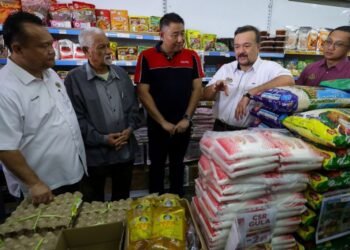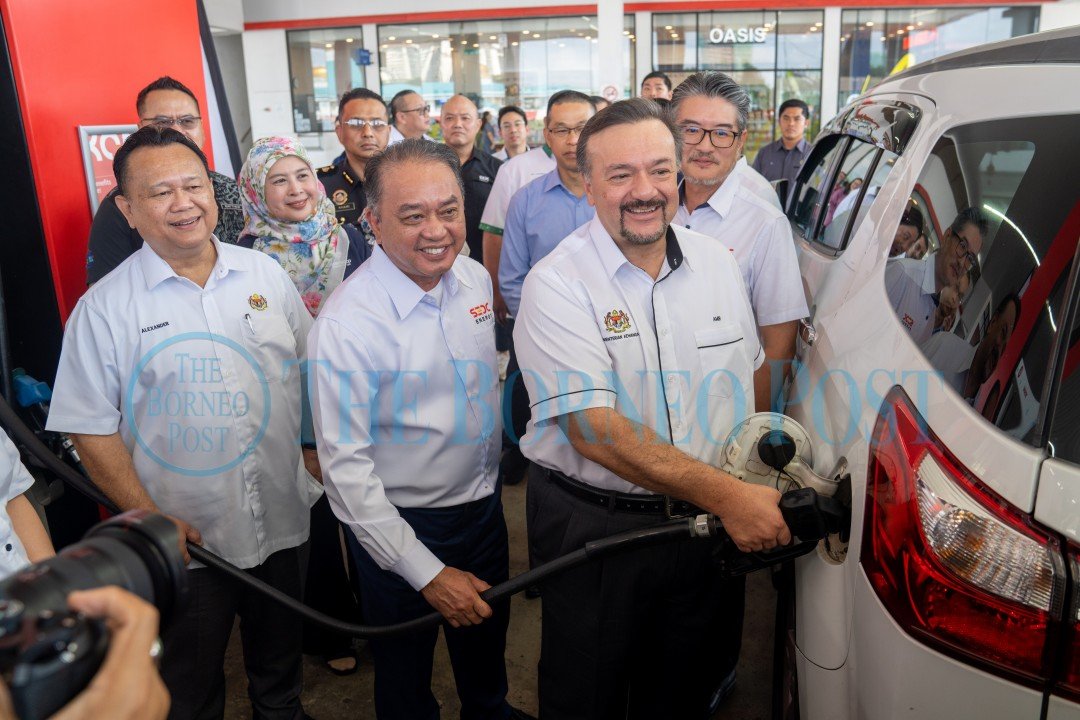

Amir Hamzah (right) refuels a vehicle with (from left) Nanta and Abdul Aziz at Petros Darul Hana Multifuel Station after the briefing session. – Photo by Chimon Upon
KUCHING (June 24): The federal government will maintain the “one vehicle, one quota” principle under the Budi Madani Diesel (Budi Diesel) programme while continuing to review public feedback on possible refinements, said Second Finance Minister Datuk Seri Amir Hamzah Azizan.
Amir Hamzah said the principle is essential to safeguard the integrity of the targeted subsidy mechanism and prevent misuse involving multiple claims linked to a single vehicle.
“I am beginning to receive feedback like this and will look into the appropriate mechanism, and we will explore the optionality of that.
“But in principle, it is one vehicle, one quota. You cannot have one vehicle, five quotas. That is difficult, because then quotas will multiply and we still have leakage issues.
“So at the moment, we have received initial feedback from engagements held yesterday in Kota Kinabalu, and we are now studying whether the quota can be shifted to an approved person to use it.
“That is something the ministry will look into,” he told a press conference after a media briefing on diesel subsidy rationalisation here.
He was responding to questions raised following recent reports on the Budi Diesel programme, where members of the public asked how eligibility would work in cases where a vehicle is registered under a spouse’s name, or where the vehicle was acquired from another party, but the registered owner does not hold a valid driving licence.
Amir Hamzah said the government has taken note of such feedback and is studying possible mechanisms to address these practical situations while maintaining system integrity.
He said the ministry is reviewing implementation challenges, including whether quotas could be allocated to an approved user in specific cases.
However, he reiterated that any changes must be grounded in actual usage data and not compromise the overall system.
He said early data shows that only a small proportion of users exceed the basic allocation.
“Based on data from January to May, only 0.76 per cent used more than 200 litres,” he said, adding that the system needs time to stabilise before any recalibration is considered.
Amir Hamzah said similar adjustments had been made in previous subsidy programmes, including Budi95, where e-hailing quotas were refined based on operational feedback.
“Sometimes we need to let the system run forward and see first. If there are gaps in the system, there is no problem to review,” he said.
On rural and specialised needs in Sabah and Sarawak, he said agencies such as the Sarawak Rivers Board will help identify eligible river transport operators, while Resident Offices will play a role in identifying households dependent on diesel generators in interior areas.
“The Resident Office will identify who is allowed. Once activated, they can go to purchase diesel at subsidised prices,” he said.
Amir Hamzah said the government will continue refining the subsidy implementation based on ground realities while ensuring the system remains targeted and leak-proof.
Following the briefing session, he also visited the Petros Darul Hana Multifuel Station here.
Also present during the visit were Works Minister Dato Sri Alexander Nanta Linggi and SEDC Energy Chairman Tan Sri Abdul Aziz Husain.