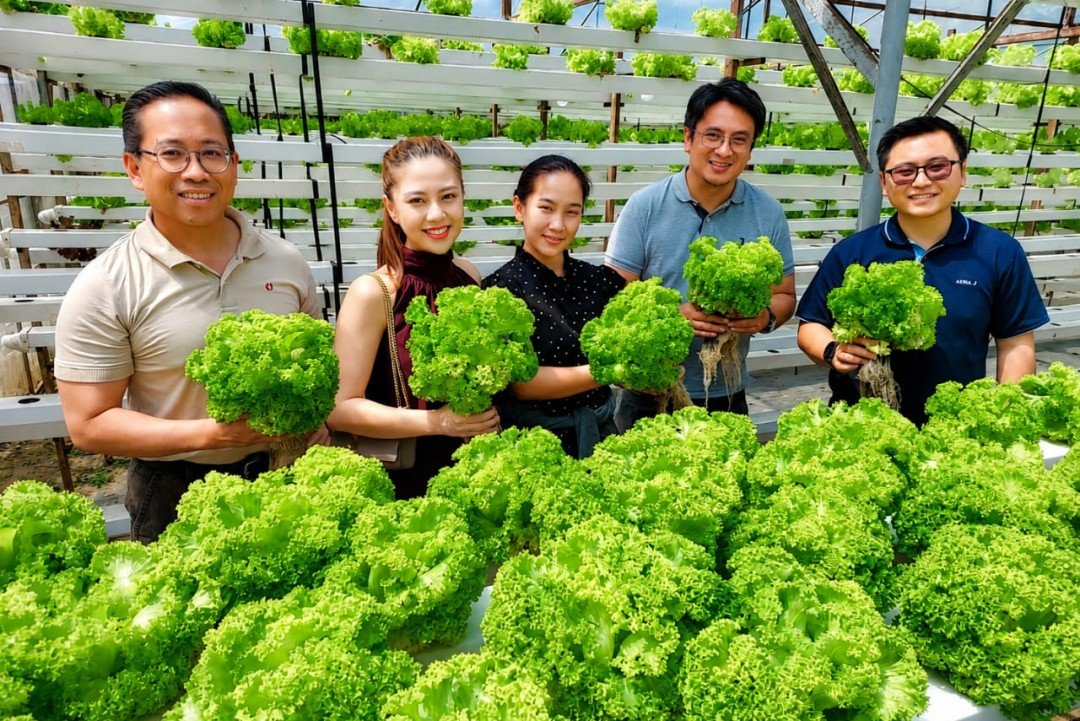

The columnist and friends visit entrepreneur Azizul Julirin (right), owner and operator of a commercial hydroponic farm in Kundasang.
 AGRICULTURE has long been one of the foundations of Sabah’s economy. Before oil and gas, tourism and the digital economy emerged as major contributors to growth, agriculture provided employment, generated export earnings and supported rural communities across the state. Plantations, smallholdings and farming villages shaped Sabah’s economic and social development for generations.
Today, agriculture remains a vital part of the state’s economy. Although services and mining-related activities contribute a larger share of economic output, agriculture still accounts for approximately 15 to 17 per cent of Sabah’s Gross Domestic Product. It continues to be a major source of employment, export revenue and rural development. Hundreds of thousands of Sabahans depend directly or indirectly on the sector through farming, processing, transportation and related industries.
Yet an important question remains: Can agriculture continue to serve as one of Sabah’s economic engines in an increasingly modern and technology-driven world?
Some believe agriculture belongs to the past. They point to automation, artificial intelligence and the growth of knowledge-based industries as evidence that Sabah’s future lies elsewhere. Others view agriculture as indispensable because of its contribution to food security, employment and economic growth. The truth lies somewhere between these positions. Agriculture no longer dominates the economy to the extent it once did, yet it continues to offer considerable opportunities for wealth creation and sustainable development.
Any discussion of Sabah’s agricultural future must begin with palm oil. Over the past several decades, palm oil has transformed the state’s economy. The industry has generated billions of ringgit in export earnings, created employment opportunities and stimulated development in many rural districts. Sabah remains one of Malaysia’s leading palm oil-producing states, with plantations spread across Lahad Datu, Sandakan, Kinabatangan and Tawau.
The achievements of the palm oil industry are undeniable. However, excessive dependence on a single commodity creates vulnerabilities. Prices fluctuate according to global demand and supply conditions. Increasing environmental scrutiny and competition from other producing countries present additional challenges. As a result, diversification has become increasingly important.
Fortunately, Sabah possesses several natural advantages. Fertile soils, abundant rainfall and diverse climatic conditions support the cultivation of a wide range of crops. Rather than focusing primarily on volume-based commodities, Sabah can expand into higher-value agricultural products capable of generating greater income per hectare.
One promising opportunity is premium durian. Varieties such as Musang King and Black Thorn command high prices in regional markets, particularly in China. Districts such as Tenom, Keningau and Ranau have suitable conditions for commercial cultivation. With effective branding, quality control and export infrastructure, Sabah can become a significant producer of premium durians.
Avocado presents another attractive opportunity. Global demand continues to rise as consumers embrace healthier lifestyles. Sabah’s highland areas, particularly around Kundasang and Ranau, provide favourable growing conditions. A well-developed avocado industry can serve both domestic and export markets.
Coffee offers substantial potential as well. Tenom coffee already enjoys strong recognition among Malaysians. By focusing on specialty and premium coffee markets, Sabah can create greater value while strengthening its reputation as a producer of quality agricultural products. Similar opportunities exist in cocoa. Once a leading cocoa-producing state, Sabah can revitalise the industry by targeting premium chocolate and specialty cocoa markets rather than competing in mass production.
Aquaculture represents another area of growth. Sabah’s long coastline and rich marine resources provide excellent opportunities for cultivating products such as grouper, tiger prawns, lobster and seaweed. The success of seaweed farming in Semporna demonstrates the way coastal communities can participate in export-oriented industries. With better technology, financing and market access, aquaculture can become a more significant contributor to economic growth.
While exports and income generation are important, agriculture plays an equally critical role in food security. Recent global events have highlighted the vulnerability of international food supply chains. The Covid-19 pandemic, geopolitical conflicts and climate-related disruptions have shown the extent to which food supplies can be affected.
Despite its abundant natural resources, Sabah continues to import substantial quantities of food. Food security therefore deserves greater attention. Achieving food security involves more than complete self-sufficiency. It requires sufficient local production capacity to ensure stable food supplies during periods of uncertainty.
Rice production deserves special emphasis. As the staple food of most Sabahans, rice occupies a unique position that extends beyond economic considerations. While crops such as durian and avocado generate higher returns, rice remains essential to food security.
Sabah still relies heavily on imported rice from Peninsular Malaysia and overseas markets. This dependence exposes the state to potential supply disruptions and price fluctuations. Important rice-producing districts such as Kota Belud, Kota Marudu, Papar, Tambunan and Keningau therefore play a strategic role in strengthening Sabah’s food resilience.
Expanding rice production can occur without large increases in cultivated land. Greater gains can be achieved through higher productivity. Improved irrigation systems, better seed varieties, mechanisation and precision farming technologies can increase yields while improving farmers’ incomes. Although complete self-sufficiency may prove economically impractical, increasing Sabah’s rice self-sufficiency level will reduce vulnerability to external shocks.
Vegetable production offers similar opportunities. Kundasang has long been known as Sabah’s vegetable basket, supplying produce throughout the state. Advances in greenhouse cultivation, hydroponics and precision farming can significantly increase output. Similar potential exists in Tambunan and Keningau.
One challenge facing the agricultural sector is its image among younger people. Farming is often associated with hard physical labour and relatively low incomes. However, modern agriculture differs greatly from traditional perceptions.
Today’s agricultural industry increasingly relies on technology. Drones, sensors, satellite data and digital monitoring systems help farmers manage crops more efficiently. Technology enables producers to optimise irrigation, fertiliser application and pest management while reducing costs. Digital platforms enable farmers to access market information and connect directly with buyers.
To remain competitive, Sabah must embrace this transformation. Smallholders, who make up a significant portion of the agricultural sector, require access to technology, financing, training and market opportunities. The future of agriculture depends as much on innovation as it does on land availability.
Environmental sustainability must remain a priority as well. Sabah is blessed with rich biodiversity and valuable natural ecosystems. Future agricultural growth should focus on improving productivity rather than expanding cultivation through extensive land clearing. Sustainable farming practices can increase output while protecting the environment.
Another important area is value addition. Too often, agricultural development focuses primarily on production while neglecting downstream opportunities. The greatest economic value frequently lies beyond the farm gate. Premium chocolate, specialty coffee, processed seafood products and branded agricultural goods can generate significantly higher returns than raw commodities alone.
Sabah’s future economy will undoubtedly involve tourism, manufacturing, oil and gas, services and the digital economy. Agriculture alone is unable to carry the entire burden of development. Nevertheless, dismissing agriculture as an industry of the past will be a serious mistake. Few sectors contribute simultaneously to employment, food security, export earnings, rural development and entrepreneurship. Agriculture’s continued contribution of roughly one-sixth of Sabah’s economy demonstrates that it remains a vital pillar of growth.
The key lies in transformation. Agriculture must move beyond dependence on palm oil, embrace diversification, strengthen food security through greater rice production, adopt modern technologies and focus on value-added products. If these changes are successfully implemented, agriculture will continue to be one of Sabah’s most important economic engines for generations to come.
* Dr Richard A. Gontusan is a Human Resource Skills Training and Investment Consultant. He writes on academic, economic, political and social issues. His views expressed in this article are not necessarily the views of The Borneo Post.