Suddenly I stop in front of the bookcase in the study. I look but I don’t see. Stop and pull. And this book of monumental art, weighing several kilos, beautiful, stupendously preserved, with the title Wild areas. The last virgin regions of the world? Of course, it was a gift from Cementos Mexicanos (Cemex) in Colombia, in 2003, my years as a cultural attaché. The company’s headquarters were in a pleasant area in the north of Bogotá.
Printed in Japan, in 2002, by Toppan Printing Co., it must have cost a fortune due to its characteristics. The editor is the renowned activist Patricio Robles Gil and the production was in charge of the Sierra Madre Group (one of many under his initiative). The detente led me to remember that a giant like Cemex, for decades, in compensatory work for the type of business, has intervened in sports, social interests, research in its field, preservation of ecosystems and of course, in culture.
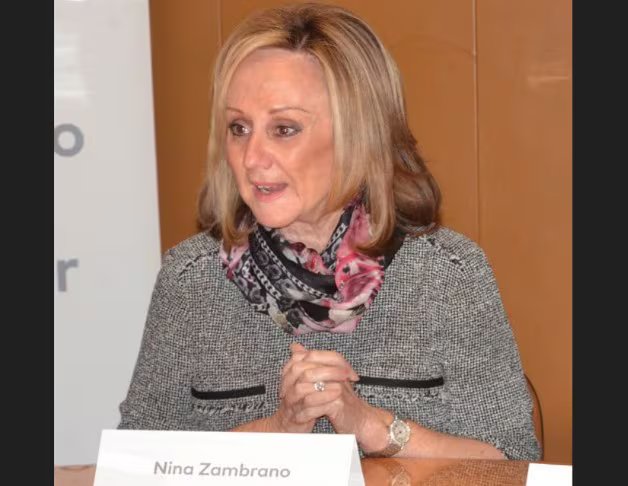
That is why in the revolt over the management of the Gelman Collection, by the person who made the purchase, Marcelo Zambrano Alanís, I began to review my memories of Cemex, of Monterrey, of what Nuevo León means in the history of the country, in terms of economic power and the temperament of its inhabitants. In them the figure of Nina Zambrano Treviño who was born in 1950.
What I did was catch up on his genius and figure. A lot of information, by the way. I condensed what I found and corroborated the story with people who know about her.
Read also: The Mexican humanism of Mauricio Beuchot

Credit: El Universal Archive
He is a great character who helps broaden the understanding of what is happening.
Routes, strokes, brushstrokes
Nina Zambrano Trevino He gave the MARCO Museum of Contemporary Art (inaugurated in 1991, the years of the salinate with a brand in Monterrey) two decades of splendor, from 1997 to 2017, without receiving a salary for directing it. There he deployed his greatest capabilities for cultural management, patronage and collecting.
Daughter of Lorenzo Zambrano Hellion and Alejandrina Treviño Madero, Nina grew up in a family where “leadership was not an option, but an implicit mandate.”
On the maternal side, her ancestry is connected to revolutionary history: Alejandrina was the niece of Francisco I. Madero. On the paternal side, the Zambranos have been the pillars of Monterrey industrialization. His grandfather, Lorenzo Zambrano Gutiérrez, was the founder of Cementos Hidalgo in 1906, which would later become Cemex, the company that under the direction of his brother, the legendary Lorenzo Zambrano Treviño (1944-2014), was consolidated into a global giant.
Read also:Encounter with the Gelman catalog from 1992
Nina, who studied interior design, grew up between brothers: Lorenzo, Jorge and Hernán. With her husband Héctor Armstrong, now deceased, of Puerto Rican origin, she had Alexandra and two children, Héctor “Tito” and Ian. As part of the business elite, his network of contacts has been a vital tool for sustaining his cultural work. Before his tenure at MARCO, he operated at the intersection of political power and private capital. With this mystique, he was part of the organizing group of the Monterrey celebrations for the 400th anniversary of the founding of the city, in September 1996, promoting educational and cultural initiatives through the so-called “Patronato Monterrey 400”, which projected his capabilities and generated the perception of his leadership to head the museum.
It is said that he has been one of the few figures capable of bringing governors, secretaries of state and directors of the largest corporations in Mexico (the so-called “Big Five” of Monterrey) to the table. It is known that her family maintained close ties with figures of national political power, from historical PANism to the administration of Enrique Peña Nieto, who attended the funeral of her brother Lorenzo in 2014. Nina knew how to turn this relational capital into a vein to institutionalize patronage. Without a doubt, Monterrey’s “city brand” owes a lot to him.
In addition to making a difference among other prominent business leaders in intervening in the development of the royal cultural sector, she is a collector of strain. It is said that his home in San Pedro Garza García – the municipality with the highest GDP per capita per inhabitant, estimated at 75 thousand dollars – is, in itself, a testimony of this dialogue between architecture and plastic arts.
His hobby began organically, influenced by family trips and living with his brother Lorenzo, who is credited with having integrated an important collection, with an emphasis on Latin America. Country where Cemex was installed, it was an indication to obtain the work of local artists.
There are Mexican collectors who open their doors and others, the vast majority, reserve the privacy of their acquisitions and influences on other people and museum institutions for this purpose. The sources consulted indicate three spheres of Nina’s universe. As far as contemporary art is concerned, it is said that he leaned towards the school of rupture, in its different plastic expressions. Then there is the distinctive Mexican in its contemporary diversity. Finally, the sphere that came hand in hand with MARCO: pieces that are part of Monterrey’s heritage underwent his personal scrutiny. His “eye” for spotting talent before it became a global trend was what allowed MARCO to bring in artists like Ron Mueck and James Turrell at key moments in their careers.
During her time as director she applied “corporate rigor.” For Nina, contemporary art needed not only the genius of its architect, Ricardo Legorreta, and the concrete used in its construction. This mentality allowed MARCO to withstand the ups and downs of the local and national economy, such as changes in state administration, a tug-of-war league for money. In the process it was key to provide it with a society of “Friends of the Museum”.
His museum talent not only selected pieces; “healed experiences.” In this perspective, we talk about three great moments that defined their ability to stimulate the role of these venues. It is about the management of three figures, José Clemente Orozco (1995), Frida Kahlo (2007) and Dr. Atl (2011). Frida Kahlo: her photos It attracted a large attendance.
With the Ron Mueck exhibition in 2011 he made a commitment to the hyper-realistic: it was, perhaps, the highest point of his management in terms of social impact. Long waiting lines. As is known, mobilizing Mueck’s monumental sculptures requires great skills. Another event that characterized his work is what is called “the consecration of abstraction”, with the exhibition of James Turrell and later Anish Kapoor.
In those two decades, the museum’s permanent collection forged a narrative, growing not only in quantity, but in thematic coherence. He focused on ensuring that the museum possessed key works of the Latin American avant-garde, guaranteeing that the cultural heritage of the people of Monterrey had market value and, above all, historical value. By handing over the reins in 2017 to Alfonso González Migoya, Nina outlined an institutionally strong succession and did not mean her departure from cultural management.
Perhaps one day we will know if Nina had any role in the acquisition of the Gelman Collection by her great-nephew Marcelo Zambrano Alanís, who works in the real estate sector. His father is his cousin, Marcelo Zambrano Lozano, who is linked to Cemex. We are talking about a movie genealogy.