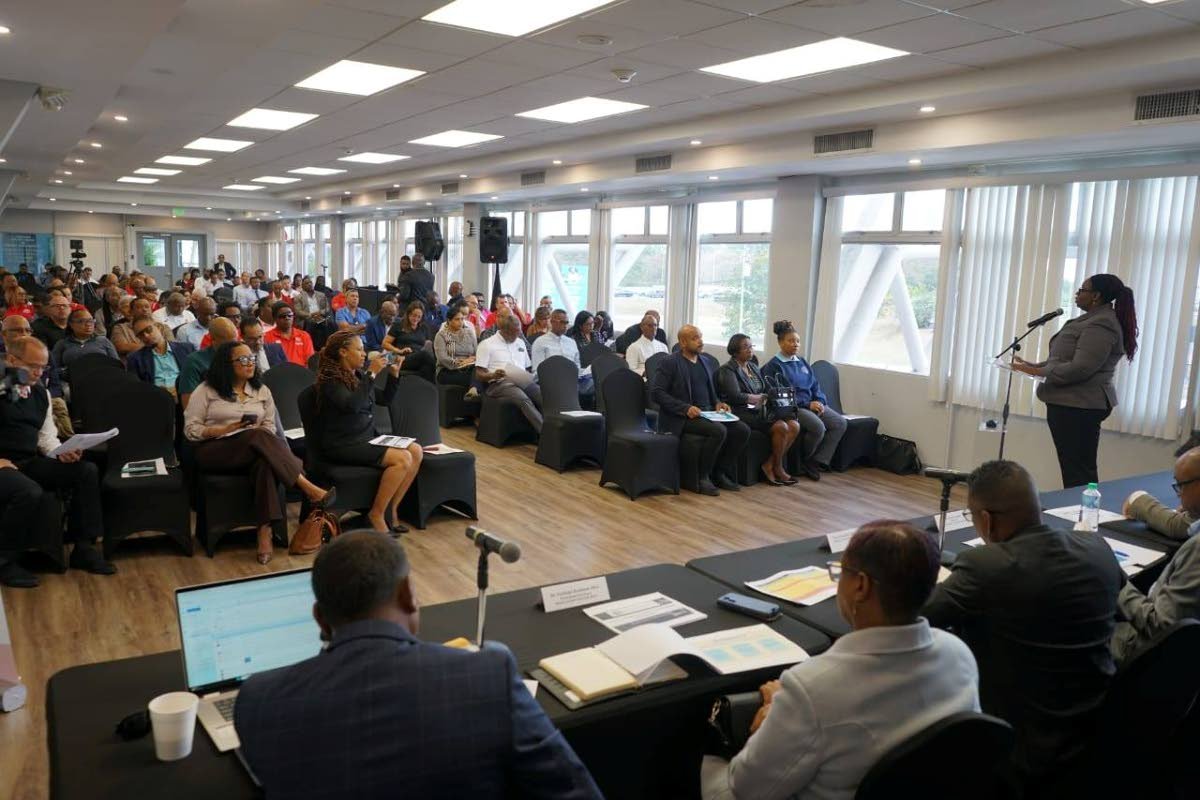
After a four-hour meeting among Minister of Sports and Youth Affairs Phillip Watts; his Permanent Secretary Penelope Bradshaw-Niles; the Board of the Sports Company of T&T, including directors Adrian Ali, Nefertiti Kernahan, Ndu-Bisi Hall, Kester Lendor, the chairman, Shaun Teekasingh, the deputy chairman, and Chief Executive Officer (CEO) Arnold Ram; and the members of 15 National Governing Bodies (NGBs), which lasted from 10 am to 2 pm, there was no solution to the financial problems plaguing sports in Trinidad and Tobago (T&T).
Minister Watts, who failed to make it to a previous meeting on May 11, despite calls by the NGBs to attend, was the one to have arranged Wednesday’s (June 3) meeting and ensured that his permanent secretary, who was also demanded at the initial meeting, was present. However, the NGBs left the meeting which took place at the VIP lounge of the Hasely Crawford Stadium in Mucurapo, uttering one sentence: ‘We are in real trouble.’
It appeared to have been the general consensus after Minister Watts raised eyebrows when he said he was unaware of the funding freeze that left athletes and the NGBs motionless for months.
President of the National Association of Athletic Administration (NAAA) Ephraim Serrette, who attended the initial meeting, again described yesterday’s gathering as a talk shop, saying there was no change from where they were months ago.
Minister Watts delivered a presentation warning NGBs about the importance of being compliant if they are to receive funding.
He underscored the importance of the engagement, noting that the forum is designed to foster open dialogue, strengthen collaboration, and directly address the concerns of sporting organisations across the country. He emphasized that the Ministry is committed to listening to stakeholders, identifying operational challenges, and working collectively to implement practical, results-driven solutions that will enhance governance, development, and performance within the sector.
The Minister further highlighted that this initiative reflects Government’s continued focus on building a more responsive and inclusive sporting ecosystem, one where the voices of NGBs inform policy direction, resource allocation, and programme development.
However, Serrette, a former national athlete, and three other NGB members described the presentation as a tactic to deny NGBs funding. According to the NAAA’s boss, “My question was, where are we now? Are the reviews still going on? Is there money available so I can better plan because I have two teams to travel? “So I would know how to plan. It was a waste of time. All they say is no, no. It’s the same thing they said up in Tagarigua. They will meet individually with each NGB, and in the case of funding, well, they say they will deal with it on a case-by-case basis.”
“But, you know, the whole thing shrunk to this compliance thing. The whole thing shrunk to the compliance, and the minister said he had a spreadsheet, so apparently, everybody is not. And now they have introduced a new thing as well. So, besides being compliant, you also had to reconcile,” Serrette explained.
At present, Serrette is holding his head with two teams expected to wing out soon, namely, a team to compete at the NACAC for the under-18 and under-23 between the 10th and 12th of July in Santo Domingo, Dominican Republic, as well as the World Juniors in Eugene, Oregon, from the 5th to the 9th of August.
Meanwhile, there is also the Commonwealth Games in Glasgow, Scotland, from July 23 to August 2, which is to be funded by the T&T Olympic Committee.