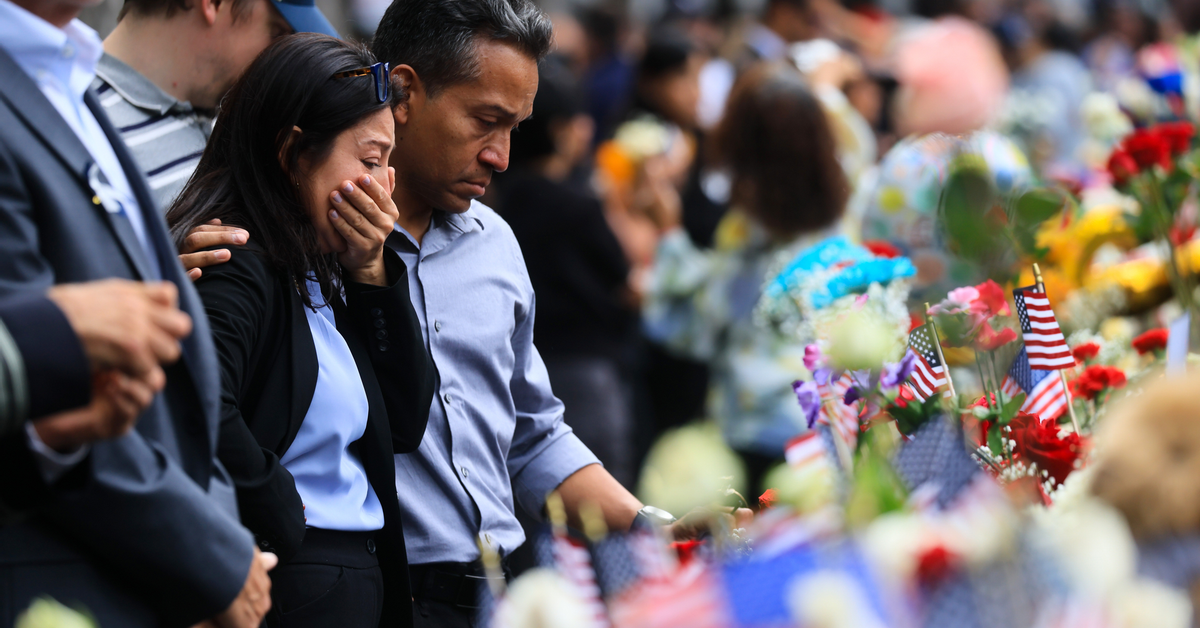

New York/This Friday, New York remembered the nearly 3,000 victims of the September 11, 2001 attacks with its traditional ceremony at Ground Zero, focused on the reading of the names of the deceased and with solemn moments of silence, also dedicated to those who died in the 25 years since from illnesses related to the terrorist attacks.
Early in the morning, relatives of the victims gathered around the two fountains that occupy the place where the Twin Towers stood to read the names of the 2,983 people who died in the 2001 attacks and also the 6 who died in the 1993 attacks.
The event was attended by former presidents Joe Biden, Barack Obama, George W. Bush and Bill Clinton, as well as Vice President JD Vance. The president, Donald Trump, was absent, choosing to attend another event at the Pentagon to give a speech. At the ceremony in New York, the politicians do not speak and it is the families who take center stage.
At the ceremony in New York, the politicians do not speak and it is the families who take center stage
But while the names were being read, relatives such as Terry Strada, widow of a man who died in the attacks, went off script to demand responsibility from Saudi Arabia for its alleged role in the attacks and question successive US governments for their agreements with the country, receiving applause from many present.
Meanwhile, the mayor of the Big Apple, the democratic socialist Zohran Mamdani, attended despite criticism from voices such as that of former Republican councilor Rudy Giuliani, who called his presence “offensive” by alleging that the young Democrat “does not agree that 9/11 was an Islamic terrorist attack against the United States.”
Mamdani, who is Muslim, has defended his attendance like all previous mayors to honor the victims, and this week announced the publication of thousands of documents revealing that city authorities at the time concealed that the air at Ground Zero was “toxic.”
The day included moments of silence for the impacts of the planes against the Twin Towers and the Pentagon, the collapse of the two towers, the crash of Flight 93 in Pennsylvania and another dedicated to those who died from diseases related to 9/11.
Among those attending this Friday was Lieutenant Joe LaPointe, a member of the New York Fire Department (FDNY) for decades, who went to Ground Zero on the same day as the attacks. The Twin Towers collapsed shortly after I got there.
“The first reaction was to think about what to do, how to help. It was simply destruction,” he recalls for EFE about those first hours.
And so the following months were, “a succession of work, searches, tributes and funerals,” he adds. The FDNY lost 343 people in the attacks.
The New York Fire Department lost 343 workers in the attack
He assures that the link between the emergency services and the memory of 9/11 “survives”, in part thanks to more everyday places, such as O’Hara’s, a pub located just two blocks away and which over the years has become a meeting point about 9/11.
The store was severely damaged and took almost eight months to reopen, and now preserves photographs, press clippings and letters about the attacks.
LaPointe adds that in fire stations, plaques and memorials remember the names of deceased colleagues, and that the tradition is for veterans to tell their stories to newcomers, so that they can do the same with the next generation.
Thus, their names continue to be pronounced: “You die twice. Once when you leave this world and the second when they stop saying your name. The challenge is to keep the memory alive,” he says.
They do not forget family members like Jennifer Nilsen, who lost her husband, Troy, in the attacks. He worked in the first tower and they had two small children. She watched the news of the attacks on television, knowing he was there.
“I still feel like crying,” he comments in front of journalists. He claims that “we must never forget” and that “the pain is always there”, “it never gets easier.”
But a quarter of a century later, the memory of that day begins to fade for those who did not experience it. About 100 million Americans are too young to remember the attacks, the 9/11 Memorial & Museum estimates.
“I lost my uncle. Everyone in this city had some connection with someone who died that day,” says Noah Rauch, an educator at the museum whose goal is “to convey to new generations that the victims were not just a number, but parents, children, brothers, cousins and friends.”