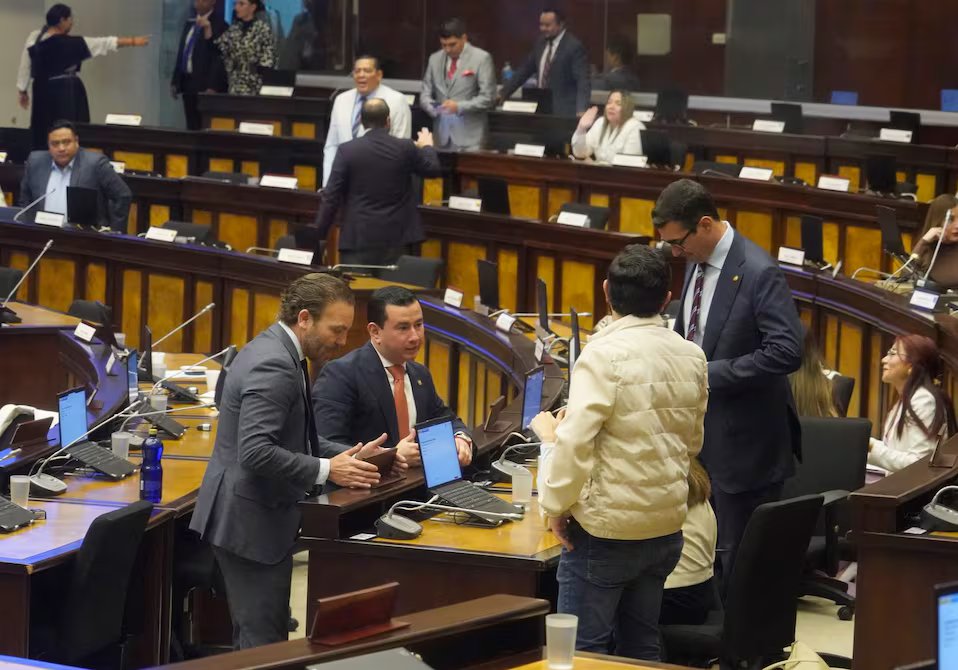
With 79 votes in favor56 negatives and 6 abstentions, the plenary session of the National Assembly approved the inspection report on the alleged irregular issuance of license plates by the municipal entities in charge of traffic responsibilities, which are attributed to organized crime groups (GDO).
The non-binding document that was debated and voted on in the plenary session of Parliament, this Wednesday April 22, 2026was prepared by the Oversight Commission.
The text points out that organized crime groups They have infiltrated various municipal transit agencies, taking advantage of the laxity in access controls to registration systems and the lack of purification of human talent in the decentralized autonomous governments (GAD), poorly using vehicle registration as a tool for the legalization of criminal logistics.
“The problem of illegal license plates “It is not an isolated computer failure, but a multi-causal governance failure where the lack of reporting by the GAD and monitoring them and the void in the strategic leadership of previous years allowed the consolidation of criminal networks in the transit system,” the report says.
The report includes the appearances of authorities such as the Minister of the Interior, John Reimberg, who revealed that the Transit Agency Duran It was managed by the organized crime group “Chone Killers”; and the Transit Agency Blanket was managed by “The Choneros”.
Likewise, the minister reported that in certain transit agencies officials with family ties to GDO were identified, in addition to improper access to databases to profile victims for extortion.
Likewise, the investigation of the legislative board indicates that there is a critical vulnerability in the AXIS system administered by the ANT, characterized by the lack of biometric controls and the persistence of unauthorized users in the municipal nodes.
“The current management model of traffic competition at the municipal level is inefficient to face the threats of the internal armed conflict,” dictates the document approved in plenary.
The audit report also maintains that the total decentralization of enrollmentwithout a centralized and technical command regarding cybersecurity, has compromised the legal and personal security of citizens, whose data is vulnerable to being used in extortion networks and other serious crimes.
At the same time, the Oversight Commission recommended to the plenary session of the legislature that it begin the process of a urgent reform to the Organic Law of Land Transportation, Transit and Road Safety (LOTTTSV)to centralize the management of the vehicle registration system.
Under this reform, the text says, “the process of the registration system and the administration of the vehicle database would once again be the exclusive responsibility of the central government through the National Transit Agency (ANT)leaving the GAD only the powers of vehicle technical inspection and operational control in the territory, as long as it is subject to national supervision controls and standards.
The report also recommends reforming the Organic Code of Territorial Organization, Autonomy and Decentralization (Cootad) and incorporating an exceptional and temporary figure of “reversal of powers for national security”.
The debate in the plenary session was opened by the legislator expelled from Pachakutik and allied with the ruling party Jose Nango and continued with the intervention of the assembly members of the ruling National Democratic Action (ADN) bench María Paula Villacreses, Luigi García, Fabiola Sanmartín and Ana Belén Tapia.
The legislators supported the work of the Oversight Commission, of which they are part, and requested to apply the recommendations established in the report.
“The findings are conclusive. It has been determined that the vehicle registration system “It has been used as a mechanism to legitimize illicit assets and logistical support for organized crime,” said Nango, who presented the motion to vote for the document.
For his part, Villacreses emphasized that the National Transit Agency She cannot continue being a spectator of a real problem that affects thousands of Ecuadorians daily. “Today we must decide which side we are on: if we continue on the side of a fragmented system or if we are going to fight for the State to regain control,” he added.
For its part, Xavier Lassoan assembly member of the Citizen Revolution (RC) bench, questioned that this report has a “political whiff,” as he considered that this inspection “is part of the policy of persecution and harassment of the GAD, carried out by the ruling party.”
“This report aims to combat the irregular issuance of licenses and registration plates that facilitates vehicle theft and other crimes. I fear not, that the real objective is to attack the municipalities again as part of the early electoral campaign that we are already experiencing poorly,” said Lasso. (YO)